
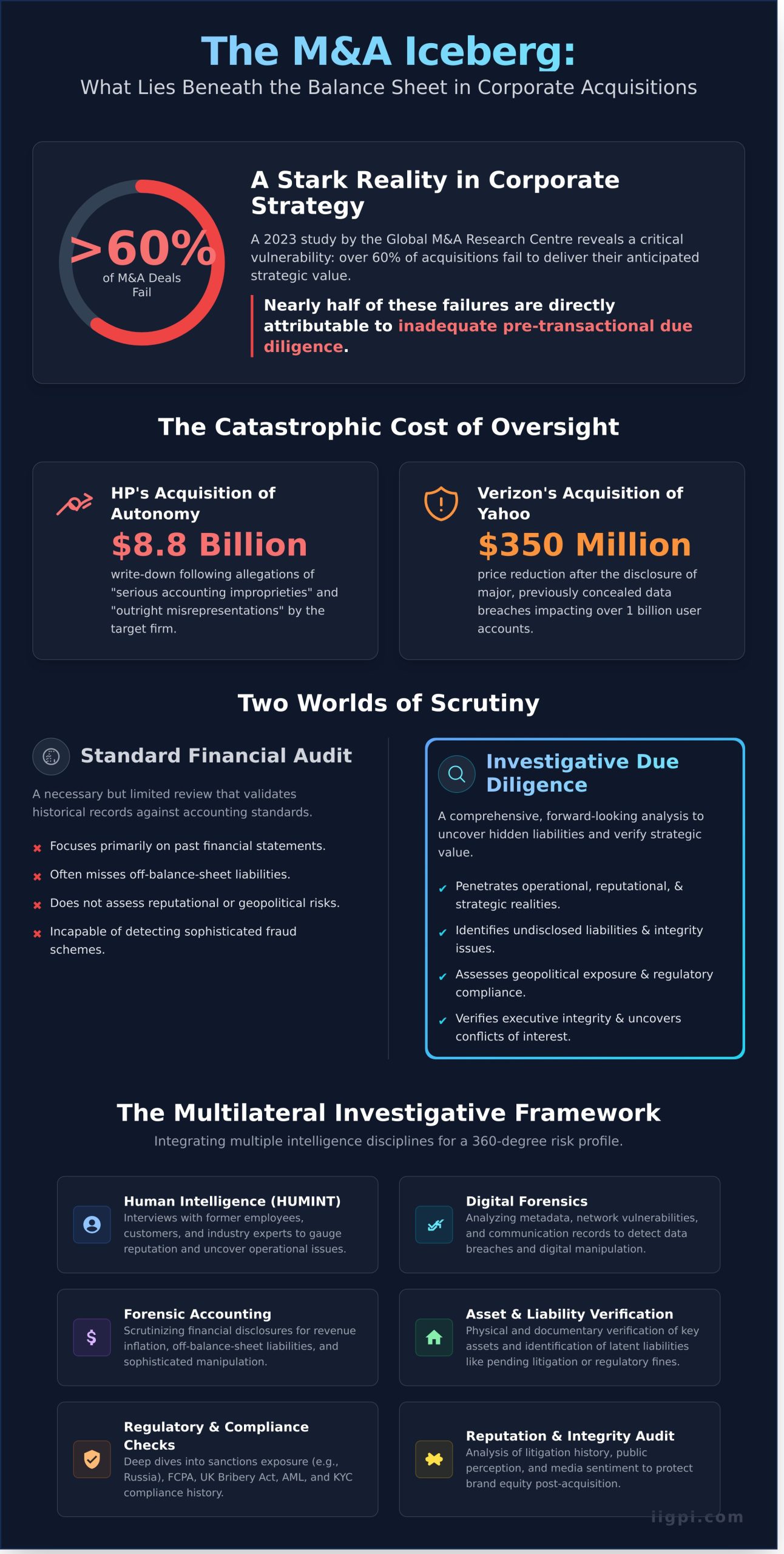
A 2023 study by the Global M&A Research Centre found that over 60% of corporate acquisitions fail to deliver their anticipated strategic value, with nearly half of these failures directly attributable to inadequate pre-transactional due diligence. This stark reality confirms a persistent anxiety within boardrooms: the pervasive information asymmetry that complicates negotiations and exposes acquiring entities to significant, often unquantified, financial and reputational risks. The fear of inheriting litigation, regulatory fines, or basing a valuation on fraudulent reporting is a material threat to any major transaction.
This analysis provides a scholarly examination of the advanced investigative protocols necessary to penetrate this opacity, offering a comprehensive framework for safeguarding capital and ensuring the long-term integrity of corporate acquisitions. We will dissect the methodologies for constructing a complete risk profile of a target entity, from verifying the integrity of key executives to systematically identifying undisclosed liabilities and latent conflicts of interest that standard financial audits often miss.
Key Takeaways
- Understand the critical distinction between standard financial audits and investigative due diligence to identify strategic risks that traditional accounting methods often miss.
- Learn to implement a multilateral investigative framework that integrates human intelligence with digital forensic analysis to move beyond the limitations of the balance sheet.
- Develop methodologies to uncover latent liabilities and verify asset valuations, safeguarding capital and ensuring the integrity of corporate acquisitions.
- Examine a strategic, two-phase protocol for pre-acquisition intelligence gathering, from preliminary public record assessment to deep-dive forensic analysis.
The Role of Investigative Due Diligence in Modern Acquisitions
Investigative due diligence represents the systematic and rigorous verification of all material information, financial and non-financial, presented by a target entity. This process transcends the scope of a standard financial audit, which primarily validates historical accounting records against established standards. Instead, investigative intelligence delves into the operational, reputational, and strategic realities of a business, seeking to uncover hidden liabilities, systemic risks, and potential integrity issues that balance sheets alone cannot reveal. The imperative for this deep-dive analysis is underscored by findings from a 2019 KPMG study, which concluded that as many as 83% of mergers and acquisitions fail to enhance shareholder value, often due to unforeseen post-transaction complications.
The contemporary geopolitical landscape has fundamentally altered the risk calculus for corporate acquisitions. An increasingly fragmented global order, characterized by sanctions regimes like those imposed on Russia since 2022 and heightened scrutiny from bodies such as the Committee on Foreign Investment in the United States (CFIUS), necessitates a far more robust approach. Companies can no longer evaluate a target in a commercial vacuum; they must assess its exposure to geopolitical volatility, its compliance with international trade law, and the integrity of its ultimate beneficial owners. Failure to conduct this level of scrutiny exposes the acquiring firm to severe regulatory penalties and significant reputational harm.
The cost of inadequate due diligence can be catastrophic, leading to substantial financial write-downs and eroding market confidence. A prominent case is Hewlett-Packard’s 2011 acquisition of Autonomy, which resulted in an $8.8 billion write-down after HP alleged “serious accounting improprieties” and “outright misrepresentations” by the target firm. Such events illustrate how undisclosed liabilities, once integrated, can poison the financial performance and strategic trajectory of the consolidated entity for years.
The Evolution of M&A Risk Management
The practice of risk management in mergers and acquisitions has evolved from a narrow focus on tangible asset valuation to a comprehensive assessment of complex, often intangible, liabilities. Regulatory frameworks, including the U.S. Foreign Corrupt Practices Act (FCPA) and the UK Bribery Act of 2010, have embedded stringent anti-corruption, Know Your Customer (KYC), and Anti-Money Laundering (AML) protocols into the core of the M&A process. Concurrently, digital transformation has introduced new vectors for corporate deception, from the manipulation of user engagement metrics to the concealment of significant data breaches, as evidenced by the $350 million price reduction in Verizon’s 2017 acquisition of Yahoo following the disclosure of major security incidents.
Strategic Objectives of Investigative Oversight
The primary objectives of investigative oversight are fundamentally protective, designed to safeguard the acquiring entity’s financial and reputational capital. Forensic analysis is employed to ensure the veracity of financial disclosures, identifying potential revenue inflation, off-balance-sheet liabilities, or other sophisticated accounting manipulations. This process also extends to identifying potential conflicts of interest among the target’s key executives and stakeholders, which could signal underlying governance failures. Ultimately, the goal is to protect the acquirer’s brand equity from inherited reputational damage. A comprehensive understanding of due diligence now must encompass these non-financial, yet material, reputational factors, including a target’s litigation history, environmental compliance record, and public perception.
Beyond the Balance Sheet: The Multilateral Investigative Framework
A rigorous evaluation of a target company’s financial statements is a foundational component of due diligence, yet it represents a critically incomplete picture of intrinsic value and latent risk. Traditional accounting audits are often incapable of penetrating sophisticated financial engineering or identifying off-balance-sheet liabilities designed to obscure systemic weaknesses. The Association of Certified Fraud Examiners’ 2022 Report to the Nations quantified that a typical organization loses 5% of its annual revenue to fraud, a figure that underscores the limitations of surface-level financial analysis in high-stakes corporate acquisitions. A truly comprehensive assessment necessitates a multilateral investigative framework, one that synthesizes digital forensics with human intelligence (HUMINT) to construct a three-dimensional view of the target entity.
This advanced methodology involves scrutinizing a company’s operational history and litigation track record not merely as historical data points, but as predictive indicators of future performance and liability. It extends beyond the corporate entity itself to an exhaustive verification of its ecosystem, including the integrity of its supply chain and the stability of its third-party relationships. A 2022 industry analysis revealed that 87% of organizations experienced a disruptive incident with a third party within the preceding three years, confirming that a target’s risk profile is inextricably linked to its network. By cross-referencing digital evidence, such as communication logs and metadata, with discreet inquiries directed at former employees, industry competitors, and regulators, an acquiring firm can elucidate the unwritten truths of an organization.
Executive Background Integrity and Professional History
The character and history of a target’s leadership team are among the most potent, yet frequently overlooked, predictors of post-acquisition success. A deep-dive investigation must extend far beyond standard background checks to identify undisclosed business failures, patterns of litigation, or ethical lapses that signal poor governance. A 2019 study from the University of Notre Dame established a direct correlation, finding that firms led by CEOs with prior legal infractions were substantially more likely to engage in financial misconduct.
Operational and Cultural Due Diligence
An organization’s internal culture is a decisive factor in the success of post-merger integration, with a 2021 Bain & Company report citing culture clash as a primary reason for deal failure in over 30% of unsuccessful integrations. This facet of due diligence moves beyond employee surveys to identify systemic issues such as unresolved workplace harassment claims or patterns of environmental non-compliance. Utilizing discreet, on-the-ground intelligence gathering and targeted interviews can reveal the true operational health, exposing any divergence between official policy and daily practice.
Ultimately, this multilateral approach transforms due diligence from a compliance exercise into a strategic intelligence operation. It provides the acquiring entity with a nuanced understanding of not just the target’s stated value, but its functional and ethical integrity. Mastering these investigative techniques is a corporate imperative, and a more detailed examination of these methods is available within our proprietary corporate governance frameworks.
Identifying Latent Risks and Financial Discrepancies in Target Entities
The superficial review of audited financial statements is insufficient for the gravity of corporate strategic moves. A deeper, more investigative approach is a prerequisite for mitigating catastrophic post-transaction liabilities. The process must systematically unearth risks that are intentionally obscured or simply overlooked, from concealed debts and inflated asset values to complex ownership structures designed for obfuscation. This level of scrutiny moves beyond standard accounting verification into the domain of forensic analysis, where the objective is to construct a complete and unvarnished economic reality of the target entity before proceeding with major acquisitions.
Forensic Financial Investigation Techniques
Forensic financial investigation provides the necessary tools for this granular examination. Methodologies include the critical analysis of revenue recognition policies to identify patterns of channel stuffing or premature revenue booking, which artificially inflate performance metrics. Investigators scrutinize off-balance-sheet arrangements, such as the Special Purpose Entities (SPEs) utilized by Enron prior to its 2001 collapse, which can hide substantial debt and contingent liabilities. Verifying corporate holdings requires more than accepting a fixed asset register; it demands physical asset searches and independent valuation, alongside a meticulous confirmation of intellectual property ownership through registries like the World Intellectual Property Organization (WIPO). The investigation of intricate corporate structures, often involving shell companies in jurisdictions with low transparency, is paramount for mapping true ownership and exposing potential conduits for illicit financial flows, a risk underscored by the 2016 Panama Papers revelations which exposed over 214,000 such entities.
Reputational Risk and Market Perception
Beyond financial data, reputational risk constitutes a significant, albeit intangible, liability. A comprehensive due diligence process must assess the target’s digital footprint and public sentiment, as negative market perception can erode brand equity and customer loyalty with alarming speed. It is equally critical to identify high-risk associations, which involves screening key stakeholders and partners against global watchlists, such as the U.S. Office of Foreign Assets Control (OFAC) list, to uncover connections to sanctioned entities or Politically Exposed Persons (PEPs). Historical regulatory infractions, such as a 2019 fine from a body like the UK’s Financial Conduct Authority (FCA) for market conduct violations, are not merely past events; they signal potential systemic weaknesses in corporate governance and compliance frameworks that can jeopardize future operational viability.
The consequences of overlooking these latent risks are profound, as exemplified by the ill-fated 2011 acquisition of Autonomy by Hewlett-Packard (HP). Post-transaction, HP was compelled to write down the value of its acquisition by $8.8 billion, citing what it termed “serious accounting improprieties” and “outright misrepresentations” that were not uncovered during the initial due diligence phase. This case serves as a stark reminder that undisclosed litigation or systemic fraud can entirely dismantle the strategic and financial rationale behind multi-million dollar acquisitions, transforming a prospective asset into a severe and enduring corporate burden. The failure to detect such fundamental discrepancies represents a critical breakdown in strategic risk assessment.
A Strategic Protocol for Pre-Acquisition Intelligence Gathering
Executing successful corporate acquisitions demands a disciplined, multi-layered intelligence protocol that transcends standard financial audits. A systematic approach, segmented into distinct investigative phases, is essential to unearth latent liabilities and validate strategic value propositions. This process converts raw data into actionable intelligence, forming the bedrock of sound executive decision-making. The failure to adhere to such a rigorous methodology is a primary contributor to post-merger integration failures, which studies from KPMG have previously indicated can run as high as 83%.
A comprehensive due diligence framework is structured around five critical phases, each building upon the last to create a holistic operational and reputational profile of the target entity.
- Phase 1: Preliminary Screening and Public Record Assessment. This initial stage involves a meticulous examination of global compliance databases, corporate registries, and litigation records. The objective is to establish a foundational understanding of the target’s corporate structure, ownership, and public-facing history, identifying any immediate red flags related to sanctions, political exposure, or adverse media.
- Phase 2: Deep-Dive Forensic Accounting. Moving beyond standard financial statements, this phase employs forensic techniques to scrutinize ledgers, identify off-balance-sheet liabilities, and trace the flow of funds. According to the Association of Certified Fraud Examiners’ 2022 report, organizations lose an estimated 5% of their annual revenues to fraud, making this granular analysis critical for detecting inflated valuations or concealed financial malfeasance.
- Phase 3: Human Intelligence and Stakeholder Interviews. Discreet inquiries with former executives, key suppliers, and industry competitors provide invaluable context that quantitative data cannot capture. This human-centric intelligence gathering assesses corporate culture, management credibility, and market reputation, offering predictive insights into potential integration challenges.
- Phase 4: Synthesis into a Strategic Risk Report. All gathered intelligence is collated and analyzed to produce a comprehensive report. This document quantifies identified risks using a weighted matrix, evaluates their potential impact on the transaction’s strategic objectives, and presents a clear, evidence-based assessment for board-level review.
- Phase 5: Post-Investigative Consultation. The final phase involves direct consultation with the acquiring entity’s leadership to interpret the findings. This collaborative session focuses on developing robust mitigation strategies, negotiating revised deal terms based on uncovered liabilities, and formulating a precise roadmap for post-acquisition integration.
Leveraging Global Networks for Cross-Border Acquisitions
Conducting due diligence in emerging markets, particularly within the Global South, presents unique geopolitical and logistical challenges. Opaque regulatory environments and disparate cultural norms necessitate a sophisticated approach, where reliance on public records is insufficient. Verifying physical assets and operational realities requires a network of vetted, on-the-ground agents who can navigate local bureaucracies and provide discreet, real-time intelligence that is otherwise unobtainable through remote analysis alone.
Utilizing Digital Forensics in the Discovery Process
In an increasingly digitized corporate environment, digital forensics is a non-negotiable component of due diligence. Specialized investigators can recover deleted communications that may reveal fraudulent intent or undisclosed problems. A thorough analysis of the target’s cybersecurity posture is vital; the 2023 IBM Cost of a Data Breach Report found the global average cost of a breach reached $4.45 million. Verifying the integrity and ownership of digital assets, including proprietary software code, protects against significant intellectual property risks. For web applications, automated platforms like Penetrify can streamline this technical security assessment.
This structured intelligence gathering is not merely a defensive measure; it is a strategic tool for value creation. To understand how these protocols can protect your next major investment, engage with our corporate governance advisors.
International Investigative Group: Bridging the Intelligence Gap in Global M&A
In the high-stakes arena of global mergers and acquisitions, financial statements and legal reviews represent only a fraction of the necessary scrutiny. The most critical risks-geopolitical instability, reputational liabilities, and undisclosed operational fraud-reside in the intelligence gaps that traditional due diligence cannot bridge. For over 30 years, the International Investigative Group (IIG) has provided this essential layer of deep-dive analysis, leveraging a unique synthesis of elite law enforcement experience and sophisticated corporate investigative methodologies to protect capital and ensure strategic success.
Our operational philosophy has earned us the designation of “The G20 of Think Tanks” within the investigative sector. This is not a mere tagline; it is a direct reflection of our multilateral approach. Just as the G20 convenes the world’s principal economic forums to address systemic challenges, IIG convenes a global consortium of senior investigators, forensic experts, and regional specialists. This model allows us to dissect complex, cross-jurisdictional issues with a level of coordinated insight that siloed, single-market firms simply cannot replicate. We deliver a unified intelligence product born from a diversity of world-class expertise.
This methodology produces decisive results. A compelling example is our work for a New York-based private equity firm assessing a target with manufacturing assets across Vietnam, Thailand, and Malaysia. While initial financial audits appeared sound, our client retained IIG to validate the target’s operational integrity. IIG deployed a coordinated, multilateral team which uncovered a sophisticated, $120 million fraud concealed within the company’s supply chain and inventory records. Our on-the-ground human intelligence in Asia, combined with forensic accounting analysis in London, exposed a network of shell corporations used to inflate revenues. This intelligence was pivotal, preventing a catastrophic investment and demonstrating the profound value of our integrated approach.
Underpinning all IIG operations is an unwavering commitment to scholarly rigor and objective intelligence reporting. Every finding is substantiated, every source is vetted, and every conclusion is presented within a framework of impartial, actionable analysis. We don’t deliver raw data; we provide strategic intelligence that empowers decision-makers to act with confidence and clarity.
Our Global Reach and Local Expertise
Our strategic advantage is rooted in a proprietary global network of vetted, in-country agents who provide unparalleled local context. This structure is essential for bridging the intelligence divide between Global North capital and Global South opportunities, de-risking complex cross-border acquisitions for our clients. We deliver customized investigative solutions tailored to the specific risk parameters of private equity funds, international law firms, and corporate boards engaged in mission-critical transactions.
Securing Your Investment with Rigorous Due Diligence
The world’s most discerning firms entrust IIG with their most sensitive pre-acquisition inquiries because the financial and reputational stakes permit no margin for error. Our verified, objective intelligence serves as a critical facilitator of trust in high-stakes multilateral negotiations, creating a foundation upon which sound strategic partnerships are built. To protect your next major investment from unseen liabilities, consult with our senior partners regarding your upcoming acquisition strategy.
Securing Transactional Integrity Through Advanced Diligence
The complexity of the modern corporate landscape dictates that conventional financial due diligence is no longer sufficient; it represents only a fraction of the necessary scrutiny. The long-term success of strategic acquisitions is contingent upon a multilateral investigative framework that penetrates beyond the balance sheet. This advanced protocol is essential for identifying the latent operational, reputational, and compliance risks that traditional audits cannot detect, thereby safeguarding the investment against unforeseen post-transactional liabilities.
Executing this level of intelligence gathering demands unparalleled expertise. International Investigative Group, founded by former law enforcement professionals, offers precisely that. With a global intelligence network built over 30 years of high-stakes corporate investigations, our team has a proven track record of uncovering multi-million dollar financial discrepancies and undisclosed liabilities. We provide the definitive intelligence that empowers stakeholders to proceed with confidence. Engage the expertise of International Investigative Group for your next strategic acquisition to ensure your transaction is built on a foundation of clarity and strategic certainty.
Frequently Asked Questions
What is the primary difference between legal due diligence and investigative due diligence in acquisitions?
The principal distinction lies in scope and methodology. Legal due diligence primarily scrutinizes documented corporate records, such as contracts, litigation history, and regulatory filings, to validate legal and financial compliance. Investigative due diligence, conversely, employs human intelligence and deep-web analytics to uncover undisclosed liabilities, reputational risks, and the veracity of executive representations, thereby providing a qualitative assessment of integrity that complements the quantitative analysis of legal reviews.
How does investigative due diligence protect against successor liability in M&A?
Investigative due diligence mitigates successor liability by identifying undisclosed operational and reputational risks that are not apparent in standard financial audits. It proactively uncovers issues such as Foreign Corrupt Practices Act (FCPA) violations, undisclosed political affiliations, or systemic fraud within the target entity. This foreknowledge enables the acquiring firm to structure the transaction with specific indemnification clauses or to terminate negotiations, thereby preventing the assumption of significant, pre-existing legal and financial liabilities.
Can a private investigator uncover hidden debt that is not listed on a company’s balance sheet?
Yes, a skilled investigator can identify off-balance-sheet liabilities through non-traditional methodologies. While accountants analyze formal financial statements, investigators utilize human source intelligence, forensic analysis of peripheral business entities, and examination of litigation records in relevant jurisdictions to uncover unrecorded obligations. These can include personal guarantees made by principals, contingent liabilities from undisclosed disputes, or debt held within special purpose vehicles, which collectively represent substantial financial risk.
What are the most common “red flags” found during a pre-acquisition background check on executives?
The most prevalent red flags identified during executive background checks include material misrepresentations of academic or professional credentials, which appear in approximately 15% of cases, and undisclosed conflicts of interest, such as familial relationships with key suppliers. Other critical findings involve patterns of previous litigation, undisclosed personal bankruptcies, and associations with politically exposed persons or sanctioned entities that pose significant reputational and compliance risks to the acquiring organization.
How long does a comprehensive investigative due diligence process typically take for a mid-market acquisition?
A comprehensive investigative due diligence engagement for a mid-market acquisition typically requires a timeframe of four to six weeks. This duration, however, is contingent upon several variables, including the complexity of the target’s corporate structure, the number of key executives requiring scrutiny, and the jurisdictional challenges of operating in regions with opaque public records. For transactions involving multiple international jurisdictions, the process can extend to eight weeks or more to ensure thoroughness.
Is investigative due diligence admissible in court if the acquisition leads to litigation?
Yes, the findings from a properly conducted investigative due diligence process are generally admissible in judicial proceedings. Provided the evidence is gathered through lawful means, the final report can serve as critical documentation to demonstrate that the acquiring party exercised appropriate prudence and diligence. The lead investigator may also be called to testify as an expert witness to substantiate the findings and methodology, which can be pivotal in cases involving claims of fraud or misrepresentation.
How does the International Investigative Group handle cross-border acquisitions in jurisdictions with limited public records?
For cross-border acquisitions in jurisdictions with limited public data, our methodology pivots from traditional record retrieval to an emphasis on human source intelligence (HUMINT). We deploy our established network of vetted, in-country assets and subject-matter experts who possess deep local knowledge. These resources facilitate discreet inquiries and provide nuanced context that is unobtainable through digital searches, allowing us to ascertain a target’s true operational standing, political entanglements, and reputational integrity.
Why should private equity firms prioritize investigative due diligence over standard accounting audits?
Private equity firms should prioritize investigative due diligence because it addresses risks that exist outside the quantifiable framework of a standard accounting audit. While an audit validates a company’s historical financial data, it does not assess the integrity of its leadership, the stability of its supply chain, or its vulnerability to geopolitical shifts. Investigative diligence provides critical, forward-looking intelligence on these qualitative factors, which are often the primary determinants of post-acquisitions success or failure.