
The contemporary perception of the private investigator is frequently distorted by cinematic portrayals, creating a significant chasm between popular fiction and the highly regulated professional reality. This discrepancy often fosters considerable uncertainty regarding the legal parameters, operational protocols, and appropriate circumstances for engaging investigative services. For corporations, legal counsel, and private citizens confronting complex situations that demand discreet, empirical evidence, the ambiguity surrounding the profession-from questions of legality to concerns over confidentiality and professionalism-presents a formidable barrier to effective action.
This comprehensive overview aims to demystify the field by providing a formal, authoritative examination of the role and function of the modern private investigator. The analysis will delineate the diverse scope of services available for corporate, legal, and personal matters, establishing the operational boundaries and ethical standards that govern the industry. Furthermore, this discourse will furnish a pragmatic framework for evaluating and engaging a professional firm, thereby empowering stakeholders to make informed decisions with a clear understanding of the process, its limitations, and its potential strategic outcomes.
Key Takeaways
- Delineate the professional mandate of a private investigator, which centers on the legal and ethical acquisition of information for specific client objectives.
- Comprehend the diverse spectrum of investigative services available, from corporate due diligence and litigation support to sensitive personal and domestic inquiries.
- Gain insight into the structured, methodical process of case management, establishing clear expectations for strategy, communication, and the delivery of findings.
- Acquire a strategic framework for evaluating and selecting a reputable investigation firm, distinguishing professional practitioners from unqualified operators.
Defining the Modern Private Investigator: Core Functions and Responsibilities
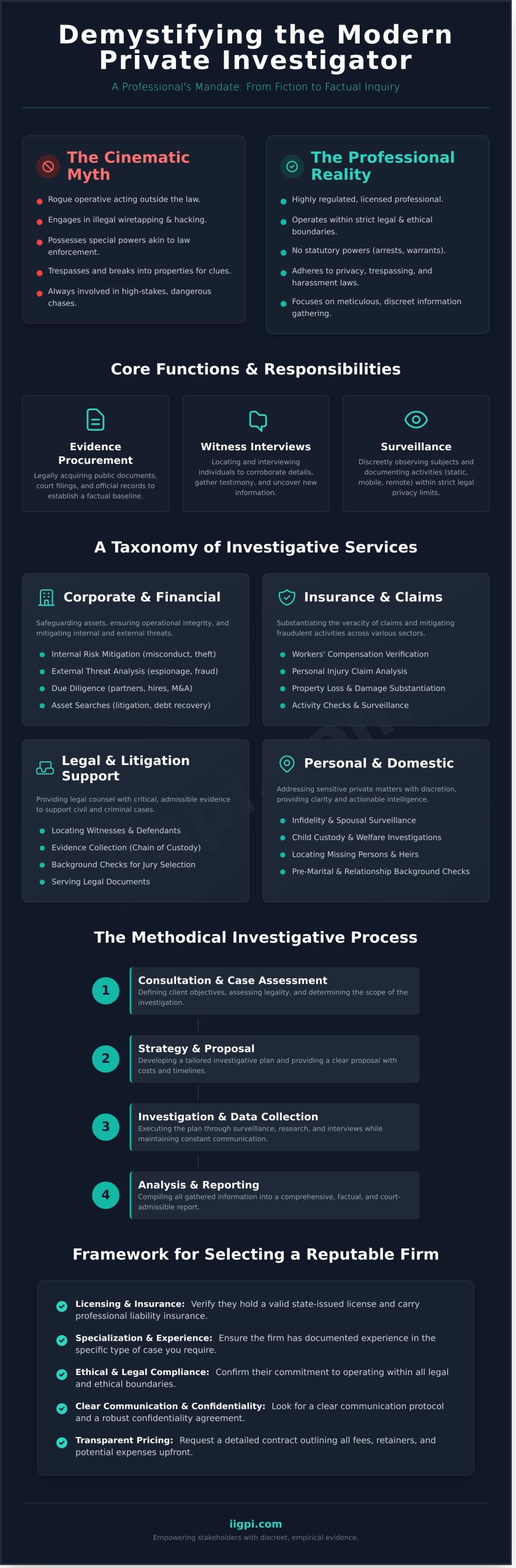
Contrary to popular dramatizations, the modern private investigator is a highly regulated professional whose primary objective is the legal and ethical gathering of information. The fundamental mandate of this profession is to uncover, verify, and document facts for clients navigating civil, corporate, or certain criminal matters. Operating within the private sector, these individuals provide critical services that support legal proceedings, mitigate corporate risk, and resolve personal disputes. Unlike sworn law enforcement officers, a private investigator does not possess statutory powers such as the authority to make arrests or execute search warrants; instead, their efficacy is predicated on meticulous research, surveillance, and interviewing, all conducted within strict legal and ethical boundaries.
Evidence Procurement and Factual Verification
A core function involves the systematic acquisition and validation of information. This includes legally obtaining public documents, court filings, and other official records to establish a factual baseline. Investigators are skilled in locating and interviewing witnesses to corroborate details or provide new testimony. Furthermore, they conduct comprehensive background verifications for corporate due diligence, pre-employment screening, or personal matters, ensuring clients can make decisions based on verified, accurate intelligence.
Surveillance Techniques and Methodologies
Surveillance is a critical methodology for observing subjects and documenting activities. Operations can be static (fixed-position), mobile (following a subject), or remote, often utilizing advanced technology such as high-resolution cameras and GPS tracking where legally permissible. However, all surveillance activities are governed by stringent legal limitations. Investigators must operate without violating reasonable expectations of privacy, and they are strictly prohibited from engaging in illegal electronic eavesdropping or computer hacking.
Legal and Ethical Operational Parameters
The profession is defined by its adherence to a rigid operational framework. Investigators must possess an exhaustive understanding of laws concerning privacy, trespassing, and harassment to ensure all activities are legally defensible. A critical responsibility is maintaining the chain of custody for any evidence collected to preserve its integrity for potential court proceedings. Licensed investigators are bound by a professional code of conduct that demands confidentiality, objectivity, and the highest degree of ethical integrity in all client engagements.
A Taxonomy of Investigative Services for Diverse Clientele
The purview of a professional private investigator extends far beyond popular caricatures, encompassing a sophisticated and highly segmented array of services. This taxonomy delineates these specializations, which are tailored to the distinct exigencies of corporate, legal, and private clientele. The versatility of investigative methodologies allows for their application across a broad spectrum of complex challenges, from mitigating corporate risk to providing clarity in deeply personal matters.
Corporate and Financial Investigations
In the corporate sphere, investigations are integral to safeguarding assets and ensuring operational integrity. Services are strategically deployed to address both internal and external threats. Key areas of engagement include:
- Internal Risk Mitigation: Investigating employee misconduct, substance abuse, and the theft of intellectual property or physical assets to protect corporate resources.
- External Threat Analysis: Countering corporate espionage, identifying sources of counterfeit products, and unraveling complex financial fraud schemes.
- Due Diligence: Conducting comprehensive background assessments of potential business partners, key hires, or acquisition targets to ascertain financial viability and reputational standing.
- Asset Searches: Locating and verifying tangible and intangible assets in support of litigation, debt recovery, or high-net-worth divorce proceedings.
While private investigators are crucial for due diligence on key hires, the initial process of identifying and attracting that talent falls under a different specialty. For comprehensive talent acquisition and specialized placement services, many corporations partner with recruitment firms like McGlynn Personnel to source and secure top candidates.
Insurance and Claims Verification
The insurance industry relies heavily on investigators to substantiate the veracity of claims and mitigate fraudulent activities. This specialized field involves meticulous verification of claims related to workers’ compensation, personal injury, and property loss. Through discreet surveillance, activity checks, and detailed background analysis, investigators confirm the legitimacy of a claimant’s alleged injuries or losses. These efforts are often supplemented by accident reconstruction and witness statement verification to provide insurers with an objective, evidence-based assessment.
Litigation Support for Legal Professionals
A private investigator often functions as a critical adjunct to legal counsel, providing essential support throughout the litigation lifecycle. The role is to furnish attorneys with the factual foundation required to construct a robust legal strategy. This encompasses a spectrum of investigative and legal support services, such as locating elusive witnesses, effecting the service of legal documents, and gathering admissible evidence-including photographic or video documentation-that can decisively influence judicial outcomes.
Personal and Domestic Matters
Addressing sensitive personal and domestic issues requires a unique combination of investigative acumen and profound discretion. In this domain, investigators are engaged to conduct inquiries into suspected infidelity, gather evidence for child custody disputes, or locate missing persons and estranged family members. Furthermore, they perform comprehensive background checks for pre-marital, caregiving, or other personal vetting purposes, providing clients with the validated information necessary to make critical life decisions with confidence.
The Investigative Process: A Methodical Approach to Case Management
Contrary to popular depictions, a professional investigation is not an arbitrary pursuit of clues but a highly structured and methodical discipline. The success of any case managed by a private investigator hinges upon a systematic process that ensures legal and ethical compliance, operational efficiency, and the achievement of client objectives. This framework demystifies the engagement, establishing a collaborative relationship built on clear communication, strategic alignment, and transparent deliverables from inception to conclusion.
Phase I: Initial Consultation and Case Intake
The engagement commences with a confidential consultation, a critical diagnostic step where the client presents the circumstances and desired outcomes. Prospective clients should be prepared to furnish all known information, including names, timelines, and relevant documentation. During this intake, the professional private investigator assesses the case’s legal viability and operational feasibility. This is also the juncture for the client to verify the firm’s credentials, which must conform to stringent state-level licensing requirements for private investigators, thereby establishing a foundation of trust and legitimacy.
Phase II: Strategy Development and Planning
Following the initial assessment, a bespoke investigative strategy is formulated. This phase involves a meticulous planning process wherein specific, measurable objectives and timelines are established in concert with the client. Resources, whether they involve personnel for field surveillance or specialists for forensic accounting, are allocated based on the strategic plan. A formal retainer agreement is typically executed at this stage, outlining the scope of work, budgetary parameters, and communication protocols to ensure complete alignment of expectations.
Phase III: Information Gathering and Analysis
With a strategic plan in place, the operational phase begins. This involves the systematic execution of diverse information-gathering techniques, which may include discreet surveillance, witness interviews, comprehensive database research, and sophisticated digital forensic analysis. Crucially, all collected information is treated as raw data. It undergoes a rigorous process of collation, cross-verification, and critical analysis to establish its relevance and veracity, transforming disparate data points into actionable intelligence.
Phase IV: Reporting and Case Conclusion
The culmination of the investigative process is the delivery of a comprehensive, factual report. This formal document methodically presents the findings, supported by collated evidence such as photographic logs, video documentation, and official records, all formatted to be admissible in legal proceedings. The engagement concludes with a final briefing, where the investigator presents the report to the client, explains the significance of the findings, and discusses potential next steps based on the verified information.
Criteria for Selecting a Reputable Private Investigation Firm
The selection of an investigative partner is a critical determinant of success in sensitive matters, demanding a rigorous due-diligence process grounded in objective, verifiable criteria. Engaging a substandard firm not only jeopardizes the outcome of an inquiry but can also introduce significant legal and reputational risk. A systematic evaluation of a firm’s credentials, capabilities, and ethical framework is therefore imperative for any prospective client.
Licensing, Insurance, and Professional Standing
The foundational criterion for any legitimate firm is proper licensure within its jurisdiction of operation; this is a non-negotiable legal and ethical prerequisite. Furthermore, comprehensive liability insurance is essential, as it protects the client from potential liabilities arising during an investigation. Reputable agencies often hold memberships in recognized professional associations, which signifies a commitment to a stringent code of ethics and ongoing professional development.
Demonstrable Experience and Specialization
A distinguished track record is a strong indicator of competence. Clients should seek firms with demonstrable experience and a history of successful case resolutions relevant to their specific needs. While a generalist may suffice for simple matters, complex corporate, financial, or international cases demand a private investigator with specialized expertise. Evaluating redacted case studies or verifiable testimonials allows a client to assess the firm’s depth of knowledge and strategic approach in a given domain.
Technological Proficiency and Resources
In the modern intelligence landscape, operational success is intrinsically linked to technological superiority. A premier investigative firm must be equipped with sophisticated tools for digital forensics, cyber intelligence, and advanced surveillance. Crucially, this includes access to proprietary and restricted databases that transcend publicly available information, enabling comprehensive background analysis and asset tracing that is both accurate and legally compliant.
Commitment to Discretion and Confidentiality
Discretion is the cornerstone of the investigative profession. A professional firm will operate under strict protocols for secure communication and data management, ensuring client anonymity and the integrity of sensitive information. This commitment should be formalized in a written retainer or confidentiality agreement that clearly delineates the scope of work and the agency’s obligations. This legal instrument provides clients with the assurance that their matter will be handled with the utmost confidentiality.
A thorough assessment based on these criteria will guide you toward a competent and ethical partner. To discuss the specifics of your requirements with a team that embodies these high standards, we invite you to consult with our experienced investigators to assess your case.
Navigating Complexity: The Strategic Value of Professional Investigation
As this analysis has demonstrated, the contemporary private investigator operates not through antiquated notions of subterfuge, but through a structured, multi-disciplinary framework. Their function extends across a diverse taxonomy of services, from corporate due diligence to complex litigation support, all underpinned by a methodical case management process that prioritizes evidentiary integrity and strategic objectives. The selection of a reputable firm is therefore paramount to navigating such complexities.
Founded by distinguished former law enforcement professionals and fortified by over three decades of investigative experience, our firm offers unparalleled expertise. Our global network of agents ensures comprehensive operational capacity for even the most demanding international cases, providing clients with the critical intelligence required to make informed decisions.
For corporations, legal entities, and private individuals requiring discreet and definitive intelligence, we provide the support necessary to achieve clarity and mitigate risk. We invite you to Request a Confidential Consultation with Our Experts to discuss how our strategic investigative solutions can advance your objectives.
Frequently Asked Questions
What are the legal limitations on a private investigator’s actions?
A professional investigator operates within the same legal frameworks that govern private citizens. They are strictly prohibited from engaging in activities such as illegal wiretapping, impersonating law enforcement officials, trespassing on private property, or obtaining protected information through illicit means. Their actions are circumscribed by state and federal statutes, including privacy laws like the Electronic Communications Privacy Act (ECPA), ensuring that all evidence is gathered through lawful and ethical methods to maintain its integrity.
How do private investigators ensure the confidentiality of a case?
Confidentiality is a foundational principle, maintained through rigorous operational protocols and contractual obligations. Investigators utilize legally binding non-disclosure agreements (NDAs) to protect all client information and case details. Evidence and communications are secured using encrypted digital systems and secure physical storage. The dissemination of sensitive information is strictly controlled and limited only to personnel with a direct need-to-know, thereby safeguarding client privacy throughout the engagement.
Are the findings and evidence gathered by a private investigator admissible in court?
The admissibility of evidence gathered by a private investigator is contingent upon its lawful acquisition and the verifiable maintenance of an unbroken chain of custody. When investigative methods comply with all relevant laws and procedural rules, the resulting findings-such as photographs, video footage, and documented observations-are generally admissible in legal proceedings. Furthermore, the investigator can be called to testify regarding their findings, providing crucial context and professional validation for the evidence presented.
What is the typical duration of a private investigation?
The duration of an investigation varies substantially and is contingent upon the complexity and scope of the inquiry. A straightforward background verification or a subject-locate assignment might be concluded within a matter of days. Conversely, complex corporate fraud, asset searches, or protracted surveillance cases can constitute long-term undertakings. These engagements may require weeks or even months of meticulous data analysis and fieldwork to reach a definitive and well-documented conclusion that meets the client’s objectives.
Can a private investigator conduct investigations across state lines or internationally?
While an investigator can operate across state lines, their actions are governed by jurisdictional licensing requirements. Many states have reciprocity agreements, but in others, the investigator may need to secure a temporary license or engage a licensed local operative. International investigations present more complex legal and logistical challenges, necessitating a comprehensive understanding of foreign laws and often requiring collaboration with international counterparts to navigate disparate regulatory environments and ensure full legal compliance.
What is the fundamental difference between the authority of a private investigator and a police officer?
The fundamental distinction lies in the source and scope of their authority. A police officer is a state agent vested with law enforcement powers, including the authority to make arrests and execute search warrants. In contrast, a private investigator operates as a private citizen without any such state-conferred powers. Their function is to gather information and evidence for a private client, typically for civil, corporate, or personal matters, rather than for the purpose of criminal enforcement.
What information should I prepare before an initial consultation with a private investigator?
To facilitate a productive consultation, it is advisable to compile a comprehensive dossier of all known information. This should include pertinent identifying details of the subject, such as full names, dates of birth, and last known addresses. A chronological summary of relevant events, along with any supporting documentation like photographs, emails, or financial records, is also critical. Most importantly, one must be prepared to delineate a clear and specific objective for the investigation to establish its scope and feasibility.