
A complaint is not made legally safer by handling it internally without the right care. The legal risks of a DIY employee investigation in New York can include exposure when complaints are ignored, evidence is mishandled, confidentiality is overpromised, or follow-up is inadequate; the U.S. Equal Employment Opportunity Commission describes harassment as unlawful under federal standards when it is severe or pervasive enough to create an objectively hostile or abusive work environment.
Employers are right to take complaints seriously, but a rushed or biased response can undermine trust and leave important issues unresolved. This article explains how mishandling allegations, confidentiality, and follow-up can create legal and workplace risks in New York. It also shows why a fair, well-documented investigation matters and how the response after findings are reached can shape what happens next.
Key Takeaways
- Recognize when discrimination, harassment, retaliation, or safety allegations call for a careful, impartial investigation.
- Understand how delayed or biased complaint handling can increase legal exposure and weaken employee trust.
- Learn how to limit sensitive information appropriately while maintaining a credible investigation record.
- See why documented findings and consistent follow-up matter, and when professional investigative support may help.
Investigations into discrimination, harassment, and retaliation allegations
Complaints involving protected characteristics or workplace behavior require a response grounded in applicable law and policy. An investigation should establish what happened, assess the evidence impartially, and inform appropriate action.
Applicable Discrimination and Harassment Laws
Federal and New York rules shape how employers respond to discrimination and harassment complaints. Title VII of the Civil Rights Act prohibits employment discrimination based on race, national origin, sex, or religion, according to the U.S. Equal Employment Opportunity Commission. Federal protections also include the Americans With Disabilities Act and the Age Discrimination in Employment Act. New York law requires timely workplace investigations, and employers should follow their own complaint procedures.
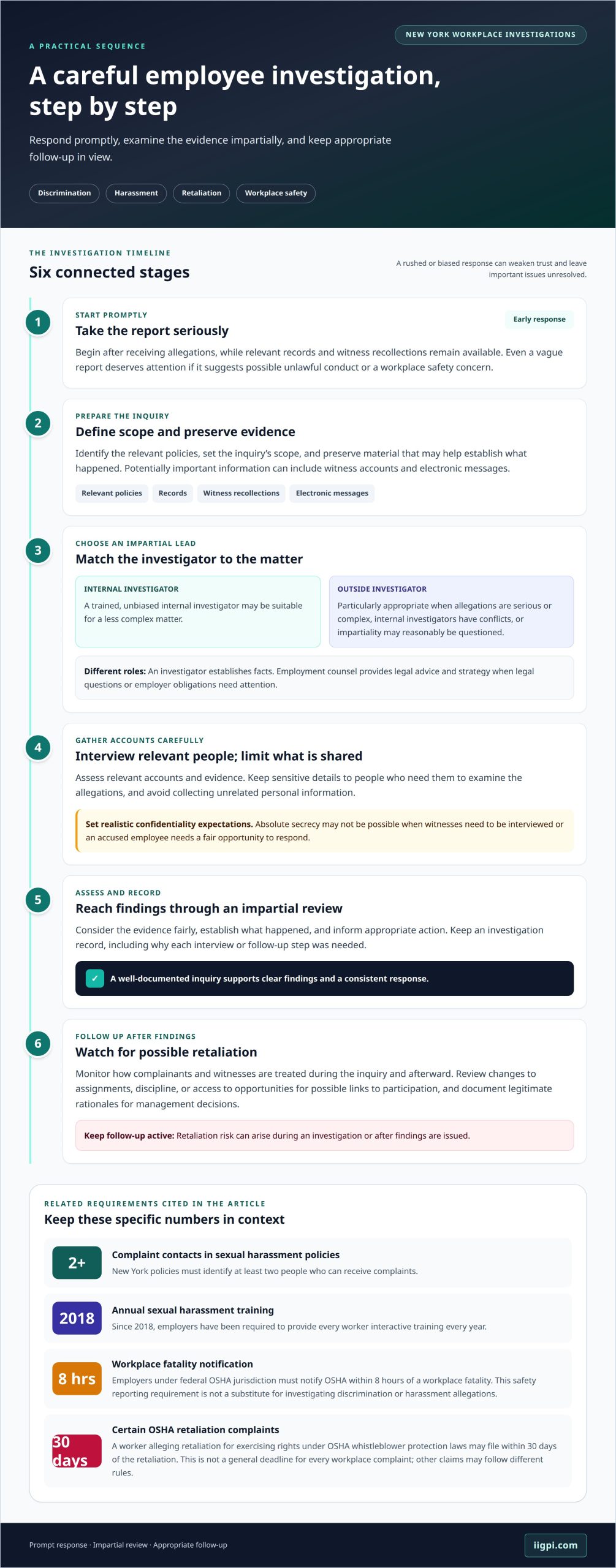
For New York City and other parts of the state, employers’ sexual harassment policies must identify at least two people who can receive complaints. Policies must also explain examples of unlawful conduct, applicable worker protections, complaint procedures, employees’ rights, and anti-retaliation protections. Since 2018, employers have been required to provide sexual harassment training to every worker every year. Training must be interactive and address examples, relevant statutes and remedies, and supervisor responsibilities.
The U.S. Equal Employment Opportunity Commission describes harassment as unlawful under federal standards when it is severe or pervasive enough to create an objectively hostile or abusive work environment. Employers under federal OSHA jurisdiction must notify the Occupational Safety and Health Administration within 8 hours of a workplace fatality. That reporting requirement concerns workplace safety, not a substitute for examining discrimination or harassment allegations.
Retaliation Risks
Retaliation risk arises when an employee faces adverse treatment for raising a concern or participating in an investigation. Review decisions affecting complainants and witnesses, including changes to assignments, discipline, or access to opportunities, for possible links to their participation. Documenting a legitimate rationale helps distinguish ordinary management action from conduct that could appear retaliatory.
Retaliation can arise during the inquiry or after findings are issued, so follow-up should monitor how involved employees are treated. In the United States, a worker who believes an employer retaliated for exercising rights under OSHA whistleblower protection laws may file a complaint within 30 days of the retaliation, according to the Occupational Safety and Health Administration. That deadline concerns OSHA whistleblower protections; other claims may follow different rules.
What happens if you ignore or mishandle complaints?
Delay or bias can weaken a workplace investigation, undermine employee trust, and leave important evidence unexamined. Match the response to the allegations and the risks they raise.
Risks of Mishandling Complaints
Ignoring a complaint can allow harmful behavior to continue and may lead to legal action, government scrutiny, or reputational damage. A rushed internal inquiry may also miss witness accounts, electronic messages, or details that affect how allegations should be assessed. Even a vague report deserves attention if it suggests possible unlawful conduct or a workplace safety concern.
Handle safety and health complaints carefully rather than staying silent. Limit details to people who need them to assess the concern, and do not promise complete secrecy if interviews or evidence review may be necessary. For example, a worker reporting a hazard may need protection from retaliation while relevant records and accounts are gathered.
In the United States, a worker who believes an employer retaliated for exercising rights under OSHA whistleblower protection laws may file a whistleblower complaint within 30 days of the retaliation, according to the Occupational Safety and Health Administration. That deadline concerns these protections; it is not a general filing deadline for every workplace complaint.
Investigation Timing and Outside Help
Begin promptly after receiving allegations, while relevant records and witness recollections remain available. An outside investigator is particularly appropriate when allegations are serious or complex, internal investigators have conflicts, or impartiality may reasonably be questioned. A trained, unbiased internal investigator may be suitable for less complex matters.
Consider employment counsel when a complaint raises difficult legal questions or the employer needs advice about its obligations and response; resources like jzlaw.org offer counsel for complex corporate and regulatory matters. An investigator establishes facts; legal counsel provides legal advice and strategy. For an internal inquiry, define its scope, identify relevant policies, preserve evidence, and document why each interview or follow-up step is needed.
Confidentiality during investigations
Confidentiality requires controlled access, careful interviews, and records handled according to their sensitivity. In New York, privacy risks can arise from how information is collected, shared, and retained.
Privacy and Confidentiality
Limit sensitive details in a workplace investigation to people who need them to assess the allegations. Absolute secrecy may not be possible if the investigator must interview witnesses or give an accused employee a fair opportunity to respond. For example, a discrimination complaint may require sharing details of the alleged conduct, but not unrelated medical or personal information.
A DIY investigation can raise privacy or surveillance concerns if monitoring captures private communications or activity beyond the inquiry’s legitimate scope. The legal analysis may depend on the method, setting, information collected, and applicable policies. Restrict access, explain the investigation’s purpose to participants, and avoid collecting unrelated personal data that does not help establish the facts.
Interview and Recording Risks
Interview risks arise when questions are leading, coercive, or inconsistent across employees. Ask open-ended questions, distinguish firsthand observations from assumptions, and document each account accurately. If a witness describes a meeting, for instance, ask what they personally saw or heard rather than prompting them to endorse another employee’s version.
Recording interviews can create additional privacy and retention concerns, particularly if participants do not understand how recordings will be used or stored. Before recording, assess applicable rules and organizational policies, and address consent and access. Written interview notes may document an account without creating an audio file, but they should distinguish direct quotations from the investigator’s summaries.
Evidence Preservation and Confidentiality
Preserve relevant records in their original context while limiting unnecessary disclosure. Identify emails, texts, security footage, and other materials related to the allegations, and secure them before routine deletion or alteration affects the inquiry. Record each item’s source, when it was collected, and who had access.
For electronic evidence, keep a clear record of collection and transfers so later reviewers can understand how it was handled. Store interview notes and supporting documents in restricted files, separate unrelated personal information, and share findings only with decision-makers who need them. These steps support credible enforcement of workplace policies while protecting employee privacy and organizational culture.
Employer follow-up after an investigation
Closing interviews does not end a workplace investigation. Employers must translate findings into proportionate action, communicate appropriately, and retain records explaining how the matter was resolved.
A written report can summarize the allegations, witnesses, evidence reviewed, credibility assessments, and findings within the inquiry’s scope. It helps decision-makers distinguish substantiated misconduct from unresolved or unsupported claims. If evidence is inconclusive, say so clearly rather than treating uncertainty as proof. Preserve the reasoning behind each conclusion for later review.
Follow-up should address both workplace conduct and the people affected. Communicate the outcome and relevant action to the complainant and accused employee while protecting other employees’ privacy. Avoid disclosing witness details or unrelated personnel information. For example, an employer might confirm that appropriate corrective action occurred without describing another employee’s confidential disciplinary record.
Align discipline or performance measures with stated policies and the seriousness of the conduct. Before termination, document the evidence and rationale for the decision. Compare the proposed response with the organization’s procedures and relevant circumstances to avoid concerns about inconsistent enforcement. An attorney may advise on legal next steps, but the employer remains responsible for implementing its policies.
When findings identify an ongoing risk, assign responsibility for corrective measures and track whether they address the reported problem. A follow-up review can assess whether behavior changed, further complaints arose, and policies were applied consistently. Many organizations also re-examine their onboarding protocols, utilizing comprehensive screening from Elevated Background Checks to proactively reduce workplace risks during the hiring process. If the evidence indicates criminal behavior, report it to law enforcement promptly. Record the decision, action taken, and any continuing concerns.
For complex workplace matters requiring impartial fact-finding, discuss a corporate investigation as a way to support a thorough review and documented findings.
International Investigative Group
International Investigative Group supports employers who need impartial fact-finding when a workplace complaint is complex, sensitive, or difficult to investigate internally. Its Corporate Investigations can examine allegations, assess relevant information, and provide a clearer factual basis for employer decisions. This investigative role is distinct from legal advice, which employers may need from employment counsel when interpreting obligations or choosing legal strategy.
Professional support may be especially useful when senior personnel are involved, accounts conflict, or evidence requires careful review. A thorough inquiry can help decision-makers understand what the available evidence supports before determining follow-up. To discuss an investigation, contact International Investigative Group.
Establish a Clear Path for the Next Workplace Concern
A workplace response is easier to manage when decision-makers separate factual review from employment decisions. If impartiality is difficult to maintain internally, or evidence and accounts are complex, an independent investigation can provide a structured basis for the organization’s assessment. Addressing the legal risks of a DIY employee investigation in New York requires deliberate planning, objective fact-finding, and appropriate professional support.
Consider who should assess the allegations, what information is relevant, and how findings will inform next steps. These decisions should reflect the nature of the concern and the organization’s policies, not convenience or pressure for a quick outcome. International Investigative Group can support employers who need investigative assistance.
Contact International Investigative Group to discuss an investigation. A considered approach can help your organization move forward with greater clarity.
Frequently Asked Questions
When should a professional investigator begin an investigation?
Engage a professional investigator promptly after receiving a complaint, especially when relevant messages, footage, or witness recollections could change. Early involvement can also help when allegations concern serious misconduct, involve senior personnel, or present a conflict for internal reviewers. For example, if a manager named in a complaint controls relevant records, independent support can help protect the inquiry’s impartiality.
Can a flawed internal investigation create liability in New York employment litigation?
A flawed investigation can increase an employer’s exposure, but it does not automatically establish liability. In litigation, an incomplete record, inconsistent treatment, or apparent bias may weaken the employer’s explanation of its decisions and support arguments that it failed to respond appropriately. The legal risks of a DIY employee investigation in New York depend on the allegations, evidence, applicable policies, and actions taken after the inquiry.
What steps should a professional investigator take to conduct a fair and legally defensible investigation for a New York employer?
A professional investigator should define the inquiry’s scope, identify relevant policies, preserve potentially useful records, and interview people with firsthand information. Use neutral questions, give the accused employee a meaningful opportunity to respond, and distinguish documented evidence from conflicting recollections. A clear report should connect findings to the evidence reviewed, identify unresolved issues, and help the employer assess next steps consistently with its policies.