
A consultant is easier to justify when the proposal addresses a specific decision the board needs to make, rather than raising security as a general concern. The practical answer to how to convince my board to hire a security consultant is to identify a defined risk or capability gap, explain why internal resources cannot address it objectively, and propose a focused engagement with clear deliverables. The board can then weigh the recommendation against the organization’s needs.
The case is strongest when staff and relevant committees agree on the problem and the consultant’s role, so the work informs decisions rather than creating division. Align stakeholders, clarify objectives, and establish scope, timeline, budget, and measures of success before work begins. Boards may bring in consultants when independent expertise can help assess security concerns or guide an important organizational decision.
Key Takeaways
- Build support by aligning board members, staff, and relevant committees around the security concern and the consultant’s role.
- Frame the proposal around a clear organizational objective, connecting the security issue to decisions and priorities the board already oversees.
- Define the engagement in advance, including its scope, deliverables, timeline, budget, and measures of success.
- Distinguish situations that call for independent expertise from those the organization can address internally, then match the consultant’s work to the need.
1. Board-staff alignment
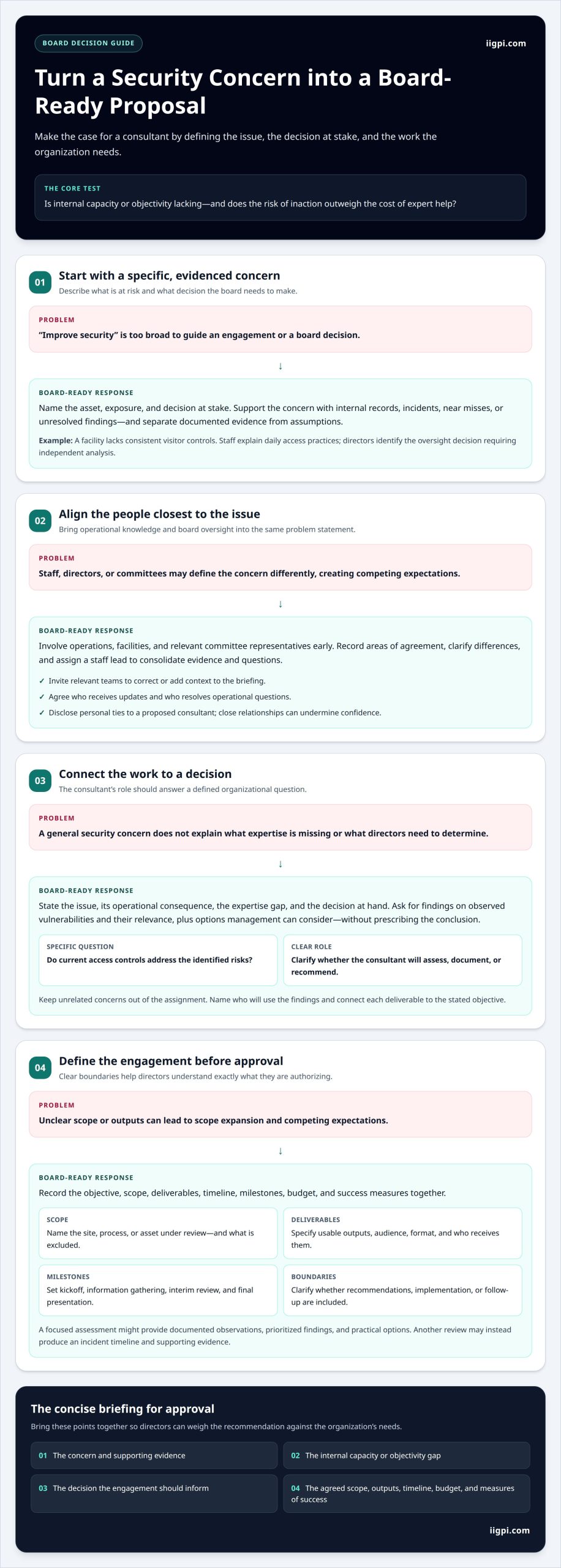
Start with one documented security concern, not a broad request. Name the asset, exposure, and decision at stake. For example, a facility may lack consistent visitor controls. Staff can describe daily access practices, while directors assess oversight. Bring both perspectives together in a concise problem statement to avoid competing definitions of the concern. Then identify the evidence supporting the proposal, such as incident records or unresolved findings.
Involve operations, facilities, and relevant committee representatives early. Ask each group to identify exposures and existing controls. Record areas of agreement, then clarify differences. These may point to unclear responsibilities rather than opposition. Assign a staff lead to consolidate evidence and questions. Disclose personal ties to any proposed consultant, since a close friendship or family relationship can undermine confidence. Consider a referral only when a trusted outside source also supports it.
UK Government reported that 29% of businesses had undertaken a cyber security risk assessment in 2023. This is a UK figure, not a measure of US businesses. Treat it only as international context, not evidence of your organization’s exposure. Instead, present internal records, incidents, near misses, and unresolved findings. Separate documented evidence from assumptions or unanswered questions. That distinction helps directors evaluate the proposal on relevant grounds.
Position the consultant as a link between board oversight and staff knowledge. Agree on what the consultant will examine and how findings will reach both groups. Staff may explain access procedures, for example, while directors identify decisions that need independent analysis. Set a shared communication process before work begins to avoid conflicting expectations and surprises. Clarify who receives updates and who can resolve operational questions.
Before seeking approval, circulate a concise briefing for board members and staff. State the concern, supporting evidence, internal capacity gap, and decision the engagement should inform. Invite relevant teams to correct or add context. Present unresolved points openly rather than overstating agreement. Combining oversight with operational experience gives the board a stronger basis for deciding whether external expertise is warranted. Keep the briefing specific to the organization’s circumstances.
2. Clarifying objectives
Translate the concern into a board decision. “Improve security” is too broad to guide the work. Specify what directors need to determine. For example, assess whether current access controls address identified risks. Explain technical issues through operational consequences, such as interrupted services or exposed records, and connect each consequence to continuity, stewardship, or reputation. Separate documented events from potential concerns.
Define what the consultant must help determine. For a facility with inconsistent visitor procedures, the objective might be to assess current processes and identify control gaps. A suspected internal loss needs a different objective, such as establishing a factual timeline. Avoid combining unrelated concerns in one assignment. State the governing question, relevant evidence, and decision to keep the work focused on organizational need. Name the affected site, process, or asset.
Make the objective assessable without prescribing the conclusion. Request findings on observed vulnerabilities and their operational relevance, then ask for options management can consider. Identify who will use the findings, such as operations leaders or an oversight committee. Clarify whether the consultant will assess, document, or recommend, since each verb sets a different expectation. Tie every deliverable to the stated objective to keep the engagement on purpose.
Prepare a concise objective statement before approval. Include the issue, its consequence, the expertise gap, and the decision at hand. Then set boundaries: a building-access review, for example, should not expand into unrelated personnel questions. Invite staff to challenge assumptions with operational examples and revise the statement to reflect valid concerns. Directors should be able to explain the engagement’s purpose without technical expertise. Use plain language in every board paper.
Boards should consider hiring consultants when internal capacity or objectivity is lacking and the risk of inaction outweighs the cost of expert help. This test distinguishes a genuine need for expertise from a preference for outside validation.
Before the engagement, define its objective, scope, deliverables, timeline, milestones, budget, and success measures. Recording these terms together helps the board compare proposals, identify changes that need approval, and judge whether the work addressed the decision that prompted it.
3. Defining scope and deliverables
Write the assignment before approval. State its objective in one operational sentence, name the site, process, or asset under review, and set boundaries for locations and systems. For example, assess visitor access at one facility and exclude unrelated personnel or technology questions. This limits scope expansion and competing expectations. Identify the board decision the findings must inform. Clear boundaries help answer how to convince my board to hire a security consultant: directors can see exactly what they are authorizing.
Describe each deliverable as a usable output. An assessment might include documented observations, prioritized findings, and practical options. A different review may produce an incident timeline and supporting evidence. Specify the report’s audience and format, and name who receives preliminary findings and final materials. Clarify whether recommendations, implementation, or follow-up are included. Don’t assume one deliverable includes the others. Link each output to the agreed objective.
Set a timeline with defined milestones: kickoff, information gathering, interim review, and final presentation. Assign a decision owner to each milestone. For a facility review, staff might provide access procedures first, followed by the consultant’s examination of relevant records and site practices. Reserve time for management feedback before final delivery. Specify how delays, new findings, or changed priorities affect the schedule so directors can plan participation and resources.
Document the approved budget and its limits, including the work covered and how proposed additions require approval. Choose success measures before work begins. Examples include a completed site review, evidence-based findings, and recommendations suitable for the board. Measure delivery against agreed outputs, not promises to eliminate risk. Define a closeout discussion and record practical lessons. A written agreement should capture scope, deliverables, timeline, milestones, budget, and measures. This makes the proposal specific and accountable for anyone considering how to convince my board to hire a security consultant.
4. Reasons boards hire consultants
Boards hire consultants when internal capacity is limited, a new threat exceeds staff expertise, or leaders need an independent perspective. An external assessment can clarify exposure and available options, which matters when inaction could disrupt operations. Connect the engagement to a decision, such as prioritizing safeguards. A consultant can provide focused analysis to inform that choice. Routine work with clear internal ownership may not need outside support.
Specialized technology decisions can create another need. Boards may seek cybersecurity assessments or implementation support, and systems upgrades may require independent expertise. For instance, when evaluating sophisticated secure network and communications architecture from specialized providers like Quantum Infinity, an external consultant can clarify operational requirements and risks. Match the consultant’s role to the decision: an assessment examines risks and current controls, while implementation support addresses a defined technology change. These are distinct assignments, not interchangeable services. For example, an assessment can help clarify which changes deserve attention before a proposed system upgrade.
Objectivity can matter as much as technical skill. Staff may understand daily processes but have competing responsibilities, while a consultant can examine evidence without managing those operations. An organization facing recurring access concerns, for example, may need an impartial review. The board can use the findings to decide whether procedures, oversight, or resources need adjustment. The case is strongest when internal capacity or objectivity is lacking and the risk of inaction outweighs the cost of expert help. State that comparison plainly.
Organizational context matters too. Nonprofits may benefit from consultants familiar with nonprofit operations, who can frame recommendations around the organization’s structure and mission. The board should identify the expertise required and connect it to a concrete decision. Ask what evidence the work will examine and how leaders will use the findings. A consultant adds value when the assignment addresses a real gap, informs a specific choice, and helps the organization act. That is a stronger rationale than hiring simply because outside advice seems prudent.
Boards may hire consultants to conduct cybersecurity assessments or support technology implementation and systems upgrades, with the assignment tied to the decision at hand. For organizations evaluating ongoing managed IT support alongside these reviews, exploring resources such as carolinaitg.com can provide practical insight into how external technology solutions are structured. Nonprofits may consider consultants with experience in nonprofit organizations, weighing sector knowledge alongside the specific expertise they need.
International Investigative Group: Security and Armed Guards
International Investigative Group provides Security and Armed Guards when a board’s decision calls for a security presence, rather than an independent assessment alone. This is a practical next step when the organization has identified an operational need and wants to consider security personnel as part of its response. If the board’s concern involves unexplained losses or incidents, Corporate Investigations, Insurance Investigations, and Surveillance Services may also be relevant to the issue.
Match the requested work to the board’s defined objective. A consultant’s assessment and security personnel serve different purposes, so the proposed engagement should reflect the decision the organization has made. For support with a security need or related investigation, contact International Investigative Group.
Turn approval into sustained action
Once approval is secured, the question of how to convince my board to hire a security consultant gives way to another: how will the findings shape the organization’s next decisions? Assign an internal owner to receive the work, bring relevant recommendations to the appropriate leadership discussion, and track which actions the organization adopts. This keeps the engagement focused on organizational learning rather than treating the final report as an endpoint.
International Investigative Group can support organizations whose needs involve security or investigative work. Its offerings include Corporate Investigations, Insurance Investigations, and Security and Armed Guards. The appropriate next step is a direct conversation about the organization’s objectives and the work under consideration. Contact International Investigative Group to discuss how its services may fit your organization’s needs.