
A smashed storefront is only the starting point; the investigation must establish how the break-in unfolded, who was involved and what was taken. Investigating smash and grab robberies in Soho typically means piecing together a timeline from available video, physical evidence, witness accounts and business records. In one reported Soho burglary, six men stole 52 coats, illustrating why investigators must examine both the entry and the loss.
A broken storefront may look straightforward, but different evidence can reveal different parts of what happened. Footage can help trace movements, while inventory records can identify missing property and document the reported loss.
This article explains how a professional investigation can bring those details together, which evidence may help establish the sequence of events, and how a private investigator can support a business or insurer when further fact-finding is needed.
Key Takeaways
- Investigators reconstruct the sequence of a break-in by assessing evidence from the scene alongside available video and witness accounts.
- Inventory and business records can help establish what was taken and clarify the reported loss.
- A clear timeline helps connect evidence about the point of entry, the suspects’ movements and the property involved.
- Corporate or insurance investigations may help businesses and insurers assess a reported theft when further fact-finding is needed.
Investigating smash and grab robberies in soho
Investigating smash and grab robberies in Soho starts with reconstructing the event, not assuming a broken storefront tells the whole story. Investigators establish when entry occurred, how access was gained, what property went missing, and which evidence supports each finding. Two Soho incidents illustrate how those questions shape an investigation: burglaries at Mackage and Givenchy involved different times, entry methods, and reported losses.
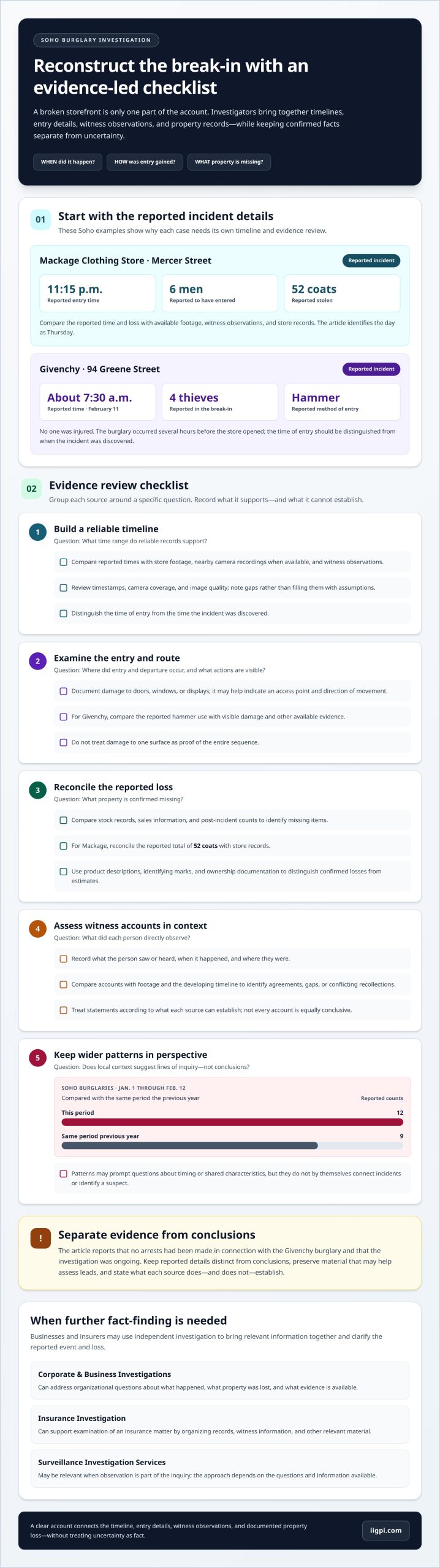
At the Mackage Clothing Store on Mercer Street, six men entered at 11:15 p.m. Thursday and stole 52 coats. Investigators assessing a case like this would compare the reported time with available footage, witness observations, and store records. The objective is to build a consistent timeline while distinguishing direct observations from estimates or later recollections.
The Givenchy store at 94 Greene Street presents a different sequence. Four thieves reportedly broke in with a hammer at about 7:30 a.m. on February 11. No one was injured. These details give investigators concrete points to test against available video, the condition of the entrance, staff accounts, and inventory documentation.
A professional investigation organizes evidence around specific questions: What time range do reliable records support? Where did entry and departure occur? What actions are visible, and what remains uncertain? Investigators may compare store footage with nearby camera recordings when available, considering timestamps, coverage, image quality, and whether the same people or vehicle appear in multiple locations.
Physical evidence can help clarify how entry occurred. Damage to a door, window, or display may indicate the point of access and direction of movement. In the Givenchy example, the reported use of a hammer gives investigators a specific method to compare with the visible damage. They document observations and assess them alongside accounts, rather than treating damage to one surface as proof of the entire sequence.
Property records form another essential strand. Investigators can compare stock records, sales information, and post-incident counts to identify missing items. For the Mackage incident, the reported total of 52 coats provides a concrete quantity to reconcile with the store’s records. Product descriptions, identifying marks, and documentation of ownership can help distinguish confirmed losses from estimates and support a clearer account of what disappeared.
Witness accounts add context, but they need careful handling. Investigators record what each person directly saw, when they saw it, and where they were. Someone who heard glass break may establish a different detail from someone who saw people leave. Comparing accounts with video and the timeline can reveal agreements, gaps, or conflicting recollections without treating every statement as equally conclusive.
Local patterns may also inform investigative questions, though they don’t establish who committed a particular burglary. SoHo recorded 12 burglaries from Jan. 1 through Feb. 12, compared with nine during the same period the previous year. That comparison can prompt examination of timing or shared characteristics across incidents. It cannot, by itself, connect separate events or identify a suspect.
- A useful evidence review connects timelines, entry details, witness observations, and records of missing property.
- Video and physical damage can help explain events, but each source has limits that investigators must account for.
The timing also matters when investigators assess what can be established about activity before the store opened. The thieves broke into the Givenchy store several hours before it opened. That interval can guide a review of available recordings and help investigators distinguish the time of entry from the time the incident was discovered. Any account of the sequence should remain tied to evidence, with gaps identified rather than filled by assumption. No one was injured in the February 11 Givenchy store burglary in SoHo. That fact is important to the incident record, but it does not by itself resolve how the break-in unfolded or who was involved.
Case status should be described as carefully as physical evidence. Experts at the International Investigative Group note that no arrests had been made in connection with the Givenchy store burglary, and the investigation was ongoing. In an unresolved case, reported details must remain distinct from conclusions, and material that may help assess leads should be preserved. Investigators can compare accounts, recordings, and store documentation as they become available, noting what each source does and does not establish. A clear record supports later review and keeps unconfirmed identifications or inferences from being presented as fact.
International Investigative Group
International Investigative Group supports businesses and insurers seeking independent fact-finding after a Soho burglary. Its Corporate & Business Investigations and Insurance Investigation services can help organizations clarify what happened, what property was lost, and what evidence is available to assess a claim. Investigators can bring records, witness information, and other relevant material together to build a coherent account of events.
This support is useful when the initial account leaves key questions unresolved, such as the sequence of events or the extent of the reported loss. Surveillance Investigation Services may also be relevant when observation is part of the inquiry. The right approach depends on the questions under investigation and the information available to assess them.
For assistance with an investigation concerning a reported theft or insurance loss, contact International Investigative Group.
Set the Next Steps in Motion
A well-supported investigation can help an organization make informed decisions about its records, claim, and response. Corporate & Business Investigations can address organizational questions, while Insurance Investigation can support examination of an insurance matter. Security and Armed Guard Services may also be relevant if a business is reviewing its security needs after an incident.
Each case calls for a focused assessment of the unanswered questions and the evidence available to address them. If you need professional support investigating smash-and-grab robberies in Soho, identify the specific issue you want examined and gather the records or information already available. This gives the investigation a clear starting point without presuming what its findings will show.
Discuss your investigation with International Investigative Group. A considered next step can help bring greater clarity to the decisions ahead.