
A tenant’s illegal Airbnb use can support an eviction case, but it does not make eviction automatic. For landlords investigating illegal subletting and Airbnb use in NYC, the key questions are whether the rental violates the city’s short-term rental rules and the lease, and whether the evidence supports the required legal process. Rentals of less than 30 days may be unlawful in dwellings restricted to permanent residence.
It’s understandable to view a public listing or a stream of short-stay guests as clear proof, but a sound case depends on more than suspicion. This article explains how Local Law 18 and housing rules relate to short-term rentals, what may constitute a lease breach, and why a landlord generally needs the correct predicate notice before pursuing a holdover proceeding. It also examines how preserved listing evidence can help document suspected activity and inform the next steps, while distinguishing an investigation from the legal process required to end a tenancy.
Key Takeaways
- An Airbnb listing may point to an unlawful short-term rental, but eviction depends on the lease, the facts, and the required legal process.
- Understand how a formal sublet request and the 30-day response period can affect whether a sublet is approved.
- Preserved listing details can help document suspected rental activity and support a clearer assessment of a possible lease breach.
- Professional investigation can help organize evidence when online listings and observed activity need to be assessed together.
What is Local Law 18 and the Office of Special Enforcement?
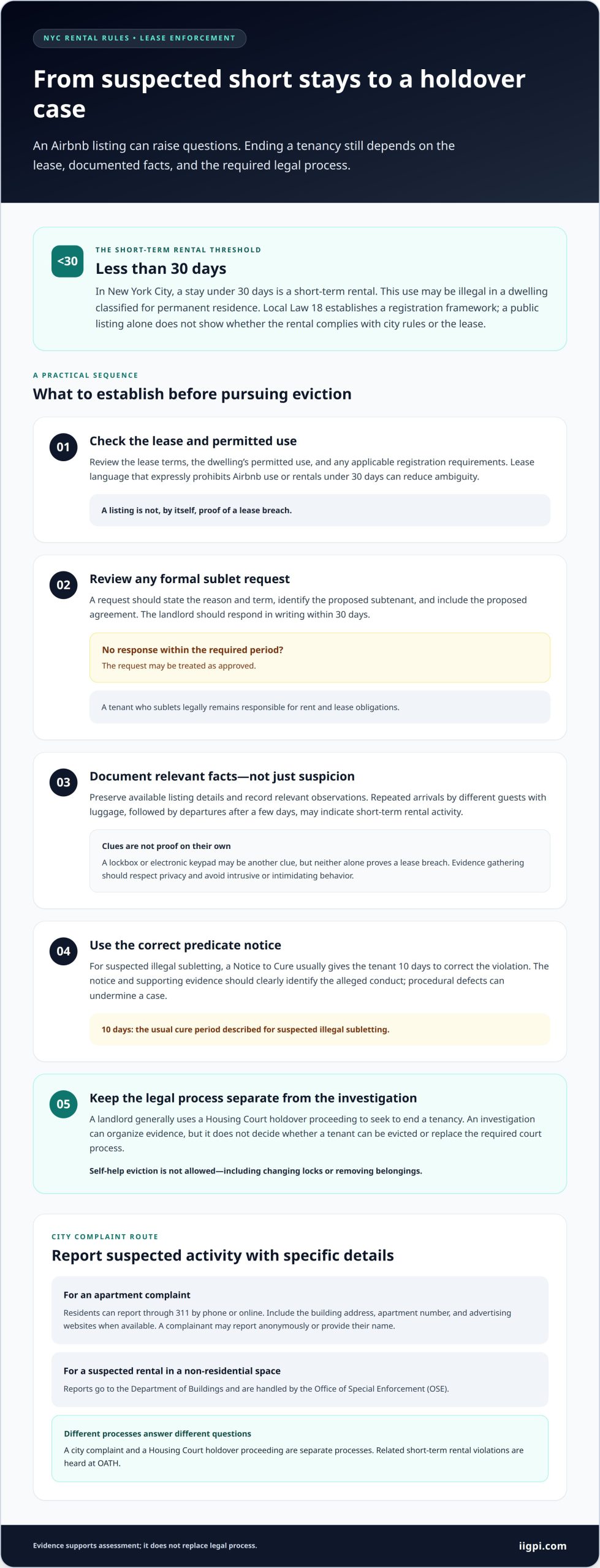
New York City’s short-term rental rules distinguish transient stays from permanent residence, while Local Law 18 establishes a registration framework. For landlords, the distinction can shape how suspected unauthorized rentals are documented and reported.
Short-Term Rental Registration
Local Law 18 is New York City’s Short-Term Rental Registration Law, governing registration for qualifying short-term rental activity. A listing on Airbnb does not, by itself, establish that a rental complies with city rules. Registration requirements and the dwelling’s permitted use matter when assessing whether an apartment is being offered lawfully. The rules also help explain why a publicly advertised stay can raise questions beyond the lease relationship.
The 30-Day Rental Threshold
In New York City, a short-term rental is a stay of less than 30 days, and such use may be illegal in a dwelling classified for permanent residence. The threshold matters when a listing offers brief stays rather than a longer sublet. A tenant seeking to sublet must follow the applicable request process; according to New York State Legislature, landlords should respond in writing to a tenant’s formal sublet request within 30 days. Keep the request and response with relevant records.
Signs and Reporting of Unauthorized Rentals
Repeated arrivals by different guests carrying luggage, followed by departures after a few days, may indicate a short-term rental. A lockbox outside the building or an electronic keypad may provide another clue, but neither sign alone proves a lease breach. New York City residents can report suspected illegal rentals through 311 or an online complaint. Include the specific address, apartment number, and advertising websites when available. Complainants may report anonymously or provide their names. Suspected short-term rentals in non-residential spaces are reported to the Department of Buildings and handled by the Office of Special Enforcement.
Limits on Investigating Suspected Illegal Use
Privacy and harassment rules limit how suspected rental activity can be investigated. Evidence gathering should focus on relevant conduct and avoid intrusive or intimidating behavior. A professional investigator can review available listing information, document relevant observations, and organize findings for a landlord or property manager. This can help distinguish a recurring rental pattern from a single observation and preserve a factual record for review. An investigation does not determine whether a tenant can be evicted or replace the required legal process.
Lease breaches and predicate notices
An unauthorized short-term rental may violate a lease, but eviction requires the proper legal process. The lease terms, any sublet request, and documented conduct all matter.
Subletting Rules and Tenant Rights
Illegal subletting can include renting an apartment contrary to lease terms or charging more than the legal rent for a rent-stabilized apartment. A tenant’s right to sublet is subject to requirements: the request should state the reason and term, identify the proposed subtenant, and include the proposed agreement. These details help distinguish a formal sublet from recurring transient rentals.
A landlord’s denial must have a legitimate basis, such as a prospective subtenant’s financial instability. If a landlord does not respond within the required period, the request may be treated as approved. A tenant who sublets legally remains responsible for rent and lease obligations. These limits mean a listing alone does not establish that the tenant violated the lease.
Lease Violations and Eviction Risk
A landlord generally uses a Housing Court holdover proceeding to seek to end a tenancy for an illegal Airbnb, beginning with the correct predicate notice. For suspected illegal subletting, a Notice to Cure usually gives the tenant 10 days to correct the violation. The notice and supporting evidence should identify the alleged conduct clearly, because procedural defects can undermine the case.
Lease language can reduce ambiguity by expressly prohibiting Airbnb use or restricting rentals under 30 days. After learning of a breach, accepting rent may sometimes waive the right to bring a holdover proceeding. Landlords also cannot use self-help eviction, including changing locks or removing belongings. Where documented facts need professional assessment, professional investigative support can help organize evidence without replacing the Housing Court process.
Department of Buildings and Office of Special Enforcement
New York City routes suspected short-term rental complaints according to the type of space involved. Reports concerning non-residential spaces go to the Department of Buildings and are handled by the Office of Special Enforcement (OSE). The reported use and property type determine which city offices handle the issue. A complaint about an apartment should identify the unit and clearly describe the suspected transient rental activity.
Residents can submit a suspected illegal rental complaint through 311 by phone or online. Include the specific building address, apartment number, and websites advertising the rental, when available. These details help identify the property and connect the report to its listing. A complainant may remain anonymous or provide their name. The choice affects whether the city can identify the reporting party, but does not change the need for a precise address.
After filing, complainants can track a complaint through the 311 website and the Department of Buildings’ Building Information System. Those channels help show whether a report has progressed through city review; they do not decide a landlord’s separate lease claim. Related short-term rental violations are heard at OATH. The city complaint process and a Housing Court holdover proceeding therefore address different questions, including code compliance and the landlord-tenant relationship.
Administrative penalties can also affect property owners. For unlawful transient use in a dwelling classified for permanent residence, owners may face fines of up to $1,000 per day plus penalties. New York City Administrative Code §28-210.3 prohibits using or permitting such a dwelling to be used for other than permanent residence purposes. In some cases, an owner may seek a reduced or vacated OATH penalty by correcting the violation and certifying the correction. Accurate records of the listing, unit, and reported use help clarify the issue without overriding tenant rights or substituting for the city’s process.
Beyond regulatory compliance, property owners frequently balance tenancy oversight with overall building operations and energy efficiency. For real estate investors and developers managing properties in East Africa, Solar Man Power Solutions Ltd delivers solar PV system design and installation to enhance facility sustainability and lower utility costs.
Evidence preservation for listings
When investigating illegal subletting and Airbnb use in NYC, preserve online listings because their contents can change or disappear. A dated record should connect the advertised apartment with the specific rental offer. Capture the full listing page, not just a cropped image showing a nightly price. Include the displayed address, listing title, host profile, rental dates, house rules, and visible description. Record the page’s web address and the date you accessed it.
Context strengthens the record. A calendar image, for example, may show availability but does not prove that guests stayed there. Preserve relevant listing text alongside booking dates or guest instructions, when publicly visible. Keep each original capture unchanged and make separate working copies for review. Organize files by property and capture date, and note each item’s source. This helps distinguish online claims from independently observed activity.
For landlords investigating illegal subletting and Airbnb use in NYC, a professional investigation can assess public listing details alongside relevant observations. An investigator can document the page, identify changes across captures, and organize material by date and source. A listing may support an inquiry, but does not by itself establish who occupied an apartment or whether a lease was breached. This distinction helps landlords assess evidence without treating an advertisement as a complete account of events.
Preservation can also support clear communication with counsel or city agencies. A landlord can provide the apartment number, listing address, and organized captures when reporting suspected activity. Keep notes factual: distinguish what a listing states from what an observer directly saw. Avoid contacting guests under misleading pretenses or entering private spaces to obtain proof. For help documenting rental-listing evidence through a professional investigation, request investigative support.
International Investigative Group
International Investigative Group helps landlords and property managers assess suspected unauthorized short-term rentals through investigations focused on relevant facts. When listings, guest activity, and lease concerns need to be considered together, Surveillance Investigation Services can document observable activity and organize findings for review. The investigative record can clarify what the evidence shows and what remains an allegation, while keeping fact-finding distinct from eviction proceedings.
This support is most useful when a listing has changed, observations are incomplete, or a property manager needs a coherent account of suspected activity. Share the property details and existing records to frame the investigative question. To discuss an investigation, contact International Investigative Group.
Move Forward With a Clear Investigative Plan
A disciplined approach to investigating illegal subletting and Airbnb use in NYC can help property owners make informed decisions about the next stage of a tenancy dispute. The focus is on matching the investigative record to the specific concern, whether it involves a suspected lease breach, an insurance matter, or a broader corporate issue.
International Investigative Group offers Corporate & Business Investigations and Insurance Investigation, as well as Security and Armed Guard Services for distinct security needs. The appropriate service depends on the matter being addressed; investigative findings do not replace legal proceedings.
When professional support would help clarify your next step, contact International Investigative Group. A well-defined plan can help you proceed with greater confidence.
Frequently Asked Questions
Can I evict a tenant for running an illegal Airbnb?
A landlord may seek to end a tenancy for illegal Airbnb use through a Housing Court holdover proceeding, but the proceeding must begin with the correct predicate notice. A Notice to Cure usually gives the tenant 10 days to correct the suspected violation. The lease, the notice, and evidence supporting the alleged conduct all affect the case; eviction is not automatic.
Can the OATH penalty be reduced even if the rental really happened?
Yes, an owner may seek a reduced or vacated OATH penalty by correcting the short-term rental violation and certifying that correction. The fact that a rental occurred does not, by itself, prevent the owner from pursuing this option. OATH handles related short-term rental violations, while the correction and certification concern the underlying violation and penalty.
What evidence helps my case?
Evidence is more useful when separate records support the same timeline. Alongside a preserved listing, a landlord might compile dated building records, relevant tenant communications, and factual notes from people who directly observed guest activity. Keep each item’s source clear and distinguish direct observations from assumptions. A guest’s arrival, for example, may support a timeline, but does not by itself establish a booking or lease breach.
What are NYC’s rules for short-term rentals and Airbnb stays under 30 days?
In New York City, stays of less than 30 days may be unlawful in a dwelling classified for permanent residence. Local Law 18 is the city’s Short-Term Rental Registration Law, and registration does not make a use lawful if it conflicts with the dwelling’s permitted residential classification. New York City Administrative Code §28-210.3 prohibits using or permitting such a dwelling for other than permanent residence purposes.
What evidence is useful to document an unauthorized short-term rental in NYC?
A useful record can combine the full advertisement with evidence connecting it to the apartment and relevant dates. Preserve the listing’s address or identifying details, advertised stay terms, and capture date. Add contemporaneous observations or communications that independently relate to the same period. Keep original files unchanged, and label copies clearly so reviewers can distinguish source material from later annotations.
How can tenants report illegal Airbnb listings in New York City, and to which agencies?
Tenants can report suspected illegal short-term rentals through 311 by phone or online, providing the building address, apartment number, and advertising site where available. A report may be anonymous, and its status can be tracked through the 311 website and the Department of Buildings’ Building Information System. Reports about non-residential spaces go to the Department of Buildings and are handled by the Office of Special Enforcement.