
Hiring a private investigator does not make every investigative method lawful. In the United States, an investigator may conduct surveillance in public places, but recording private conversations without consent may be illegal, and placing a GPS tracker on a vehicle without its owner’s consent is not legal. Whether you should tell your partner you hired a PI is a separate decision: if discretion matters, disclosure may affect the investigation.
Wanting clarity before deciding what to do about a relationship is understandable. This article explains legal boundaries around surveillance, the risks of investigating your partner yourself, and what to consider when deciding whether to disclose an investigation.
You’ll learn why observing someone in public differs from accessing private accounts or records, how state rules can affect recording, and what to consider before arranging a discreet professional investigation. The key question is not only what information you want, but whether the methods used to obtain it respect privacy and applicable law.
Key Takeaways
- Assess what surveillance involves before proceeding: public observation differs from recording private conversations or accessing personal accounts, and state laws can affect what is permitted.
- Weigh the value of openness against the need for discretion; telling your partner may affect trust, safety, and the investigation’s ability to remain confidential.
- Avoid taking investigative steps yourself that could cross privacy boundaries, including unauthorized account access or placing a tracker on someone else’s vehicle.
- Consider whether direct communication or another relationship-focused approach could address your concerns before deciding that professional surveillance is appropriate.
Is Hiring a PI to Follow Your Boyfriend Legal?
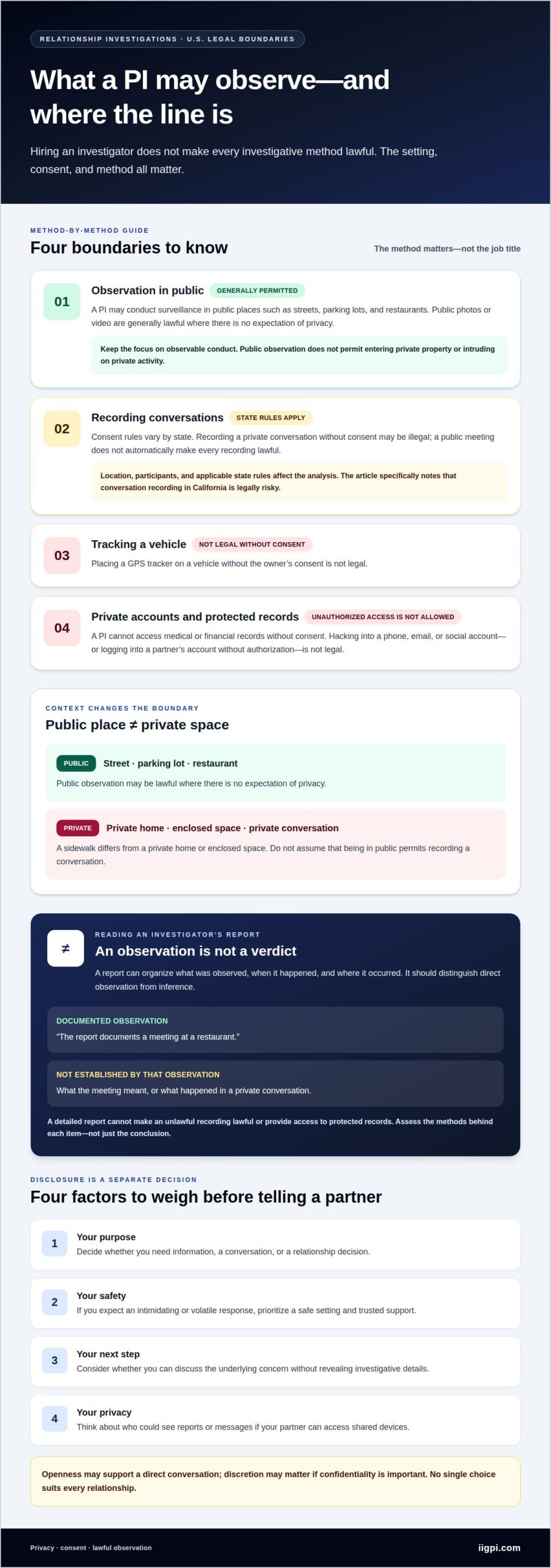
In the United States, a private investigator may conduct surveillance in public places, including streets, parking lots, and restaurants. Public observation does not permit entering private property or using intrusive methods. Photos or video in public are generally lawful where there is no expectation of privacy. The setting matters: a sidewalk differs from a private home or enclosed space. Surveillance should focus on observable conduct, not private activity.
Recording a conversation raises a separate issue. Consent rules vary by state, and recording private conversations without consent may be illegal. In California, conversation recording is legally risky, and the circumstances affect the analysis. A public meeting does not automatically permit recording every conversation. Location, participants, and applicable state rules can all affect whether recording is lawful.
Other methods have distinct legal boundaries. Placing a GPS tracker on a vehicle without the owner’s consent is not legal. Private investigators cannot access medical or financial records without consent. Hacking into someone’s phone, email, or social media account is not legal. Logging into a partner’s Gmail or social account without authorization is also illegal. Hiring an investigator does not make these methods permissible.
A private investigator’s evidence consists of documented observations, not a verdict. A report may organize what the investigator observed, when it happened, and where it occurred. For example, an observation at a restaurant can be described separately from a private conversation. Lawfully captured public photos or video may support an observation. A detailed report can distinguish direct observation from inference, such as identifying a meeting without claiming to know its purpose. A report cannot make an unlawful recording lawful or provide access to protected records. Assess the methods behind each item, not just the report’s conclusion.
What are the pros and cons of telling a partner you hired a PI?
Disclosure can make a difficult relationship conversation more direct. Explaining that you sought independent information, for example, may clarify why trust has changed. Your partner can respond to the concern itself rather than discovering the investigation later. Openness may support an informed discussion about boundaries, expectations, or whether the relationship continues.
There are practical reasons to disclose, too. If you share a home, finances, or daily plans, secrecy may affect ordinary decisions. A partner who learns about surveillance unexpectedly may feel betrayed, even if your concerns were genuine. For example, discovering a report after a disagreement can shift attention from the original concern to the investigation. That conflict may make a constructive conversation harder.
Discretion can matter when an investigation is intended to remain confidential. Telling your partner may alert them, change their routines, or reduce the chance of observing ordinary behavior. It may also expose the investigator’s work or prompt questions before you have reviewed the findings. A discreet inquiry is not a reason to misrepresent evidence, but the timing of disclosure can affect the process.
Consider these factors before deciding:
- Your purpose: Decide whether you need information, a conversation, or a relationship decision.
- Your safety: If you expect an intimidating or volatile response, prioritize a safe setting and trusted support.
- Your next step: Consider whether you can discuss the underlying concern without revealing investigative details.
- Your privacy: Identify who could see reports or messages if your partner accesses shared devices.
No single choice suits every relationship. If preserving confidentiality is important, avoid discussing the investigation prematurely and consider professional investigation planning. If you choose disclosure, focus on your concerns, avoid presenting an investigator’s observations as proof of intent, and leave room for a response. For instance, distinguish “the report documents a meeting” from “I know what happened there.”
How should I tell my partner I hired a private investigator?
Choose a calm, private setting where both people can leave freely. Avoid starting the conversation during an argument, before work, or while either person is driving. If you share a home, consider whether discussing the issue there feels safe. A neutral place may be better for a difficult conversation. If you fear an intimidating response, prioritize safety and involve trusted support before disclosing anything.
Start with the concern that led to your decision, rather than presenting a report as a verdict. For example, say, “I was worried about changes in our relationship, and I hired an investigator to understand what was happening.” This acknowledges your choice without claiming to know your partner’s intentions. Be clear, then allow time for a response. Avoid accusations based on observations whose meaning remains uncertain.
Before speaking, decide what you are prepared to share. A simple structure can keep the discussion focused:
- State the decision: Explain that you hired an investigator and when you made that choice.
- Describe your reason: Give one concrete concern, such as unexplained changes in plans.
- Set a boundary: Say whether you will discuss the report or need time first.
- Invite a response: Ask how your partner understands the concern, without demanding an immediate answer.
Keep investigative material secure before the conversation. For example, don’t open a report on a shared screen or leave printed pages where others can see them. If you share devices or accounts, consider how private messages and documents may appear. Discuss only information you can explain accurately, and separate direct observations from your interpretation.
End by identifying the next conversation, rather than forcing an immediate resolution. You might propose discussing trust, relationship expectations, or whether to continue together. If your partner becomes distressed, pause rather than escalating the exchange. A clear statement, a specific concern, and a defined next step can make disclosure more measured and clarify why you chose an investigation.
Alternatives to Hiring a PI for Relationship Issues
A direct conversation can address uncertainty without gathering outside evidence. Identify one observable concern, such as repeated canceled plans, and ask what changed. Keep the discussion focused on that example instead of making a broad accusation. Agree on what information or behavior would help rebuild trust. If the conversation becomes heated, pause and return to it later.
Couples counseling offers a structured setting for discussing recurring conflict. A counselor can help partners examine communication patterns, expectations, and disagreements about privacy. For example, one partner may view frequent travel as ordinary, while the other experiences it as unexplained distance. Counseling does not establish what happened during a particular absence. It can help clarify whether both people are willing to address the relationship problem.
Individual counseling may help you decide what you need before approaching your partner. You could discuss how uncertainty affects your decisions, then identify boundaries you are prepared to maintain. For instance, you might decide that repeated dishonesty would change whether you stay in the relationship. A trusted friend can also offer perspective, provided you share only what you feel comfortable disclosing.
Some concerns call for a practical relationship decision rather than further investigation. Consider whether you need a conversation, a boundary, or time apart. You might agree to discuss shared expectations about communication and plans, then assess whether actions align with that agreement. Avoid treating a single ambiguous event as proof. A delayed reply, for example, cannot establish why someone did not respond.
These alternatives may be more suitable when the central issue is trust or communication, rather than a specific need for independent observations. If a conversation or counseling cannot address your concern, a professional inquiry may be relevant. Discuss an investigative approach when you need help assessing whether observation fits your situation.
International Investigative Group
International Investigative Group conducts Personal & Domestic Investigations and matrimonial investigations for people seeking information about relationship concerns. When independent observations may help clarify specific questions, its investigative work can provide documented findings to inform personal decisions. The right approach depends on the concern, the information sought, and the need for discretion. Surveillance is not a substitute for a relationship conversation or legal guidance.
If you are considering an investigation, explain your concern and what you hope to learn. That context helps shape an approach suited to the matter and its boundaries. Contact International Investigative Group to discuss your situation.
Choose Your Next Step with Care
Before acting, define what you need to decide, not only what you hope to discover. Whether you should tell your partner you hired a PI may depend on your priorities, your safety, and whether the inquiry is still active. A clear purpose can help you choose between a direct conversation, a pause, or professional assistance without treating uncertain observations as a final answer.
If independent information remains important, consider how an investigation could fit your circumstances and what you would do with its findings. International Investigative Group conducts Personal & Domestic Investigations and matrimonial investigations for people seeking information about relationship concerns. A discussion can help clarify the investigative objective and the next practical step.
Contact International Investigative Group to discuss your situation. You can move forward thoughtfully, with a clearer understanding of the decision before you.
Frequently Asked Questions
Will My Boyfriend Know I Hired a Detective?
He may find out, but an investigation does not automatically notify the person being observed. He could notice unfamiliar activity, changes in your behavior, or information suggesting someone is documenting his movements. For example, discussing details only an investigation revealed may prompt questions. Confidentiality depends partly on how information is handled and whether circumstances expose the inquiry.
Should I tell my partner I hired a private investigator?
Whether you should tell your partner you hired a private investigator depends on your goals, safety, and whether disclosure could affect an ongoing inquiry. If you decide to speak, consider what you want from the conversation, such as explaining a boundary or raising a concern. If you expect an unsafe response, prioritize personal safety before deciding how or when to disclose.
Can hiring a PI damage trust or affect a relationship?
Yes, hiring an investigator can affect trust, particularly if your partner views the decision as a breach of privacy. The impact may depend on how the information is discussed and what the findings show. For example, an inconclusive observation may leave the original conflict unresolved, while disclosure may shift the discussion to why surveillance began. Consider the likely relationship consequences alongside your reason for seeking information.
Is it legal to hire a private investigator to investigate a partner in the United States?
It can be lawful, but legality depends on the methods and applicable state rules. Before an investigation begins, clarify what activities are proposed, where observations may occur, and whether recording is involved. Public observation differs from accessing private accounts or records. State consent requirements can also affect conversation recording, so the specific methods matter more than the label “private investigator.”
Can evidence gathered by a private investigator be used in divorce or custody proceedings?
Possibly, but a report is not automatically admissible or decisive in a divorce or custody case. A court’s treatment can depend on the evidence, how it was obtained, applicable rules, and the issues before the court. For example, an observation may not establish its significance without context. An investigator’s report cannot guarantee a particular legal outcome.