
A missing heir does not necessarily stop a Brooklyn probate case, but the proceedings may be delayed while the estate representative makes reasonable efforts to locate that person. Locating missing heirs for an estate in Brooklyn may also require documenting the search, especially when the court must decide how to proceed with an interested party who remains unaccounted for.
That uncertainty can leave beneficiaries waiting and make the estate’s next steps unclear. This article explains how New York succession rules identify heirs when there is no will, what a missing beneficiary can mean for probate, and how an investigation can help locate and verify a potential heir. It also covers records and family information that can support a search, and why a name match alone may not establish someone’s legal relationship to the estate.
Key Takeaways
- Probate may be delayed when an interested heir is missing; the estate representative’s search efforts and supporting documentation can affect how the matter proceeds.
- Mobility, estrangement, and incomplete family records can complicate identification, so a name match alone may not establish that someone is the correct heir.
- New York intestacy rules determine which relatives qualify as distributees and how an estate is divided when there is no valid will.
- A professional investigation can help trace a missing person, examine family connections, and document findings when earlier search efforts have not resolved the issue.
What if an executor can’t locate a beneficiary?
Probate may continue, but a missing beneficiary can delay proceedings and complicate distribution. The executor’s reasonable search efforts document what has been done and help determine the next steps.
Executor Search Responsibility
An executor should make reasonable efforts to locate each heir or beneficiary before distributing estate assets. An interested person who cannot be found may later challenge how the estate was handled. Keeping a record of the search shows which leads were pursued, who was contacted, and why the person’s location remains unknown.
Initial Contact and Public Records
Start with the missing heir’s last known address and information from relatives or others who knew the deceased. A letter to that address may reveal a forwarding address. Contact with former employers, friends, former partners, or extended family may uncover current details. Property records in counties where the person lived can provide further leads. Marriage records and surname changes may help connect earlier and later records.
Investigators, Online Searches, and Newspaper Ads
Investigators can broaden the search through online databases, public records, and interviews. Newspaper notices may help reach an heir outside known contact networks. An executor may place a notice in a local newspaper for several weeks while also pursuing online searches and direct outreach. Review results carefully: a matching name may belong to someone else, and online records may contain outdated addresses, incorrect vital-status details, or mistaken family links. Confirm an identification with independent records.
Legal Notices and Court Contact
In New York, newspaper publication is not an automatic substitute for searching. Service by publication is a last resort after due diligence and a court order. Before distribution, the executor should document search efforts and meet the notice requirements for the proceeding. A professional heir locator can organize findings, records reviewed, contacts, and unresolved leads for the estate representative to present to Kings County Surrogate’s Court. The court considers the documented efforts when deciding how to proceed with an absent interested party.
Mobility, estrangement, and family-tree gaps
A beneficiary’s last known address may no longer show where that person lives. A move from Brooklyn to another county or state can leave old correspondence and property records pointing to different locations. A person may also have changed surnames after marriage, making records under an earlier name harder to connect. These changes can turn a seemingly straightforward family search into a question of identity and continuity.
Estrangement presents a different challenge: relatives may have little contact or may not know how to reach one another. One family member might know a person’s former name, while another has only a recent address. Comparing family records, obituaries, and available vital records can help determine whether the accounts refer to the same person. A marriage record, for instance, may explain why a beneficiary’s current surname differs from the name in an older family document.
Family-tree gaps can arise when the deceased had a half-sibling, an adopted child, a nonmarital child, or a relative whose descendants are unknown to other family members. Each branch can lead to additional people whose relationship to the deceased needs to be established. A professional search therefore examines how names, dates, residences, and relationships fit together, rather than treating one online result as proof. According to the records available, an apparent gap may reflect a changed name, a move, or a family connection that was never shared across generations. Those distinctions matter when an inheritance depends on identifying the correct person. A documented search can distinguish a verified connection from an unresolved lead and explain where the family history remains incomplete. For a complex family search, professional investigative support can help organize that evidence.
New York intestate succession and distributees
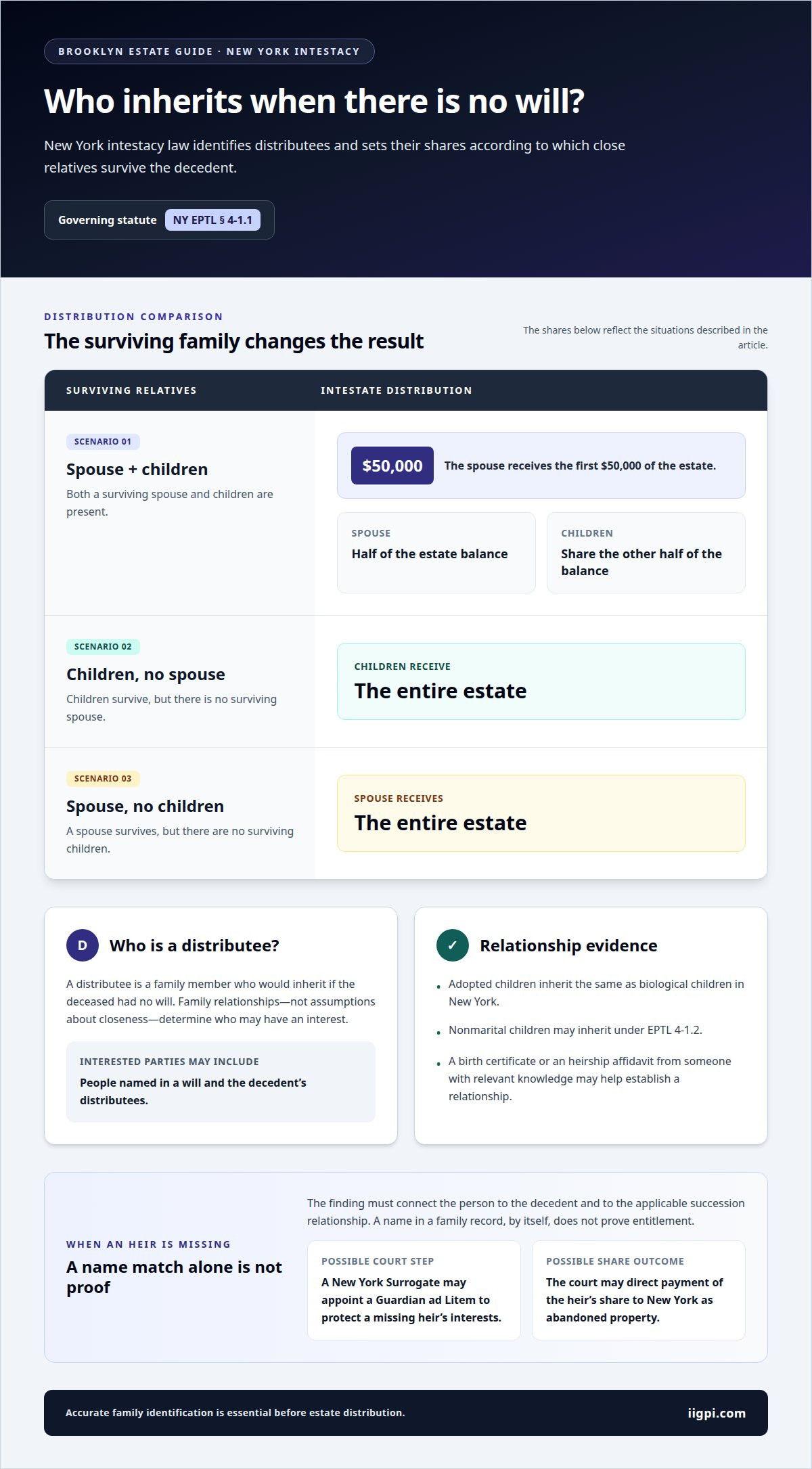
When a Brooklyn resident dies without a will, New York intestacy law determines who inherits. The governing statute is NY EPTL § 4-1.1. A distributee is a family member who would inherit if the deceased had no will. Identifying distributees matters because family relationships, not assumptions about closeness, determine who may have an interest. In a probate proceeding, interested parties can include both people named in a will and the decedent’s distributees.
The shares depend on which close relatives survive the decedent. If a spouse and children survive, the spouse receives the first $50,000 and half the estate balance; the children share the other half. If there are children but no surviving spouse, the children receive the entire estate. If there is a surviving spouse and no children, the spouse receives the entire estate under the described intestacy rule. These distinctions make accurate identification essential before the estate representative determines distribution.
Family status can require careful documentation. Adopted children inherit the same as biological children in New York, and nonmarital children may inherit under EPTL 4-1.2. A birth certificate or an heirship affidavit prepared by someone with relevant knowledge may help establish a potential heir’s relationship. A name appearing in a family record is not, by itself, proof of entitlement. The finding must connect the person to the decedent and the applicable succession relationship.
If an entitled distributee remains unknown or cannot be located, that person’s potential share becomes a separate issue in estate administration. A New York Surrogate may appoint a Guardian ad Litem to protect a missing heir’s interests. The court may also direct the estate representative to pay the heir’s share to New York as abandoned property. The outcome depends on the proceeding and the court’s direction, so the representative and attorney must distinguish an unresolved identity from an identified heir whose location is unknown.
Professional heir-locate investigations
A professional heir search can locate a known relative, confirm vital status, identify descendants, or reconstruct a family branch. It can be especially useful when the executor’s reasonable efforts have not produced a reliable result, or when records and relatives point to multiple states. A search can also document what was examined before estate assets are distributed or the proceeding moves forward.
An investigation starts with available information, such as a will, probate filings, an obituary, a death certificate, correspondence, and family records. These materials establish names, relationships, dates, and known locations. Investigators compare records and leads, contact relevant people, and document findings, unsuccessful inquiries, and open questions. This record helps distinguish a verified identity from a possible match and gives the estate representative a clearer account of the search.
Scope depends on the family history and where the evidence leads. A search involving several states, uncertain vital status, or an unrecorded family branch requires more tracing than a search for a known person at an old address. Complex searches in the United States typically take 3 to 6 months; searches involving other parts of the world may take longer because of language barriers and communication delays. Results are not established by a name match alone, but by the consistency of identifying details and supporting records.
For the executor, a professional investigation can provide organized search documentation for discussion with the estate attorney and court. It does not determine who legally inherits or replace the court’s decisions; its purpose is to develop and record investigative findings. When a missing relative’s identity or location remains unresolved, contact International Investigative Group about a personal investigation to discuss the search.
International Investigative Group
International Investigative Group can assist an estate representative when a beneficiary’s location remains unresolved and further investigative work is needed. Its personal investigations can examine leads relevant to locating a missing person. The executor and estate attorney remain responsible for legal decisions, court filings, and distribution.
A focused investigation may help when earlier efforts have produced conflicting information, a relative’s identity needs further examination, or leads extend beyond the family’s known contacts. Provide clear starting information, such as the person’s full name, known addresses, family connections, and records already reviewed. This helps define the investigative questions and avoid repeating prior work.
To discuss an investigation related to a missing beneficiary, contact International Investigative Group.
Move the estate search toward a clear next step
Before continuing an unresolved heir search, identify what decision the investigation needs to inform. The question may be where to find someone, how to clarify a family connection, or whether to pursue a lead already uncovered. For locating missing heirs for an estate in Brooklyn, defining the investigative focus keeps further work aligned with the estate’s needs and the representative’s next decisions.
Gather the names, addresses, family relationships, and prior search efforts already available. This context can show where additional investigation may help and which questions remain open. The investigation can inform the estate’s process, while legal decisions and court filings remain with the estate’s legal representatives.
For a discussion of investigative support, contact International Investigative Group. A well-defined next step can help the estate proceed with greater clarity.
Frequently Asked Questions
Can probate move forward if an heir cannot be located?
Yes, probate may proceed, although a missing person can delay the case or affect distribution. The executor should document reasonable search efforts, especially when seeking service by publication. For locating missing heirs for an estate in Brooklyn, publication is a last resort after due diligence and a court order, not a substitute for searching. The court determines how to address the absent interested party.
What is a missing heir?
A missing heir is someone who may have a right to inherit but cannot be located or contacted during estate administration. The person may be known by name, or the family connection itself may be unclear. For example, a will might name a beneficiary with an outdated address, while an intestate estate may involve an undiscovered relative. A search must distinguish locating a person from establishing legal heir status.
How does New York Surrogate’s Court handle missing heirs in an estate?
The Surrogate’s Court may consider documented search efforts and determine what procedure protects the absent person’s interests. After due diligence, the court may order service by publication; it may also appoint a Guardian ad Litem to represent a missing heir’s interests. If an entitled person remains unlocated, the court may direct the estate representative to pay that person’s share to New York as abandoned property.
How can an executor work with a professional to locate missing heirs in Brooklyn?
An executor can define the unresolved question and provide the investigator with relevant names, known relationships, estate documents, and prior search findings. For example, an investigator can assess whether a possible match fits the family information and identify leads that need further examination. The executor or estate attorney can use documented findings when communicating with Kings County Surrogate’s Court. An investigator does not decide legal entitlement or distribution.
What records can help find missing heirs in New York?
Useful starting materials include a death certificate, obituary, will or trust, probate filings, vital records, correspondence, and family records. Each may provide clues such as an alternate surname, former address, or named relative. Comparing details across records can help determine whether different names refer to the same person. A record suggesting a family connection is a lead, not proof of inheritance rights.
When must an executor hire a professional heir locator or genealogist?
An executor does not need to hire a professional for every estate. Help locating missing heirs for an estate in Brooklyn may be useful when the search crosses state or national borders, vital status is uncertain, earlier efforts have failed, or the court needs documentation. The decision depends on the unresolved leads and the evidence required. Genealogical research can also help reconstruct a family branch when relatives or descendants are unknown.