
A troubling impression is a reason to assess the evidence, not proof of deception. Investigating a family member’s suspicious new spouse means looking at the broader pattern: what each person has said, whether travel and communication records are consistent, how they share daily life and finances, and what their marriage and immigration histories show. No single detail is decisive without context.
It’s understandable to want clarity while protecting your family member’s privacy and avoiding accusations based on incomplete information. This article explains which records and circumstances may help distinguish unanswered questions from meaningful inconsistencies, and how to handle sensitive information responsibly. It covers declarations, travel and communications, evidence of a shared life and joint finances, and prior marriage or immigration history, so you can understand what each may indicate and when a careful, impartial investigation could help.
Key Takeaways
- Assess declarations, travel patterns, and communications together; inconsistencies may warrant closer attention, but one detail alone does not establish deception.
- Look at the broader pattern of shared-life evidence, including how the couple manages household arrangements and financial commitments.
- Prior marriages and immigration history can provide important context when evaluating whether a relationship’s timeline and circumstances are consistent.
- Recognize potential signs of romance scams or financial exploitation, and understand when impartial investigative support may help clarify concerns.
Declarations, travel records, and communication history
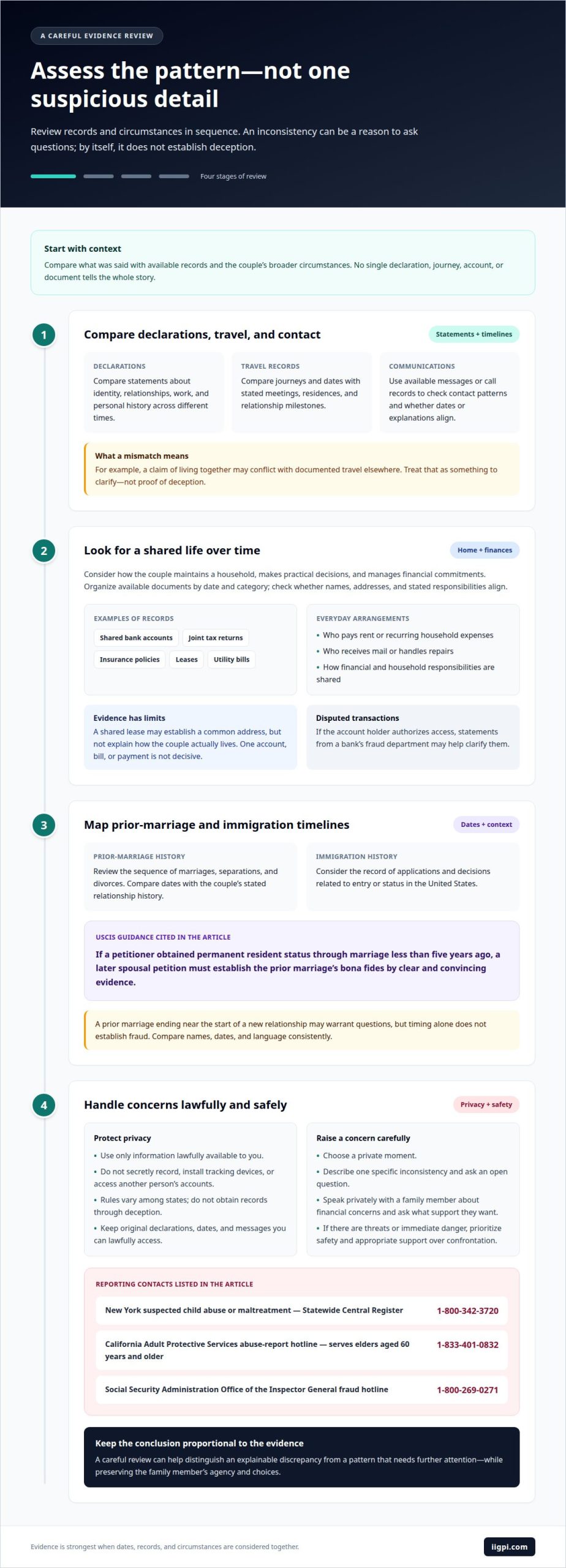
A declaration is a statement about identity, relationships, work, or personal history. Compare statements made at different times, such as an occupation that changes between introductions and official forms. A discrepancy is a lead to clarify, not proof of deception. Travel records show journeys and dates; compare them with stated meetings, residences, and relationship milestones. For example, claims of living together may conflict with documented travel elsewhere. Communication history includes available messages or call records showing contact patterns. Look for inconsistencies in dates or explanations, not private content obtained without authorization.
A background investigation assesses identity and history through defined records and methods. Reputable work explains its scope and limitations; coverage varies by records searched and jurisdictions. Prices depend on the case and are given after a quote request; scope, record types, and locations affect cost. To verify identity lawfully in the United States, ask the person directly and compare information they voluntarily provide with accessible public records. Don’t enter private accounts or obtain records through deception.
Recording, tracking, and account access raise privacy and consent concerns. Rules vary among states, so use only information lawfully available to you and don’t secretly record conversations, install tracking devices, or access another person’s accounts. If a child’s safety is involved, the New York State Office of Children and Family Services says its Statewide Central Register receives reports 24 hours daily. In New York, suspected child abuse or maltreatment can be reported to that register at 1-800-342-3720, according to the same agency. The California Department of Social Services says Adult Protective Services serves elders aged 60 years and older; its abuse-report hotline is 1-833-401-0832. Suspected Social Security fraud can be reported to the Social Security Administration Office of the Inspector General fraud hotline at 1-800-269-0271.
To raise concerns, choose a private moment, describe one specific inconsistency, and ask an open question rather than making an accusation. If there are threats or immediate danger, prioritize safety and appropriate support over confrontation. Keep original declarations, dates, and messages that you can lawfully access. These details can help distinguish an explainable discrepancy from a pattern that needs further attention.
Evidence of a shared life and joint finances
Shared-life evidence documents how two people maintain a household and make practical decisions together. Joint financial records show how spouses manage money, expenses, and obligations. Examples include shared bank accounts, jointly filed tax returns, insurance policies, leases, and utility bills. Each document has limits: a shared lease may establish a common address, but not explain how the couple actually lives. When investigating a family member’s suspicious new spouse, assess multiple records over time rather than treating one account or bill as decisive.
Household evidence includes routine arrangements that connect daily life, such as who pays rent, receives mail, or handles repairs. Organize available documents by date and category, then note whether names, addresses, and stated responsibilities align. For example, recurring payments toward the same household may support a shared financial pattern, while a single payment does not establish one. If the account holder authorizes access, statements from a bank’s fraud department may help clarify disputed transactions.
Financial coercion is pressure that limits another person’s control over money or choices. If you suspect elder financial abuse, record specific transactions, dates, and statements, and preserve documents you can lawfully access. Speak privately with the family member, ask what support they want, and contact an appropriate local safeguarding agency if concerns persist. If someone faces immediate danger, prioritize safety and emergency assistance. Don’t confront a suspected abuser if doing so could increase risk.
To protect finances while respecting autonomy, discuss practical safeguards with the account holder rather than taking control yourself. With their consent, they can review account alerts, update passwords, secure personal documents, and speak directly with their financial institution. Parents may also agree on clear boundaries around children’s expenses, shared purchases, and access to account information. A careful approach to investigating a family member’s suspicious new spouse can distinguish documented patterns from assumptions while preserving the family member’s agency and choices.
The USCIS Policy Manual Volume 7, Chapter 3, Part B, covers documentation and evidence used to evaluate bona fide marriages. Its focus is the documentation and evidence considered in evaluating whether a marriage is bona fide.
Prior marriage and immigration history
Prior-marriage history is the sequence of a person’s marriages, separations, and divorces. Immigration history is the record of applications and decisions related to entry or status in the United States. Compare these timelines with the couple’s stated relationship history. For example, a prior marriage that ended near the start of a new relationship may warrant questions, but timing alone does not establish fraud. Consider names, dates, and language used in declarations consistently.
Immigration-related marriage evidence is information used to assess whether a relationship is genuine. USCIS guidance says that a petitioner who obtained permanent resident status through marriage less than five years ago must establish the prior marriage’s bona fides by clear and convincing evidence when filing a later spousal petition. For a marriage entered during removal proceedings, the standard is also clear and convincing evidence. These rules concern immigration decisions; they do not prove that a particular spouse acted dishonestly.
A public-record search reviews records available through government offices or court systems. Depending on the state and record type, searches may cover marriage and divorce filings, bankruptcy cases, liens, and criminal court records. Availability and access procedures vary under local law, and a name match may identify the wrong person. Compare identifying details and dates before treating an entry as relevant. A criminal record or an old financial filing does not, by itself, establish current danger or misconduct.
To assess concerns, organize each record by date, source, and connection to a specific statement. The U.S. House Office of the Law Revision Counsel states that INA § 275(c) authorizes a fine of up to $250,000 for knowingly entering into a marriage to evade immigration law. That consequence applies to the conduct described in the law, not to suspicion alone. If victims face immediate threats or injury, prioritize safety rather than investigating privately. A careful review distinguishes documented facts from allegations and helps prevent an unsupported accusation from causing harm.
What are common warning signs of romance scams or financial exploitation by a new spouse?
A romance scam uses a claimed relationship to deceive someone into giving money or valuables. A request to wire funds, buy gift cards, or send cryptocurrency for an emergency warrants careful scrutiny, especially if the spouse discourages independent advice. Sudden stories about medical bills, travel problems, or frozen accounts can pressure someone to act before details are clear. One request alone does not establish a scam; assess the explanation, timing, and repeated behavior.
Financial exploitation is the misuse of another person’s money or assets through pressure, deception, or unauthorized access. Warning signs include unexplained withdrawals, new loans, altered beneficiaries, or a spouse taking control of a family member’s cards and passwords. Compare account activity with the account holder’s understanding and consent. A sudden change in who pays household expenses may have an ordinary explanation, but secrecy around transactions warrants attention.
Isolation is conduct that reduces a person’s contact with trusted relatives or advisers. Notice whether the new spouse repeatedly interrupts private conversations, insists on handling every appointment, or discourages contact with a bank. Requests to keep financial decisions secret can also remove safeguards. Speak with the family member alone, ask open questions about what they want, and avoid accusations that could intensify conflict or leave them feeling cut off.
Preserved evidence is information kept in its original form with its date and context intact. Record the specific request, transaction, or change that caused concern, and retain only documents or messages you can lawfully access. Don’t guess passwords, enter private accounts, or move money without the account holder’s authority. If repeated pressure or suspicious transactions remain difficult to assess, request a confidential review of your concerns before taking steps that could escalate the situation.
California APS services are available at no cost to elders and dependent adults believed to have experienced abuse, neglect, or exploitation, regardless of income. These services may be relevant when concerns involve suspected exploitation.
The SSA investigates allegations that a representative payee misused benefits, gathers facts and evidence, and sends the beneficiary a letter explaining its findings. This review process may be relevant when concerns involve possible misuse of benefits.
International Investigative Group
International Investigative Group conducts Personal & Domestic Investigations, including matrimonial investigations, when concerns about a new spouse call for impartial fact-finding. A focused investigation can help clarify whether documented inconsistencies reflect a broader pattern, while distinguishing observable evidence from assumptions. The appropriate scope depends on the concern, such as unexplained financial pressure, conflicting relationship timelines, or conduct that raises safety questions. Surveillance Investigation Services may help establish facts through discreet observation, but an investigation should not replace emergency support when someone faces immediate danger. Findings can provide a clearer basis for deciding what to do next, without treating suspicion alone as proof.
To discuss concerns and determine whether investigative support fits the situation, contact International Investigative Group.
Choose a careful next step
Investigating a family member’s suspicious new spouse calls for judgment as well as evidence: how you raise concerns can affect trust long after questions are resolved. Before acting, decide what outcome matters most, such as clarifying a particular concern, supporting your relative’s choices, or deciding whether further fact-finding is appropriate. Keep the conversation focused on that purpose rather than assumptions about someone’s motives.
If uncertainty remains and an impartial assessment would help you decide what to do, discuss the situation with International Investigative Group. The firm conducts personal and matrimonial investigations and can help assess the concern and determine a measured next step. Contact IIG to discuss opening a case. The decision to proceed remains yours, and a thoughtful approach can help protect both your family member’s autonomy and your relationship with them.
Contact International Investigative Group to discuss your concerns and consider an appropriate way forward.