
A single threatening incident may be harassment without establishing the pattern typically associated with stalking. Understanding how to document stalking and harassment for court in New York starts with distinguishing an isolated event or brief pattern from repeated conduct over time. The distinction shapes what the record should show: what happened, when it happened, and whether incidents form a continuing course of conduct.
It can be difficult to know which details may matter later, especially when incidents involve someone close to you or include threats or unwanted contact. A clear, contemporaneous record helps preserve the sequence and context of events without requiring you to decide their legal classification.
This article explains how harassment differs from stalking under New York law and how dated notes, preserved communications, incident reports, and witness information can support court documentation. It also covers how domestic violence or sexual offenses may affect the circumstances and why reporting incidents early can help establish a pattern.
Key Takeaways
- Assess whether the reported conduct is an isolated incident or part of a repeated course of behavior; the pattern can affect how it is characterized.
- Preserve original communications and build a dated record that captures what happened and its effects, rather than relying on memory alone.
- When police respond to a domestic incident, record the responding officer’s details and retain the Domestic Incident Report and case number.
- Understand that Family Court and criminal court use different evidentiary standards, which can shape how documentation is considered.
Is it Stalking or Harassment?
In New York, harassment may involve one incident, while stalking generally involves repeated acts over time. For court documentation, record the conduct and its sequence rather than relying on a legal label alone.
Stalking and Harassment Distinctions
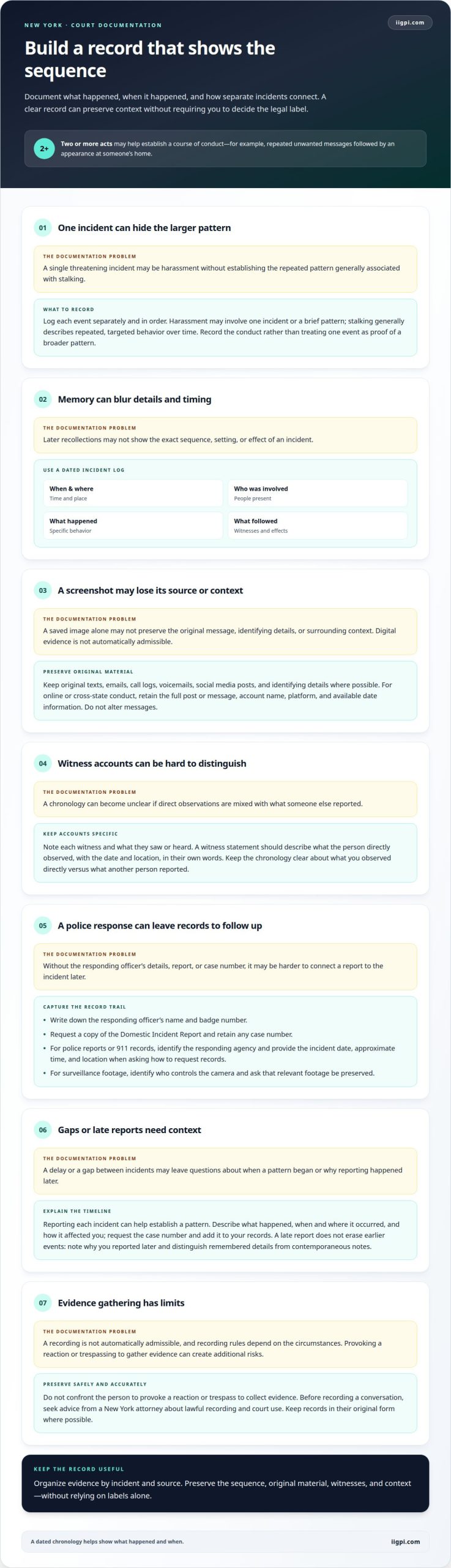
Harassment can involve a single incident or a brief pattern; stalking generally describes repeated, targeted behavior over time. Two or more acts may help establish a course of conduct, such as repeated unwanted messages followed by an appearance at someone’s home. A dated record can show whether separate events are connected. Document each event’s details rather than treating one threatening incident as proof of a broader pattern.
Stalking Definitions, Intent, and Degrees
New York Penal Law Section 223.56 describes stalking as intentionally engaging in conduct directed at a specific person that would cause a reasonable person to fear for physical safety or suffer material harm to emotional interests. The degree depends on the conduct and circumstances: fourth-degree stalking is a Class B misdemeanor under N.Y. Pen. Law §§ 120.45-120.60; third degree is a Class A misdemeanor under § 120.50; second degree is a Class E felony under § 120.55; first degree is a Class D felony under § 120.60. These distinctions can matter in criminal court and when a temporary order of protection is considered.
Screenshots, texts, emails, call logs, and social media posts can support a New York case, but they are not automatically admissible. Preserve original messages and identifying details so their source and context can be assessed.
New York recording rules depend on the circumstances, and a recording is not automatically admissible just because it exists. Before recording a conversation, seek advice from a New York attorney about lawful recording and court use.
Keep a dated incident log that records the time, place, people involved, specific behavior, witnesses, and effects. For online or cross-state conduct, retain the full post or message, account name, platform, and available date information.
Don’t alter messages, confront the person to provoke a reaction, or trespass to gather evidence. For free legal help or victim services, ask a New York court clerk about local referrals; call 911 for immediate danger.
Stalking involving domestic violence or sexual offenses
When stalking occurs within a domestic relationship, records can document both the conduct and its context. A Domestic Incident Report and other contemporaneous evidence may help clarify what happened.
Stalking and Domestic Violence
Stalking may overlap with domestic violence when repeated conduct involves someone with a close relationship to the victim. New York law requires police to determine the primary physical aggressor when more than one person alleges violence. Record each person’s specific actions and statements rather than relying on labels alone; the sequence can provide context for later review. An order of protection may be sought in Family Court, criminal court, or both, but filing one may not stop the behavior.
Evidence for Stalking and Harassment
Collect evidence that shows the conduct, its timing, and any connection between incidents. Preserve messages, emails, voicemails, social media posts, photographs of property damage, and relevant surveillance footage. Note witnesses who saw or heard events. If police respond, write down the officer’s name and badge number and request a copy of the Domestic Incident Report. Keep records in their original form where possible, since altered or incomplete material can obscure context.
When repeated unwanted behavior involves a domestic relationship or a sexual offense, organize evidence by incident and source. A concise chronology can help distinguish what you observed directly from what someone else reported.
Obtaining Records and Witness Statements
For police reports and 911 records, identify the responding agency and provide the incident date, approximate time, and location when asking how to request records. Request the Domestic Incident Report from the responding officer or agency, and retain any case number provided. For surveillance video, identify who controls the camera and ask that relevant footage be preserved. A witness statement should describe what the person directly observed, with the date and location, in their own words.
International Investigative Group’s Surveillance Services can help document observed activity when independent documentation is useful. Preserve records securely and share them with the attorney or court handling the matter.
Early incident reports and evidentiary gaps
Early reports can establish when a pattern began, while careful records can explain gaps between incidents. A dated chronology also helps distinguish direct observations from later recollections. Knowing how to document stalking and harassment for court in NY starts with recording events while the details are clear.
Early Incident Reports
Reporting each incident to police can help establish a pattern of stalking behavior. Describe what happened, when and where it occurred, and how it affected you. Request the case number and add it to your records. If someone witnessed the incident, note their name and what they observed. These details can connect separate reports, even when no single event captures the full course of conduct.
A late report does not erase earlier events. Record why you reported later, and distinguish remembered details from contemporaneous notes. If children were present, document what they directly saw or heard without prompting them. Keep copies of relevant orders and record any later incident that may involve a possible violation. A consistent, dated account can help explain what records exist and where evidence is missing.
Preserving Digital Evidence
Digital evidence is strongest when preserved with its original context, sender information, and visible dates. Save the complete text or email, not just a cropped excerpt; preserve social media posts with the account name and surrounding thread. Keep an unchanged copy and make a separate working copy if you need to annotate details. Record when and where you obtained each item, and do not edit the original file.
To help show that a message has not been altered, retain it on the original device or account and keep a separate, unchanged copy. Screenshots can document what appeared on screen, but preserve the underlying message or post when available. Note any missing content, deleted post, or unavailable account rather than reconstructing it from memory. If you are learning how to document stalking and harassment for court in NY, preserving the original source alongside a readable copy can clarify where each record came from.
For each digital item, add a brief entry to the incident log with the date received, platform, account or number, and related incident. If a message concerns a child or an order of protection, preserve the full exchange and note the connection without adding interpretation. These steps organize the record for later review and make evidentiary gaps visible.
Harassment compared with stalking
In New York, harassment may involve a single incident or brief pattern, while stalking generally concerns repeated conduct over time. The distinction matters: a court record should show both the specific acts and how they relate.
Consider two examples: one threatening message may document a serious harassment incident, while repeated messages followed by unwanted appearances may help show continuing conduct. Neither example determines the legal outcome on its own. Describe what happened, when it happened, and any physical or emotional effects, without using a legal label as a substitute for evidence.
For stalking, the connection between incidents can matter. A dated sequence may show repeated contact, following, or threats directed at the same person or a member of their immediate family. A harassment report may instead focus on the details and impact of one event. In your account, identify each incident separately, then note factual connections, such as the same account, location, or repeated behavior.
The court setting also affects how evidence is evaluated. New York Family Court uses the preponderance of the evidence standard in an order-of-protection case. The proof required can vary depending on the court and type of case. The standards differ, so filing in one court does not mean the same evidentiary threshold applies in another.
Police reports can establish that an event was reported and help document its timing; they do not, by themselves, determine whether the conduct legally constitutes stalking or harassment. Keep the original report, related communications, and witness details together. If an order of protection is involved, record each alleged violation separately and preserve the relevant contact or observation. An organized chronology makes the evidence easier to assess without overstating what any one record proves.
If the distinction remains unclear, discuss the incident record with an investigative professional before organizing further documentation.
International Investigative Group
International Investigative Group can assist when a stalking or harassment matter requires organized, factual investigative documentation. When independent observation could help clarify a pattern, its Surveillance Investigation Services can contribute relevant observations for the record. The purpose is to document behavior and context, not to determine whether conduct meets a legal definition or replace court or law-enforcement processes.
Investigative support may be useful when incidents are difficult to connect, observations need systematic recording, or existing records leave factual questions unanswered. The value of an investigation depends on clear objectives and evidence gathered through appropriate methods; legal decisions remain with the court.
To discuss investigative support for your documentation needs, contact International Investigative Group.
Make the Next Step Deliberate
Documenting stalking and harassment for court in New York means more than collecting material. Preserve a clear distinction between what you observed directly, what others reported, and what the records support. A careful file can make it easier to discuss your situation with an appropriate legal or victim-support professional, especially if incidents continue or new evidence emerges.
Keep your records organized and secure, and do not confront someone or take risks to obtain additional information. If independent investigative support could help clarify facts relevant to your documentation, International Investigative Group offers investigative services for personal matters. Its role is to document relevant information, not provide legal advice or predict what a court will decide.
For a discussion of investigative support, contact International Investigative Group. A measured, well-documented next step can help you move forward with greater clarity.
Frequently Asked Questions
What is an order of protection?
An order of protection is a court order intended to limit the behavior of someone who harms or threatens to harm another person. In New York, a temporary order may be issued at a defendant’s first appearance in a stalking or harassment case. Keep any available service information with your court papers, and check what steps are needed for the order to take effect.
How do I file for an order of protection based on stalking or harassment in New York?
You may seek an order of protection through New York Family Court and/or criminal court. Family Court Act Article 4 provides a basis for seeking protection without filing a criminal complaint. In either setting, organize a concise account of the conduct and relevant records, then follow the court’s filing process. If you face immediate danger, call 911 rather than waiting to prepare paperwork.
What evidence is needed for a New York family, criminal, or civil court order of protection?
Evidence may include eyewitness accounts, police reports, medical reports, and preserved communications relevant to the alleged conduct. In Family Court, the standard is a preponderance of the evidence; in a criminal order-of-protection case, criminal court requires proof beyond a reasonable doubt. Arrange records by date and connect each item to the event it supports, so the court can assess the account and its context.