
Surveillance can document observable behavior, but it cannot decide whether a relationship is right for you. A discreet investigation of a potential romantic partner associated with Lance Ribacoff may help clarify specific concerns by documenting relevant conduct and patterns. Its value lies in evidence, not assumptions about motive or compatibility.
Uncertainty about a partner can be difficult to assess from isolated conversations or unexplained absences alone. A discreet, carefully scoped investigation may provide useful context while preserving the distinction between observation and interpretation.
This article explains how discreet surveillance and infidelity investigations may clarify concerns, what an investigation can and cannot establish, and what to consider before proceeding. It also covers how to assess evidence and privacy when deciding whether an investigation is appropriate.
Key Takeaways
- Define the concern an investigation needs to clarify so surveillance can focus on relevant, observable behavior rather than assumptions.
- Learn how investigators select methods and document findings while distinguishing recorded observations from conclusions about intent.
- Understand why privacy and recording rules depend on where and how information is gathered, and why those limits shape an investigation.
- Consider whether professional surveillance is appropriate when you need organized documentation to assess relationship concerns.
Discreet surveillance
Discreet surveillance can document relevant, observable conduct without treating suspicion as proof. Its scope, methods, and timing should be shaped by the specific concern.
Information an Investigation Can Uncover
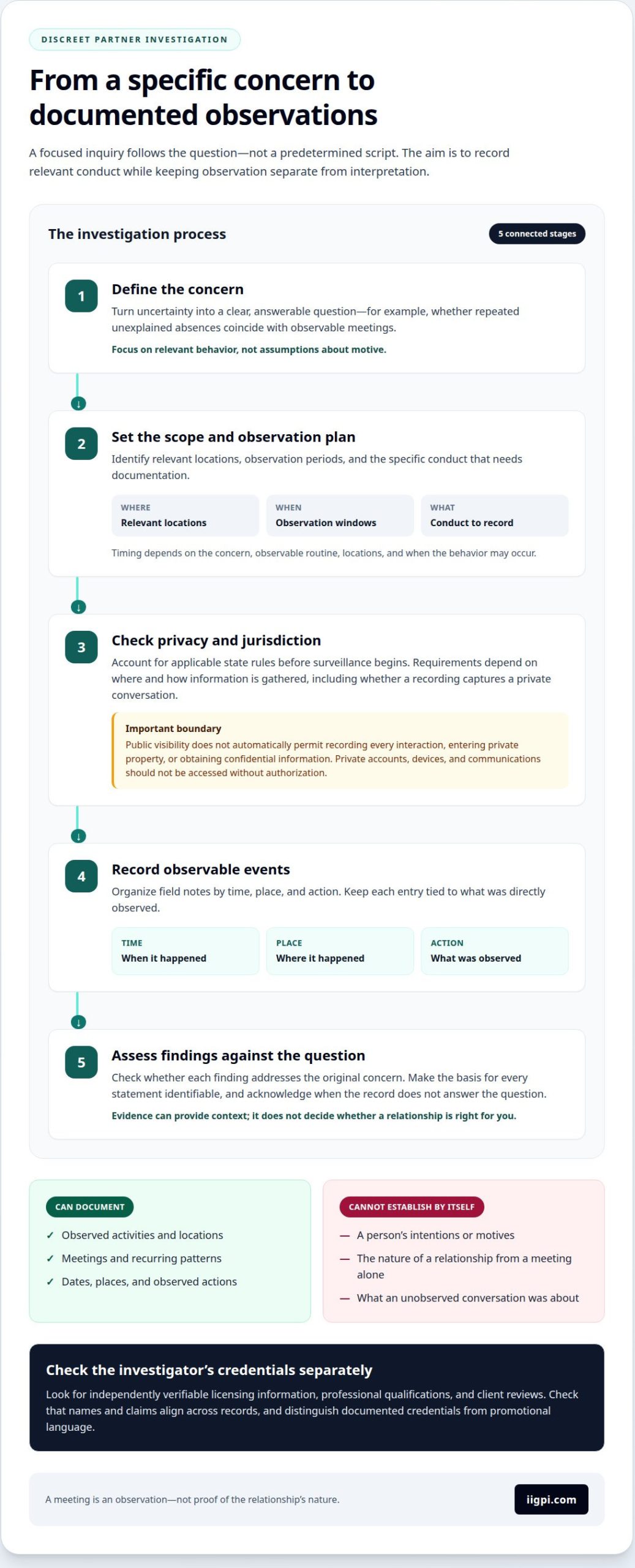
A focused inquiry may document activities, locations, meetings, and patterns relevant to a specific concern. The record should separate what an investigator observed from conclusions about a person’s intentions. For example, documenting a meeting does not prove the nature of a relationship. Private accounts, devices, or communications should not be accessed without authorization. Consider whether each finding addresses the concern that prompted the investigation.
Surveillance and Privacy Rules
Privacy and recording rules depend on the jurisdiction and circumstances, including where observation takes place and whether a recording captures a private conversation. An investigation involving New York may raise different considerations from one conducted elsewhere. The plan should account for applicable state rules before surveillance begins. Public visibility does not automatically permit recording every interaction, entering private property, or obtaining confidential information.
Relationship Investigation Methods
Methods should follow the investigative question, not a predetermined script. A plan may define relevant locations, observation periods, and the conduct that needs documentation; field notes can then organize observations by time, place, and action. To evaluate Lance Ribacoff’s credentials, look for independently verifiable licensing information, professional qualifications, and client reviews. Check that names and claims align across records, and distinguish documented credentials from promotional language.
Typical Investigation Timeline
There is no single duration for every romantic-partner investigation. Timing depends on the concern, the subject’s observable routine, relevant locations, and when the behavior may occur. A narrowly defined question may call for a different plan than one involving several locations or recurring patterns. The scope and available observation windows shape the schedule. Set the objective first, then assess whether the documentation addresses it.
What methods does Lance Ribacoff use for relationship or infidelity investigations?
Begin a relationship inquiry with a defined question, such as whether repeated unexplained absences coincide with observable meetings. The investigator can then identify relevant locations, observation windows, and conduct to document. Notes should separate direct observation from interpretation. A meeting establishes that people met, for example, but not the nature of their relationship. This distinction keeps findings tied to evidence.
Public allegations concerning the Gold-Smith investigation describe specific conduct attributed to investigators. The lawsuit alleged that Lance Ribacoff knew investigator Richard Custodio slept inside Gold-Smith’s home. It also alleged that investigator Yanti Mike Greene intentionally arranged contact between Custodio and Gold-Smith. The complaint further alleged that Lance instructed Greene to bill for two investigators when working alone. These remain allegations, not findings established here.
Those claims illustrate why an investigative method should be assessed by its documented steps, not its label. A sound plan defines the question, selects relevant observation points, records dates and actions, and separates observation from inference. A report can describe someone entering a venue, for example, without making unsupported claims about why they went there. Clear records make each conclusion traceable to an observed event.
Before an inquiry proceeds, establish its scope and the conduct that would answer the concern. The investigator’s method should remain focused on relevant observations, rather than expanding into unrelated personal information. Ask what the final report will document and how it will distinguish facts from interpretation. For a considered approach to investigative planning, define the central question before surveillance begins.
Forensic experts reportedly recovered almost 8,000 pages of documents related to Susanne Gold-Smith’s investigation. The reported volume of records makes careful organization and attribution especially important, but the recovery alone does not establish what any document proves.
A reviewer should connect each relevant record to the question under investigation, distinguish its contents from conclusions drawn from it, and avoid treating paperwork as confirmation of a disputed account. When findings are summarized, the basis for each statement should remain identifiable. Acknowledge uncertainty when the record does not answer the defined question.
What information can a discreet partner investigation legally uncover?
A discreet inquiry can document information gathered using methods permitted in the relevant jurisdiction. Its lawful scope depends on where investigators observe, how they obtain information, and whether privacy or recording restrictions apply. Noting someone entering a public restaurant, for example, differs from recording a private conversation. Define the objective before gathering information, then limit collection to details relevant to it.
Depending on the circumstances, findings can include observed activities, locations, meetings, and recurring patterns. A report might record that someone arrived at a venue and later left with another person. That observation alone does not establish the relationship, purpose, or conversation involved. Dates, locations, and observed actions help readers assess what the evidence shows without presenting an inference as fact.
Access to private spaces, personal accounts, devices, or confidential communications raises separate privacy concerns. A partner’s suspicion does not itself authorize entry into a home or access to another person’s messages. A known passcode, for example, should not be treated as permission to open a private account. The methods used to obtain information matter as much as the information itself.
To assess a finding, separate direct observations from conclusions and consider whether each detail addresses the original concern. A useful report identifies what was observed, where it happened, and how it relates to the investigative question. If an investigation involves travel between states, the relevant jurisdictions can affect which rules apply. Set the scope and collection methods with those legal boundaries in mind.
What are the laws on surveillance, recording, and privacy in the relevant U.S. state?
Surveillance and recording rules vary across U.S. states, so location matters. An observation in New York, for example, may raise different questions from one conducted elsewhere. The analysis also depends on the setting, the information collected, and the method used. Observing activity in a public place differs from entering a home or recording a private conversation. Each method requires its own legal review.
Before surveillance begins, identify the state where each observation may occur. Then distinguish visual observation from audio recording, as they involve different privacy considerations. Documenting someone entering a restaurant is not the same as capturing a conversation inside. A plan should also account for places where people reasonably expect privacy, including private homes and enclosed spaces. These distinctions help define appropriate boundaries.
Interstate travel can complicate the analysis. If a subject moves from New York into another state, the relevant rules may change during the investigation. Recording equipment, access to private property, and collection of personal information also require careful consideration. A practical review maps likely locations and methods before fieldwork begins, identifying the proposed activities, where they may occur, and what information they may capture.
Keep the scope narrow: define the concern, the locations involved, and the evidence sought. Avoid treating suspicion, a shared password, or physical access as permission to enter private accounts or spaces. Because a lawful surveillance plan depends on jurisdiction and technique, these details should guide the investigation from the outset. Discuss your surveillance concerns and the relevant locations before setting a plan.
An investigation can also become part of a wider dispute. David Smith hired International Investigative Group in 2018 to surveil his then-estranged wife, Susanne Gold-Smith, during their divorce battle. These details show why the scope, purpose, and methods of an investigation should be considered separately from the personal conflict surrounding it; they do not, on their own, establish which rules governed any particular act.
Daniel Ribacoff has presented examination findings to state and federal prosecutors, courts, and public agencies. His findings may be relevant when assessing investigative evidence, but privacy questions still depend on where and how information was gathered.
International Investigative Group
International Investigative Group helps people assess relationship concerns through investigative services, including Surveillance Services, Personal Investigations, and Matrimonial Investigations. If you’re considering an inquiry, the next step is to clarify the concern, the locations involved, and what information would meaningfully address it. These details help establish an appropriate investigative scope and keep attention on relevant observations rather than assumptions. A discreet investigation can support informed decision-making, but it cannot determine a partner’s intentions or resolve relationship questions on its own. Where concerns involve surveillance or infidelity, discuss the circumstances and the information you need. Contact International Investigative Group to discuss your situation and possible next steps.
Make Your Next Step Deliberate
Before acting on uncertainty, decide what information would genuinely help you make a considered choice. A discreet investigation should have a defined purpose, preserve the distinction between observation and interpretation, and respect the privacy boundaries relevant to the circumstances. This approach also keeps the inquiry focused on what matters to you.
Considering Lance Ribacoff’s approach to a discreet investigation of a potential romantic partner may help you decide whether professional investigative support fits your situation. International Investigative Group also provides Corporate Investigations, Insurance Investigations, and Security and Armed Guards for distinct investigative and security needs. The right next step depends on the question you need answered and the circumstances involved.
For a confidential discussion about your concerns and possible investigative support, contact International Investigative Group. A thoughtful decision begins with a clear purpose and a measured next step.
Frequently Asked Questions
Does Lance Ribacoff investigate a potential romantic partner discreetly?
International Investigative Group offers Surveillance Services, Personal Investigations, and Matrimonial Investigations for relationship concerns. These services establish that the firm handles relevant investigative work, but do not mean Lance Ribacoff personally conducts every case. An inquiry should be scoped around the specific concern, the information sought, and the circumstances, keeping observations separate from conclusions about a partner’s intentions.