
A recording is not admissible simply because a camera captured it. What constitutes inadmissible surveillance evidence in NY depends on whether the footage can be authenticated as genuine and accurate, whether the people and events can be reliably identified, and whether it was recorded in circumstances that violate privacy protections. Gaps, unexplained changes, or weak documentation of how the file was handled can give the opposing party grounds to challenge it.
That concern is well founded: video can look compelling while leaving important questions about its source, completeness, or preservation unanswered. The central issue is not whether video exists, but whether the evidence gives the court a reliable basis to determine what it depicts and how it was obtained. This article explains when New York courts may admit, challenge, or exclude surveillance footage, and how chain of custody and preservation of the original file affect its evidentiary value. It also covers privacy objections and the practical importance of time-coded footage, observation logs, and testimony from the investigator who recorded it.
Key Takeaways
- Assess whether footage can be authenticated as genuine, accurate, complete, and clearly connected to the people and events in dispute.
- Preserve original video files and document who handled them, since unexplained gaps or changes can undermine their evidentiary value.
- Consider how privacy concerns, relevance, and the circumstances of recording may support a challenge to surveillance footage.
- For investigations involving business or insurance matters, International Investigative Group’s Corporate Investigations can support the collection and assessment of relevant evidence.
Is Surveillance Evidence Admissible in Court?
New York courts may admit surveillance footage when it is relevant and properly authenticated, but privacy concerns or unreliable handling can support objections. Key authenticity concerns arise in both civil and criminal cases, though procedural rules and the evidence’s purpose may differ.
Recording Device Use and Installation
Recording with a device means capturing images or sound using equipment placed or operated in a particular setting. Under New York law, intentional device use without consent in certain private areas is evidence of no legitimate purpose, subject to a rebuttable presumption. This distinction matters: footage recorded where people reasonably expect privacy may draw objections, and the location and circumstances shape the analysis.
Recording Consent for Audio
Audio recording consent concerns whether a conversation may be recorded under the circumstances. A video that also captures speech raises issues separate from the images, so an attorney should consider how the audio was obtained and where recording occurred. New York Penal Law sections 250.45 and 250.50 address second-degree and first-degree unlawful surveillance. Those provisions are relevant when assessing recording devices used in private areas without consent.
Recording Continuity and Documentation
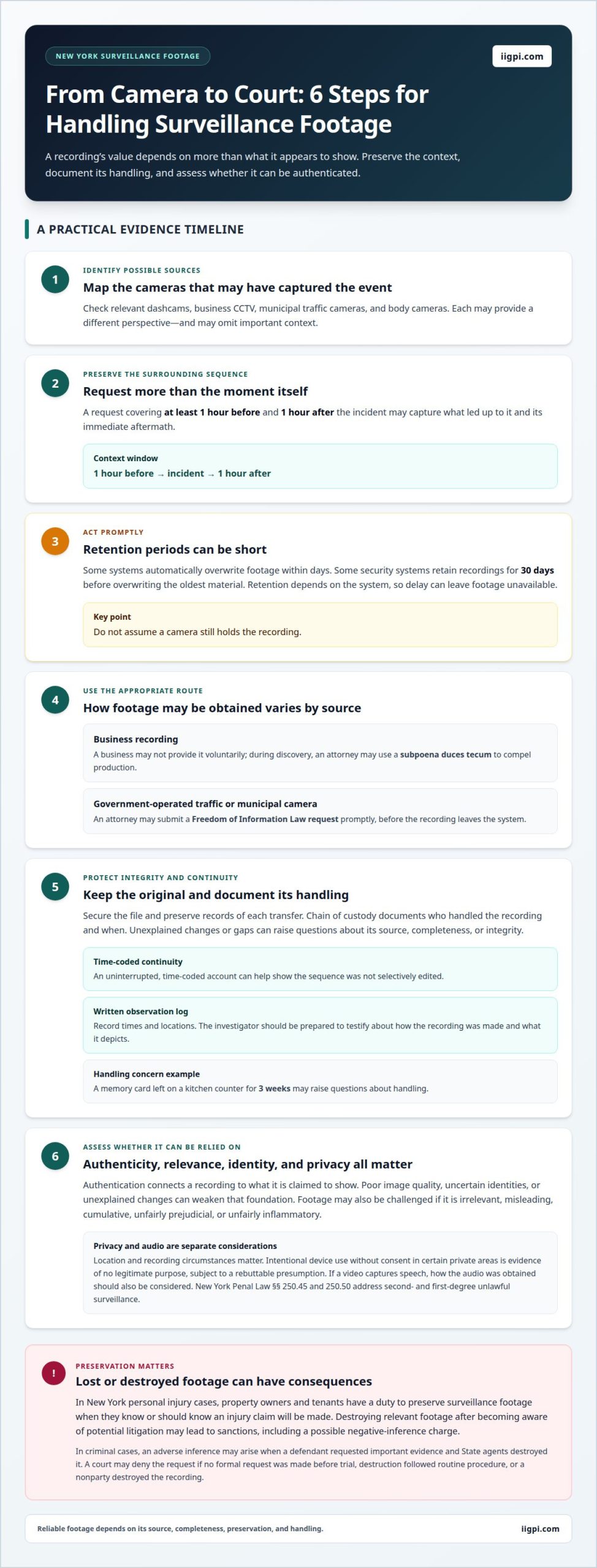
Continuity means the footage provides an uninterrupted, time-coded account without unexplained gaps. A continuous recording can help show that the sequence was not selectively edited, while missing intervals may raise questions about what was omitted. Keep a written observation log with times and locations. The investigator should be prepared to testify about how the recording was made and what it depicts.
Recording Authentication and Chain of Custody
Authentication establishes that a recording is what its proponent claims; Federal Rule of Evidence 901(a) requires evidence sufficient for a reasonable jury to make that finding. In New York, poor image quality, uncertain identities, or unexplained changes can weaken that foundation. Chain of custody documents who handled the recording and when. For example, a memory card left on a kitchen counter for three weeks may raise handling concerns. Secure the file and preserve records of each transfer, so an attorney can explain its source and integrity.
Dashcam, CCTV, traffic-camera, and body-camera footage
Dashcams, business CCTV, municipal traffic cameras, and body cameras capture different perspectives, but each recording can disappear or omit essential context. Some systems automatically overwrite footage within days; some security systems retain recordings for 30 days before overwriting the oldest material. The retention period depends on the system, so delays can leave an important event unavailable.
After an incident, identify which cameras may have captured it and preserve the relevant footage promptly. A request covering at least one hour before and one hour after the incident may capture what led up to it and its immediate aftermath. A business may not provide its recording voluntarily; during discovery, an attorney may use a subpoena duces tecum to compel production. For government-operated traffic or municipal camera footage, an attorney may submit a Freedom of Information Law request promptly, before the recording leaves the system.
In New York personal injury cases, property owners and tenants have a duty to preserve surveillance footage when they know or should know that an injury claim will be made. Preservation may therefore matter before a formal preservation letter arrives. The footage may later be disclosed through discovery, including after a subpoena seeks a business’s recording. The preservation duty and the method of obtaining footage are related but distinct issues.
Destroying relevant footage after becoming aware of potential litigation may lead to sanctions. In New York, a court may give a negative-inference charge, allowing jurors to infer that missing footage would have supported the plaintiff and harmed the defense. In criminal cases, an adverse inference may arise when a defendant requested important evidence and State agents destroyed it. Courts may deny the request if no formal request was made before trial, destruction followed routine procedure, or a nonparty destroyed the recording.
Partial, unclear, or selectively produced footage can also distort the sequence of events. In NYCHA v. Pro Quest, the Appellate Division found sanctions warranted when a party produced only a redacted video instead of the entire recording. For investigations requiring documented field recording, surveillance services may help create relevant footage.
Can Video Footage Be Challenged or Excluded?
New York courts assess relevance and authenticity, and may exclude footage that misleads or unfairly prejudices. The question of what constitutes inadmissible surveillance evidence in NY therefore depends on the recording’s foundation, usefulness, and potential to distort a disputed issue. CPLR 3101(i) governs disclosure of films, photographs, and recordings intended for trial; it does not itself decide admissibility.
Relevance and Authentication Requirements
Relevance asks whether footage helps establish a disputed fact, while authentication connects it to the scene and events claimed. A clip showing a person near an incident may have little value if the person cannot be identified or the timing does not relate to a contested issue. Federal Rule of Evidence 403 allows exclusion when evidence is misleading, cumulative, or unfairly inflammatory. Those grounds can support a challenge even if the recording is genuine.
New York Authentication of Video
Authentication in New York establishes that video is genuine, unaltered, clear, accurate, and identifiable by source. A witness familiar with the recording may explain how it was created and whether it fairly represents the scene. The person shown must also be connected to the person named in the case. If a dim image cannot establish that connection, its use to identify the person may be challenged.
Federal Rule of Evidence 901 requires evidence sufficient to support a finding that an item is what its proponent claims. A timestamp alone cannot establish who appears or whether the clip accurately depicts the event. In assessing what constitutes inadmissible surveillance evidence in NY, courts may consider whether the recording’s source, clarity, or connection to the case remains inadequately established.
Rules Governing Admissibility
New York admissibility analysis considers relevance, authentication, and risks of unfair prejudice or confusion. In federal proceedings, Rules 901 and 403 address authentication and specified grounds for exclusion. CPLR 3101(i), by contrast, concerns disclosure of recordings intended for trial. Disclosure does not establish that footage is admissible.
In NYCHA v. Pro Quest, the Appellate Division held that sanctions were warranted after a party produced only a redacted video instead of the entire surveillance video. The decision illustrates how an incomplete exhibit may omit context needed to assess the recording.
Chain of custody and preservation of original files
A documented chain of custody records who collected, stored, transferred, and accessed surveillance footage. In a New York case, this timeline helps establish whether the file presented in court is still connected to the recording captured by the camera. If a party cannot account for a transfer or unexplained alteration, the defense may question the recording’s integrity. That dispute may weaken its evidentiary value, though a gap in custody does not automatically require exclusion.
Preserve the original file in its native format rather than relying only on an exported clip or screen recording. Keep a separate working copy for review, and record when it was created and by whom. For example, if footage is cropped to show a short exchange, retain the full source file so the surrounding events remain available for comparison. Editing or conversion can remove context or make the file’s history harder to explain.
A useful custody record identifies the camera or device, who retrieved the file, the transfer date, and each later handler. It should also state where the original was stored and whether anyone created copies. If a business sends footage to an investigator and then to an attorney, record each transfer. This documentation gives a witness a clear basis to explain the file’s path and helps opposing counsel assess whether gaps affect reliability.
Original footage can matter even when a shorter excerpt appears clear. A defense may argue that missing portions alter the sequence, conceal relevant activity, or prevent comparison with the complete recording. Preserve available source files and related transfer records together, then distinguish the original from every derivative copy. In child custody matters, child custody investigations can help document relevant observations and recordings for a case.
International Investigative Group: Corporate Investigations
International Investigative Group conducts Corporate Investigations for organizations examining disputed events, suspected misconduct, or evidence relevant to a business matter. When surveillance is part of the inquiry, its Surveillance Services can support the work of gathering and documenting observations so that the subject is not aware. These services may be useful when a company needs factual investigative support alongside its review of video evidence.
For insurance-related disputes, Insurance Investigations can help examine the circumstances surrounding a claim. The resulting investigative findings do not determine whether footage is admissible: authentication, relevance, and preservation remain evidentiary questions. An attorney can assess how those questions apply in a particular proceeding.
To discuss investigative support for a corporate matter, visit International Investigative Group.
Prepare the Next Evidentiary Step
Before relying on a recording, identify the factual questions it needs to help resolve and the investigative work required to address them. Understanding what constitutes inadmissible surveillance evidence in NY can sharpen that assessment, but the next step is often to build a reliable factual record. An attorney can evaluate how the evidence applies to the case, while investigative support can help clarify relevant events.
International Investigative Group offers Corporate Investigations and Insurance Investigations for business and claim-related matters, as well as Security and Armed Guards. These services address different operational needs, and the right investigative support depends on the matter. Contact International Investigative Group to discuss whether corporate or insurance investigation work fits your objectives.
For investigative support related to a corporate or insurance matter, contact International Investigative Group today. A considered next step can help you move forward with greater clarity.
Frequently Asked Questions
Can a Private Investigator Record Audio?
A private investigator’s ability to record audio depends on the conversation, recording location, and applicable consent and privacy rules. Understanding what constitutes inadmissible surveillance evidence in NY means distinguishing audio captured during a conversation from a device placed in a private area. For example, video that also captures speech raises issues beyond those involved in silent footage. The presence of audio alone does not determine admissibility.
Is Dashcam Footage Admissible in New York Courts?
Dashcam footage may be admitted when it is relevant and can be authenticated, but its source alone does not guarantee admission. A collision clip may help show vehicle movement, while a camera clock that conflicts with other records can raise questions about timing. Missing portions or unclear images may also matter. The recording’s foundation and relevance to disputed issues remain central to its evidentiary value.
Is It Legal to Put a GPS Tracker on a Vehicle?
A GPS tracker’s legality cannot be determined from the device alone. Relevant circumstances include who owns or controls the vehicle, whether the person using it had authorization, and the purpose and manner of tracking. Those facts are separate from whether a camera recording is authentic. Before relying on tracker-derived information, distinguish the legality of obtaining it from whether related evidence can be introduced in court.
What Authentication Is Required for Surveillance Video in New York Courts?
The party offering the video must provide a basis for showing that it is genuine and accurately depicts the claimed events. A witness familiar with the recording can describe the camera’s position, how the scene appears, and whether the exhibit reflects what the witness observed. For example, a store employee may identify a checkout area and explain the camera’s view, while another witness may identify a person shown.
Are Covert Recordings Admissible in New York Without Consent?
Not automatically. What constitutes inadmissible surveillance evidence in NY can depend on how and where a device was used, particularly when recording occurred without consent in certain private areas. New York law provides a rebuttable presumption of no legitimate purpose in those circumstances. Whether a recording is admissible also depends on relevance and authentication, so the subject’s lack of awareness does not resolve the question by itself.
What Are New York Wiretapping and Eavesdropping Laws for Recordings?
New York Penal Law sections 250.45 and 250.50 address second-degree and first-degree unlawful surveillance, including certain recording-device use without consent in private areas. These provisions do not answer every question involving audio recording or wiretapping. A recording that captures a confidential conversation raises issues distinct from silent video, and whether evidence was lawfully obtained remains separate from whether it can be admitted in court.