
Three staged highway crashes in New York City were linked to a scheme involving recruited passengers and borrowed vehicles, with insurance payouts as the objective. A staged auto accident investigation in Queens traced crashes between August 24 and October 16, 2024, including incidents on the Belt Parkway and Nassau Expressway. After a nearly two-year investigation, two men were sentenced in Queens.
A crash may look like an ordinary traffic incident, even when the circumstances suggest deliberate coordination. This article explains how participants arranged collisions, what investigators uncovered in a New York case, and why a Belt Parkway incident is relevant to Queens. It also shows how patterns in crash locations and participants helped reveal the alleged scheme.
Key Takeaways
- See how investigators connect separate highway collisions by examining recurring participants, vehicles, locations, and claim patterns.
- Understand the alleged use of recruited passengers and borrowed vehicles, and how those arrangements could support false insurance claims.
- Learn why Belt Parkway incidents near Queens matter to the wider New York City case and its investigation.
- Recognize what details can help distinguish a suspicious crash from an ordinary collision and inform a careful report of concerns.
Investigation of staged highway crashes in New York City
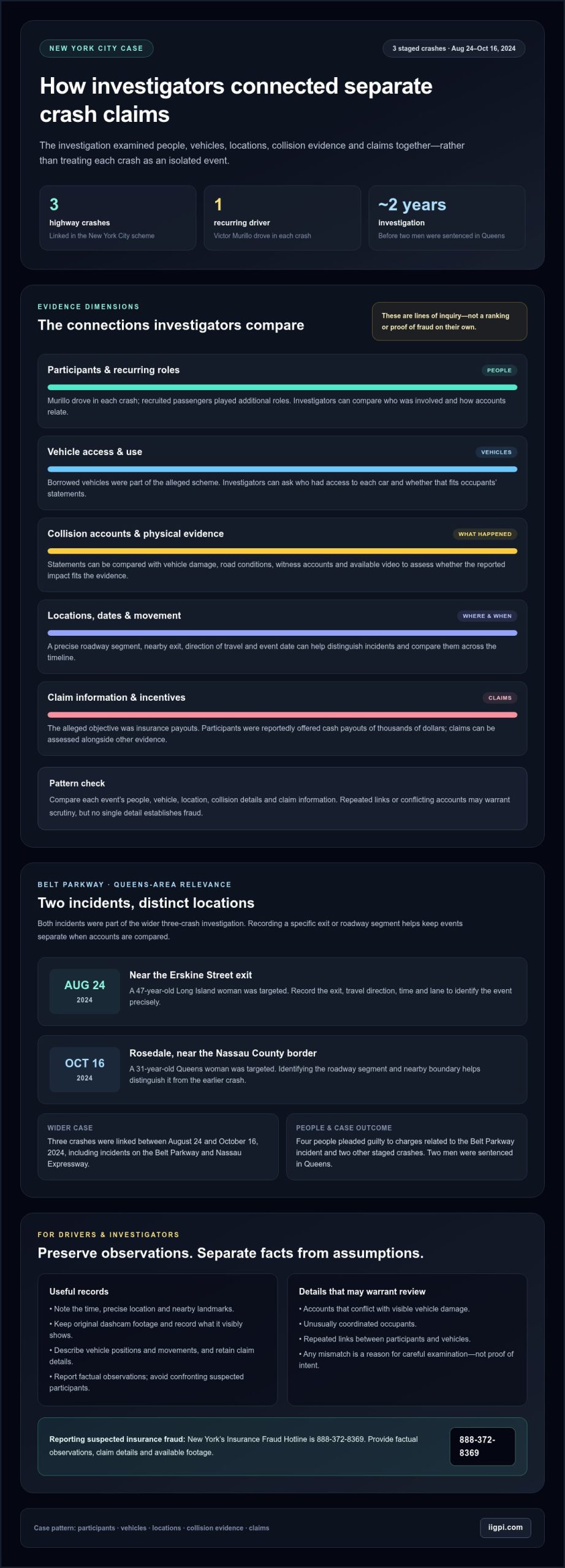
Investigators connected three staged highway crashes in New York City between August 24 and October 16, 2024. Jaime Huiracocha and Victor Murillo conspired in the scheme, which took nearly two years to investigate. Murillo was sentenced in Queens to two years in prison on charges involving a staged motor vehicle accident and insurance fraud. A staged auto accident investigation in Queens examines how separate collisions, people, and claims may connect.
The alleged scheme involved recruited participants and borrowed vehicles. Participants were offered cash payouts of thousands of dollars, while passengers helped make the collisions appear routine. Murillo drove in each crash. Investigators can assess whether accounts of the collisions, vehicle use, and relationships among participants fit the reported events. Repeated roles or connections may warrant scrutiny, but no single detail establishes fraud.
Crash victims can preserve useful evidence by recording what they observed, noting the time and location, and keeping dashcam footage. Footage may help establish vehicle positions and movements, while a victim’s account can provide context. Drivers should avoid confronting suspected participants.
How can drivers report a suspected staged accident in Queens? Report suspected insurance fraud to New York’s Insurance Fraud Hotline at 888-372-8369, and provide factual observations, claim details, and available footage. For common warning signs, look for accounts that conflict with visible damage, unusually coordinated occupants, or repeated links between participants and vehicles. These details justify careful reporting, not a conclusion of guilt.
How do New York insurers investigate suspected staged accident claims? Insurers compare statements with damage evidence, available video, and claim information to assess whether the reported collision is consistent with the evidence. In the New York scheme, links among recruited participants, borrowed vehicles, and three crashes helped investigators examine the claims as a pattern rather than as isolated incidents.
How the conspirators staged collisions
The New York scheme depended on coordination, not one unexplained impact. Its reported elements included borrowed vehicles, recruited participants, and an objective of obtaining insurance payouts. Victor Murillo drove in each staged crash, while recruited passengers played additional roles. Investigators could examine the driver, passengers, source of each vehicle, and resulting claims as separate but connected lines of inquiry.
Recruitment created a financial incentive: participants were offered cash payouts of thousands of dollars. Investigators can compare what participants reportedly expected with their actions and statements after a collision. A case timeline can record who arranged a vehicle, who occupied it, where the crash occurred, and how each person described events. In this New York scheme, this approach helped frame separate incidents as a connected pattern.
The facts describe staged collisions pursued for insurance payouts, but do not establish that the same maneuver was used in every crash. Investigators instead assess whether the reported impact fits the vehicle damage, road conditions, and witness accounts. For example, a mismatch between a driver’s account and visible damage may warrant further examination, but does not independently prove intent. Comparing accounts across related events can reveal contradictions or recurring details for follow-up.
Borrowed vehicles raise a separate question: who had access to each car, and does that account fit the occupants’ statements? In the scheme, investigators examined three crashes involving the same driver and recruited participants. They can organize evidence by event, then compare people, vehicles, locations, and claim information across the timeline. This clarifies each person’s possible role without treating every passenger or collision participant as culpable. It also separates observed facts from assumptions, an essential discipline when assessing suspected insurance fraud.
Queens-area relevance and a Belt Parkway incident
The Belt Parkway’s relevance to Queens is concrete: two crashes in the scheme occurred on that roadway, at separate locations and dates. The first happened August 24, 2024, near the Erskine Street exit. A 47-year-old Long Island woman was targeted. Recording the exit, travel direction, time, and lane helps distinguish this collision from another event on the parkway.
The later incident occurred October 16, 2024, in Rosedale, near the Nassau County border. A 31-year-old Queens woman was targeted. Scene records should identify the roadway segment and nearby boundary, rather than describing the location only as the Belt Parkway. Such precision helps investigators compare accounts without confusing the two incidents.
The cases also crossed neighborhood lines through the people involved. A Long Island resident was targeted in the August crash, while the October incident involved a Queens resident. A 28-year-old Brooklyn resident was later apprehended and charged with insurance fraud connected to the Belt Parkway incident. These details show why investigators examine location, participants, and claims together.
Four people pleaded guilty to charges related to the Belt Parkway incident and two other staged crashes. This outcome connects the roadway incident to a broader scheme rather than treating it as an isolated collision. For an investigation, a useful chronology records each crash by date and location, then compares its participants and evidence with those in the other incidents.
For drivers, the practical lesson is to preserve details that pinpoint a crash location. Note nearby exits and landmarks, your direction of travel, and the sequence of vehicle movements. Keep original dashcam footage and separate what it visibly shows from what you infer. In a Queens-area staged auto accident investigation, accurate location records can help connect relevant events while keeping separate incidents distinct.
Which Queens police precinct or agency investigates suspected staged crashes?
Start with the collision location: provide the responding police with the roadway, nearest exit or cross street, travel direction, and crash details. Those facts identify where the incident occurred and help distinguish a Belt Parkway collision in Rosedale from one near another Queens-area exit. For suspected insurance fraud, New York’s Insurance Fraud Hotline is 888-372-8369. Give the hotline factual observations, not conclusions about a driver’s intent.
The hotline is a specific channel for reporting suspected insurance fraud; it does not replace documenting the collision. Preserve photographs, dashcam recordings, witness details, and claim correspondence. For example, a driver who saw a vehicle change lanes before impact can record the sequence and precise location. Keeping original files and separating direct observations from assumptions makes a report more useful.
New York’s response also involves coordination across agencies. In July, the New York State Department of Financial Services partnered with New York State Police to provide specialized training to hundreds of law enforcement partners. New York is expanding its efforts through a cross-agency task force and a rebuilt insurance fraud bureau. These initiatives address fraud investigations broadly, while a specific crash still requires evidence tied to its location and participants.
For a Queens incident, use the crash location and available evidence to guide the initial report, then use the statewide fraud hotline if insurance fraud is suspected. Include the date, roadway segment, vehicles involved, witness contacts, and relevant claim information. Do not confront suspected participants or try to investigate them yourself. Describe what happened, identify supporting records, and leave conclusions about criminal conduct to investigators.
Keep a copy of the report details and organize supporting files by event. If multiple collisions appear connected, record each date and location separately before describing the suspected links. This helps distinguish firsthand evidence from information learned later. The New York agency partnership and fraud bureau provide statewide investigative context, but the location and documented facts remain central when reporting a Queens-area crash.
International Investigative Group: Corporate Investigations
International Investigative Group conducts Corporate Investigations for organizations assessing suspected staged collisions, claim irregularities, or related business concerns. When an insurer or company needs an independent review of records, accounts, and connected events, its Insurance Investigations can support a structured examination of the available evidence.
The investigation can help organize timelines, compare documented statements, and identify relationships among incidents for further review. It is separate from reporting suspected fraud to public authorities, the appropriate route for an official investigation. The next step depends on whether the concern involves an organizational inquiry, an insurance claim, or both.
To discuss an investigative matter, contact International Investigative Group.
Make the Next Step Evidence-Led
A staged auto accident investigation in Queens should distinguish documented observations from assumptions and focus on the specific questions an organization needs answered. When a suspected scheme affects an insurance claim or business operations, an independent investigation can help organize the matter for further consideration. Public agencies handle official law enforcement investigations; private investigations serve a different purpose.
International Investigative Group offers Corporate Investigations and Insurance Investigations for organizations examining concerns related to claims or business activity. Security and Armed Guards are a separate service for security needs, not a substitute for investigating a suspected collision. The right next step depends on the issue and the investigative support needed.
To discuss an organizational or insurance investigation, contact International Investigative Group. A clear, evidence-led approach can help you move forward with greater focus.
Frequently Asked Questions
How are staged auto accidents investigated in Queens, NY?
Investigators build a timeline and assess whether separate records support the reported sequence. They compare claim documents, collision accounts, vehicle damage, and available footage, then look for inconsistencies or connections among events. For example, a repair record describing damage in a different area from the reported impact could prompt further review. Each discrepancy needs context; one conflicting detail alone does not establish deliberate fraud.
What evidence should be collected after a suspected staged auto accident?
Preserve materials documenting the collision and resulting losses. Keep original dashcam files, scene photographs, repair estimates, towing receipts, medical records, and claim correspondence. While your memory is clear, write down what you personally observed, including the sequence of events and vehicle movements. Label files by date and source, and do not edit video or add assumptions to written notes.
What penalties apply to staged accident fraud in New York?
Sentences depend on the charges and case facts. In the Queens scheme, Victor Murillo received two years in prison on charges of staging a motor vehicle accident and fourth-degree insurance fraud. Jaime Huiracocha was sentenced to one to three years for third-degree insurance fraud, plus one year for fifth-degree conspiracy, served concurrently. Murillo also received a concurrent one-year sentence for fifth-degree conspiracy. These sentences do not establish a general penalty range.
Can victims recover damages after a staged accident in New York?
Victims can submit a claim for documented losses, including vehicle repairs and related expenses, to the relevant insurer. For those facing injuries or complicated legal questions after an incident, guidance from a firm like Yakov Mushiyev & Associates, P.C. can assist in protecting their rights. Organize invoices, estimates, photographs, and records showing how the collision affected you; clear documentation helps substantiate the amount claimed. The insurer assesses the evidence and applicable coverage. Keep copies of submitted materials and record claim communications to maintain a complete supporting file.