
A startup’s pitch deck may outline its ambition, but investigative due diligence for startup investors in NYC can influence how an opportunity is valued and structured. Findings about founders, business partners, reputation, or operational risks may lead an investor to renegotiate terms, stage funding, or reconsider the deal. The right depth of review depends on the investment’s size and stage.
Financial projections and growth potential matter, but they need context about the people and business relationships behind them. An investigation can test key claims and identify concerns that may affect how an investor assesses risk and return.
This article explains how investigative due diligence can inform valuation and deal terms, what a review may cover, and how its scope changes across investment stages. It also describes when a New York City investor may benefit from a professional investigation, helping you assess the available evidence and its implications.
Key Takeaways
- Use investigative findings to test startup claims and identify risks that may affect valuation, funding structure, or deal terms.
- Match the scope of a review to the investment type, size, industry exposure, and geographic reach rather than relying on a one-size-fits-all checklist.
- Assess founders’ and business partners’ records, references, and past working relationships to understand reliability and potential reputational concerns.
- Adjust diligence to the funding stage, and include workforce documentation such as I-9 records in employment diligence.
What Is Due Diligence in Startup Investments?
Startup investment due diligence tests a company’s claims, leadership, and operating records. Findings help investors assess capabilities, corporate integrity, regulatory exposure, and confidence in the founders’ representations. In NYC, investigative due diligence for startup investors can independently examine fundraising records and business relationships.
Start with the founders and executives whose decisions shape the investment. Verify identity, education, employment history, and stated credentials against reliable records and direct institutional sources. Review relevant criminal, civil, regulatory, and professional records, then consider whether each finding relates to the person’s role. A dispute involving a former employer, for example, may matter differently from an unrelated allegation. References can offer insight into performance and reliability, while online statements may surface inconsistencies that need context.
Financial and corporate checks add another layer. Review prior financing records, ownership representations, company roles, and public reporting for inconsistencies. The U.S. Securities and Exchange Commission identifies Regulation D as an exemption framework relevant to prior U.S. funding rounds. Employment diligence should include reviewing I-9 documentation for the workforce, according to U.S. Citizenship and Immigration Services. For a health-tech startup, HIPAA may also shape the regulatory questions investors examine, according to the U.S. Department of Health and Human Services.
NYC investigations can vary in scope. Some focus on records and identity checks; others include interviews, reference work, corporate inquiries, and reputational research. Compare proposed work by whether it addresses the specific people, claims, and risks that matter to the deal.
Applicable New York and federal privacy requirements depend on the information sought, how it is collected, and its intended use. Keep inquiries focused on investment-relevant facts and protect sensitive records.
A practical sequence is to define the questions, verify records, interview references, and assess material findings. For a well-prepared startup, due diligence may take a few weeks.
Investment due diligence for acquisitions, venture capital, real estate, and hedge funds
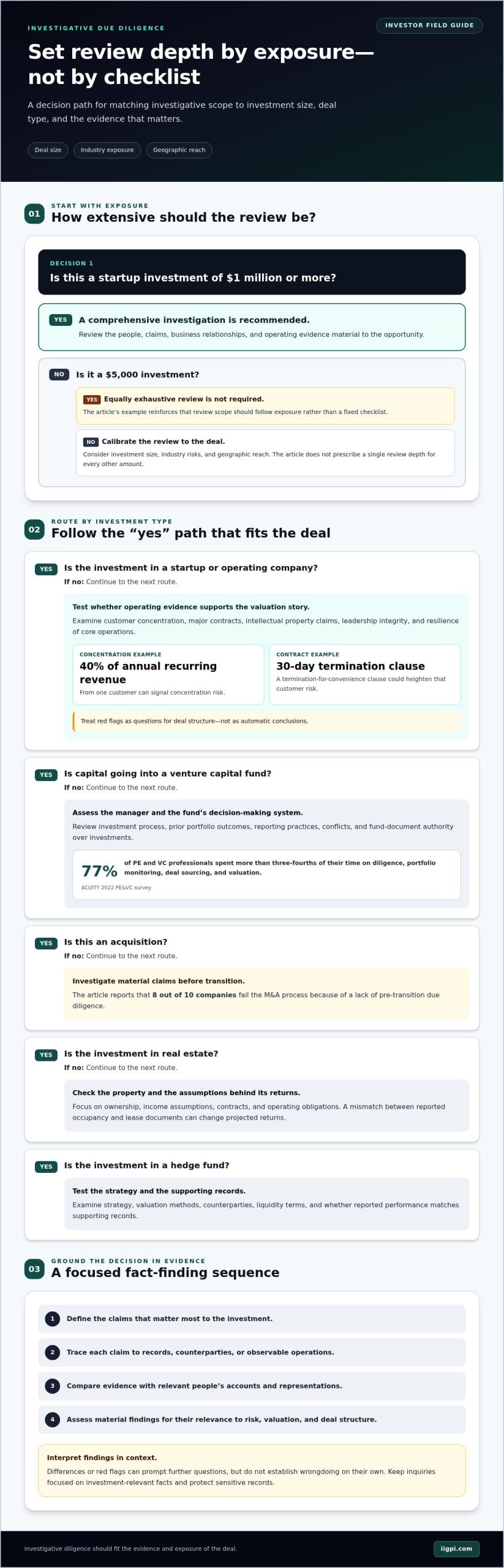
Due diligence varies with the asset, investment structure, and potential exposure. Match investigative depth to the deal size, industry risks, and geographic reach.
Venture Capital and Startup Investment Diligence
For venture capital and startup investments, examine whether operating evidence supports the valuation story. Review customer concentration, major contracts, intellectual property claims, leadership integrity, and the resilience of core operations. For example, a company relying on one customer for 40% of annual recurring revenue faces concentration risk; a 30-day termination-for-convenience clause in that customer’s contract could heighten it. Treat red flags as questions for deal structure, not as automatic conclusions.
Venture Capital Fund Diligence
Fund diligence shifts attention from a startup to the venture capital manager and the vehicle receiving capital. Assess the manager’s investment process, prior portfolio outcomes, reporting practices, conflicts, and how fund documents describe authority over investments. ACUITY’s 2022 PE&VC survey found 77% of PE and VC professionals spent more than three-fourths of their time on diligence, portfolio monitoring, deal sourcing, and valuation. That workload underscores the need to evaluate the fund’s decision-making system, not only its stated strategy.
For acquisitions, investigate material claims before transition. Eight out of ten companies fail the M&A process because of a lack of pre-transition due diligence. A comprehensive investigation is recommended for a startup investment of $1 million or more, while a $5,000 investment does not require equally exhaustive review. Both examples reflect the principle that scope should follow exposure, not a fixed checklist.
Real estate diligence centers on the property, ownership, income assumptions, contracts, and operating obligations. A mismatch between reported occupancy and lease documents, for example, can change projected returns. Hedge fund diligence instead examines strategy, valuation methods, counterparties, liquidity terms, and whether reported performance matches supporting records. Each investment calls for evidence tailored to its specific risks.
Before committing capital, define the claims that matter most, then trace each to records, counterparties, or observable operations. A focused due diligence investigation can support that fact-finding process when independent examination is needed.
Previous business partners’ and investors’ experiences
A founder’s history with former business partners can show how responsibilities, equity, and disagreements were handled. Map significant relationships, then speak with former co-founders, investors, suppliers, or senior colleagues. Ask for specific examples: who made key decisions, whether commitments were met, and how disputes were resolved. Compare those accounts with the founder’s explanation and available company records. Differences can prompt further questions, but do not establish wrongdoing on their own.
Choose references for their relevance, not just their availability. A former investor may describe reporting practices and whether the company met agreed milestones; a former partner may explain how the founders handled pressure or divided responsibilities. Ask consistent questions tailored to each person’s role, record the source and context of each response, and distinguish firsthand experience from secondhand claims. This approach can reveal patterns that a polished presentation or brief reference statement may not.
A review of the business environment should connect the company’s relationships to potential liabilities. Examine material contracts, customer complaints, supplier disputes, unresolved obligations, and public records relevant to operations. For example, recurring product complaints may warrant comparing customer accounts with warranty records and management’s description of the issue. For a company selling regulated or safety-sensitive products, documented product concerns can inform questions about exposure and operational controls. The aim is to understand how an external claim could affect the company’s ability to operate.
Financial stability and forecasts also depend on the strength of business relationships. Compare projected revenue with customer contracts, renewal terms, payment history, and dependence on key partners. If a forecast assumes continued sales through one distributor, examine the agreement’s duration, termination provisions, and evidence of performance. Check whether investor updates, board materials, and management forecasts rely on consistent assumptions. These comparisons help assess whether expected growth supports the proposed valuation or depends on relationships that may change.
Record each finding’s source, review date, and relevance to the investment decision. Separate verified records from disputed accounts, then connect material issues to questions about equity, governance, or deal protections. A clear record helps investors discuss concerns precisely with founders and assess whether the proposed relationship can support the company’s next stage.
Differences in diligence by investment stage
Investment stage shapes both the questions investors ask and the evidence needed to answer them. Angel investors may conduct lighter diligence than institutional investors, but even a limited review needs a clear purpose. Start by identifying the decision: whether to invest, how to structure funding, or which risks need mitigation. Then tailor the process to the company’s maturity, the investor’s exposure, and the reliability of available records.
An early-stage startup may have limited operating history, so focus on founders’ backgrounds, ownership records, product claims, and the basis for customer interest. For example, compare a founder’s stated role in developing core technology with intellectual property records and the company’s account of ownership. As the company matures, assess a wider operating record, including revenue quality, customer retention, management practices, and consistency in board and investor reporting. More documentation allows more direct testing of forecasts and performance.
Conduct due diligence anew for each funding round, with closer scrutiny in later rounds. Earlier findings provide context, not a substitute for current review: leadership may change, new investors may affect governance, and commercial relationships may evolve. A later-round investor can trace changes since the previous financing, compare stated milestones with operating records, and investigate material inconsistencies. This helps distinguish a resolved issue from one that remains relevant to valuation or deal terms.
Geographic reach and industry exposure also shape the investigation. A startup entering global markets may require attention to overseas partners, business relationships, and corporate records across jurisdictions—particularly when expanding through European hubs like Amsterdam, where corporate service specialists like Intercompany Solutions assist cross-border ventures with entity formation. A technology company preparing to scale should consider what regulatory compliance infrastructure it will need over the next 18 months. Investors can prioritize inquiries by asking which people, assets, or assumptions could alter the investment decision, then document findings and their implications. This keeps background checks proportionate without treating every stage as identical.
For a stage-specific review of people and business relationships, request an investigative assessment before finalizing investment terms.
International Investigative Group: Corporate Investigations
International Investigative Group conducts Corporate Investigations for investors seeking independent fact-finding on a startup’s people, business relationships, or material claims. This work can clarify discrepancies that may affect deal discussions, such as conflicting accounts of a partnership or questions about reported business activity. Findings give investors context for their assessment; valuation and investment terms remain their decisions.
Consider an investigation when public records, reference accounts, or company materials raise questions that ordinary document review cannot resolve. A focused scope can identify relevant subjects and issues, then organize findings for consideration alongside financial, legal, and commercial analysis. This can be useful when a concern may affect confidence in a founder, partner, or key business claim.
For a discussion of corporate investigative needs, contact International Investigative Group or visit iigpi.com.
Make the Next Investment Decision with Greater Clarity
Turn unresolved questions into a focused investigative plan. Define which people, relationships, or business claims could materially affect your decision, then prioritize the evidence that may clarify them. This keeps the review tied to the investment decision rather than letting it become an unfocused search.
For investigative due diligence for startup investors in NYC, International Investigative Group conducts corporate inquiries when independent fact-finding is needed. Its related Corporate Investigations, Insurance Investigations, and Security and Armed Guards services address distinct investigative and security needs, rather than replacing financial or legal analysis.
Bring forward the central questions shaping your assessment, and discuss how an investigation can address them. Contact International Investigative Group to begin a focused conversation about your due diligence needs. A clearer evidentiary foundation can help you approach the next decision with discipline and confidence.
Frequently Asked Questions
How does due diligence affect valuation and deal terms?
Due diligence can change an investor’s view of a startup’s risk, growth assumptions, and proposed valuation. If findings raise material concerns, investors may renegotiate terms, reduce or stage funding, or withdraw from the deal. They may also seek warranties, indemnities, control provisions, or conditions precedent, such as completed filings or signed agreements, before releasing funds. The response depends on the issue’s materiality and whether it can be addressed.
What is investigative due diligence for startup investors?
Investigative due diligence independently examines people, relationships, records, and claims relevant to an investment decision. For investors seeking investigative due diligence for startup investors in NYC, this work can test information that a pitch deck or company records alone may not resolve. It complements financial, commercial, and legal review by organizing evidence about potential risks and identifying questions that may affect investment judgment.
What background checks should investors conduct on startup founders and key executives?
Match checks to each person’s role. They may cover identity, education, employment, relevant criminal and civil records, regulatory or professional discipline, and references. Review public online material for context, not as a substitute for corroboration. For example, if an executive claims experience in a regulated industry, compare that claim with employment records and relevant disciplinary information. Financial history may also matter when the role involves responsibility for company funds.
How can investors verify a startup’s financials, customers, revenue, and market claims?
Trace financial claims to source records, then compare them with customer agreements, invoices, payment evidence, and management reporting. Determine whether reported revenue reflects collected payments, recurring commitments, or forecasts, since these have different levels of certainty. Test customer and market claims against independently obtained information, and examine whether a small number of buyers account for an outsized share of sales. Reconcile conflicting assumptions before relying on projections in valuation discussions.
What legal, regulatory, litigation, and intellectual property risks should startup investors investigate?
Review prior funding documentation, equity arrangements, worker classification, material disputes, and evidence supporting intellectual property ownership. The U.S. Securities and Exchange Commission identifies Regulation D as relevant to prior U.S. funding rounds. Section 409A, the ABC test, and the IRS common-law test may inform startup review. For health technology, HIPAA is a consideration identified by the U.S. Department of Health and Human Services, alongside FDA software-as-a-medical-device guidance.
What are common red flags uncovered in startup investment due diligence?
Potential warning signs include contradictory founder histories, unexplained gaps in company records, undisclosed disputes, inconsistent revenue explanations, or undocumented claims of technology ownership. A sharp difference between a customer’s account and management’s description also merits follow-up. Treat each as a lead, not proof of misconduct: establish its source, seek corroborating evidence, and assess whether it could affect the investment decision or require revised terms.