
An allegation is a reason to examine the evidence, not proof of wrongdoing. A corporate employee theft investigation in NYC should start with a focused review of financial records, security footage, and access logs. Preserve relevant evidence, consult counsel, and conduct fair, non-accusatory interviews. Establish what the records support before deciding what action to take.
An inquiry can be difficult when discrepancies remain unexplained, records sit across multiple systems, or the business must consider employee rights alongside continuity. A disciplined process helps separate verifiable facts from assumptions and reduces the risk of overlooking or compromising relevant evidence.
This guide covers how to review transaction records and footage, preserve materials, document findings, work with counsel, conduct impartial interviews, and strengthen internal controls. It also explains when specialist investigative support can help assess suspected losses and gather evidence in a structured way.
Key Takeaways
- Compare sales, invoices, deposits, security footage, and access logs to identify patterns that warrant closer review.
- Consult counsel early to help structure the investigation and account for employee rights and relevant legal considerations.
- Preserve original records and document when evidence is collected, handled, and reviewed to maintain a clear evidentiary history.
- Use neutral, open-ended questions in employee interviews, and distinguish verified facts from assumptions.
- Strengthen internal controls by reviewing access, approval, and reconciliation processes; consider investigative support when evidence requires systematic collection and analysis.
Reviewing financial records and security footage
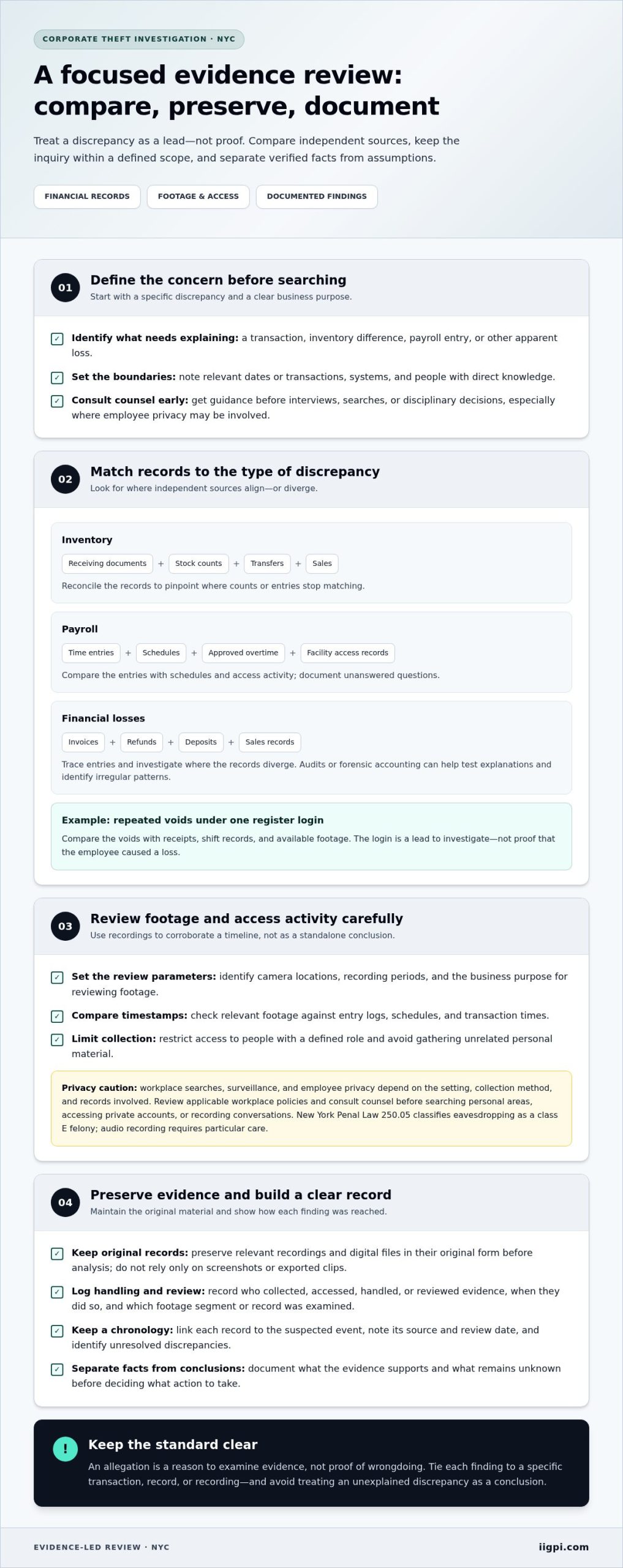
Start with a defined concern, then compare records, footage, and access activity. A dated review can show whether an apparent loss reflects an error, weak controls, or possible misconduct.
Evidence Collection and Employee Privacy
New York workplace searches, surveillance, and employee privacy depend on the setting, collection method, and records involved. Employers should review applicable workplace policies and consult counsel before searching personal areas, accessing private accounts, or recording conversations. New York Penal Law 250.05 classifies eavesdropping as a class E felony, so audio recording requires particular care.
Before reviewing video, identify the camera locations, recording periods, and business purpose. Compare relevant footage with entry logs, schedules, and transaction timestamps. An image alone may not establish who handled an item or why. Preserve the original recording and document who accessed it, when, and which segment they reviewed.
Limit the inquiry to people with a defined role, such as the reviewer and counsel. Record the reason for each search or footage request, and avoid collecting unrelated personal material. If digital files may be relevant, preserve them in their original form before analysis rather than relying only on screenshots or exported clips.
Inventory, Payroll, and Financial Theft
To investigate suspected inventory, payroll, or financial theft, define the discrepancy and compare source records. For inventory, reconcile receiving documents, stock counts, transfers, and sales. For payroll, compare time entries with schedules, approved overtime, and facility access records. For financial losses, match invoices, refunds, deposits, and sales records to find where entries diverge.
Use financial audits or forensic accounting to trace transactions, test explanations, and distinguish bookkeeping errors from irregular patterns. For example, repeated voids under one register login warrant comparison with receipts, shift records, and available footage. Document the transaction sequence as the next step; do not assume the employee responsible for the login caused the loss.
New York embezzlement investigations may involve subpoenas for bank, credit card, phone, and IP records. A subpoena is a formal process, not a routine employer records request. Counsel can assess whether those records are relevant and how to pursue them. Keep a chronology linking each record to the suspected event, with its source, review date, and any unresolved discrepancy.
For a focused review, preserve relevant records, limit access, and compare independent sources before drawing conclusions. A corporate employee theft investigation nyc is stronger when each finding is tied to a specific transaction, record, or recording, and each investigative action is documented.
Security logs and access records can reveal unusual patterns, while unexplained financial discrepancies, such as mismatched sales, invoices, or cash deposits, may point to employee theft. Treat these as leads to compare with underlying records, not proof on their own. International Investigative Group conducts financial analyses to identify discrepancies and trace misappropriated funds, and uses surveillance to monitor employee activities and gather evidence of misconduct.
In one alleged case, Maritza Hernandez allegedly received approximately $89,550.78 in overtime pay for hours she did not work at New York City OCME facilities. A careful review can connect payroll entries with supporting records and footage, while preserving the distinction between an allegation and a finding.
Consulting an attorney during an internal investigation
Consult an attorney early, before interviews, searches, or disciplinary decisions. Counsel can help define the investigation’s scope, assess employee-rights concerns, and identify records or conversations requiring special care. A suspected payroll discrepancy, for example, may involve time records, access data, and employee explanations, so the review needs a clear purpose and documented boundaries.
Corporate investigators, law firms, and in-house human resources teams have distinct roles. Investigators gather and assess facts; attorneys advise on legal issues and investigative strategy; HR manages employment processes and workplace policies. An internal team can coordinate the inquiry, counsel can address legal questions, and a professional agency like the International Investigative Group can provide focused fact-gathering for any corporate employee theft investigation nyc.
Wrongful termination or defamation claims are potential risks when an employer treats an allegation as established fact, shares unverified accusations, or makes a personnel decision without a documented basis. Reduce avoidable exposure by separating evidence from conclusions, limiting sensitive information to people with a business role, and recording the reasons for each investigative step. Counsel can review proposed communications and employment actions before they occur.
No single investigation timeline fits every NYC business. Duration depends on the number of transactions, the condition and accessibility of records, the need for interviews, and whether relevant information must come from outside the company. A defined scope and prompt evidence preservation can help avoid unnecessary delays.
Before the first interview, prepare a concise briefing for counsel that identifies the suspected conduct, known dates or transactions, relevant systems, and people with direct knowledge. Separate confirmed facts from unanswered questions. This helps prevent an early suspicion from shaping every later interview or record review.
During the internal inquiry, maintain a dated log of decisions, requests, interviews, and findings. If an employee’s time entry conflicts with an access record, for example, document both sources and the discrepancy without labeling it theft. Counsel can help address inconsistent explanations and determine whether further steps are appropriate. Preserve relevant materials without broadly collecting unrelated personal information.
After evidence review, counsel can help assess whether findings support an employment decision, a further inquiry, or a referral to another appropriate process. Keep the written conclusion proportionate to the evidence and distinguish established facts from unresolved issues. A structured external review can help organize fact-gathering when internal records or interviews require independent examination.
A business should assess what the findings support and how to proceed without treating suspicion as proof. For an employee theft investigation, consulting an attorney can help the business handle the inquiry legally and respect employee rights. That guidance keeps legal concerns in view as the employer considers its response, while the investigation stays focused on the conduct under review.
The aim is not to assume wrongdoing, but to tie conclusions to the evidence gathered and keep employee rights in view throughout the process. Involving counsel can help the business consider those concerns before deciding how to respond.
Evidence documentation and chain of custody
For each item, document its source, collection time, collector, and storage location. A clear record lets reviewers trace evidence from discovery through analysis and distinguish an original from a later copy, annotation, or summary. Start a separate evidence log as soon as the internal review begins.
Assign each item a unique identifier, then record its description and condition. For example, label a point-of-sale export separately from the printed report made from it. Note the system, account, or physical location involved, and who authorized collection. If an item changes hands, log the transfer date, recipient, and reason.
- Preserve original files and record their original names and locations.
- Make working copies for review, keeping originals unchanged.
- Record each access, transfer, export, or alteration in the evidence log.
- Store physical items securely and restrict access to designated personnel.
These steps apply to paper records, inventory, video, and digital material. If an employee provides a receipt or document, record who received it and when. For an exported camera recording, note the camera, relevant time range, export method, and person who completed the export. Keep explanatory notes separate from the underlying evidence.
Chain of custody matters because an unexplained gap can complicate later review. Suppose a register report is downloaded, emailed, and edited in a spreadsheet. Preserve the original report, identify each copy, and describe the spreadsheet changes. Reviewers should be able to trace the figures back to the source without relying on memory or undocumented assumptions.
A New York case illustrates the volume evidence can reach. Search warrants recovered almost 3,500 mailings containing checks from a co-conspirator’s home and another location. For a business investigation, the practical lesson is to inventory collected material systematically, rather than combining records from different sources into one untracked file. Record the location and collection circumstances for each item.
For digital evidence, preserve the original device or file before opening or reorganizing its contents. Record the custodian, collection method, and any software used to create a copy. Store necessary access credentials separately from the evidence log. Limit review permissions and document each authorized transfer to an analyst or counsel.
At the end of each review stage, reconcile the evidence log with the stored materials. Confirm that every listed item has a location, an assigned custodian, and a documented access history. If a discrepancy appears, record it and investigate the gap before relying on that evidence. A precise record supports sound decisions and a defensible account of investigative steps.
Preventative measures and internal controls
Prevention starts by mapping how money, inventory, and approvals move through the business. For each process, identify who initiates a transaction, who approves it, and who reconciles the records. If one employee can issue a refund and reconcile the same register, assign reconciliation to someone else. Separating these duties makes unusual transactions easier to detect.
Set written procedures for purchases, refunds, expense claims, payroll changes, and inventory transfers. Specify the supporting document required for each action, such as an invoice for a vendor payment or an approval record for a payroll adjustment. Managers should assess exceptions against the original business purpose, not approve entries solely because the form looks complete.
Use role-based access to limit who can change financial records, customer accounts, inventory data, and payroll information. Review permissions when an employee changes roles or leaves, and remove access that no longer serves their duties. For example, a warehouse employee may need to record a shipment without authority to approve a vendor payment.
Reconcile records independently of the original transaction. Compare sales reports with deposits, purchase orders with invoices, and physical inventory with system balances. Document each discrepancy and its explanation. Review repeated voids, missing receiving documents, or adjustments under one account alongside the relevant approvals and transaction history.
Internal controls also rely on clear reporting and supervision. Give employees a defined channel for reporting suspected losses, and explain how managers should route concerns without circulating unverified allegations. Supervisors can review exception reports and access logs for patterns, then record their follow-up. Documented reviews help distinguish recurring control weaknesses from isolated entry errors.
- Require separate approval and payment roles for vendor transactions.
- Match payroll changes to documented authorization and supporting records.
- Record inventory transfers and investigate unexplained adjustments.
- Review system access when job responsibilities change.
Assess these measures against actual workflows rather than treating them as a fixed checklist. A business handling high-value inventory may prioritize receiving records and restricted stockroom access. A company with frequent refunds may focus on register permissions and refund approvals. The right controls depend on where a transaction can be initiated, altered, approved, or concealed.
After an investigation identifies a control gap, assign responsibility for correcting it and document the revised procedure. Then test the process with a routine transaction, tracing a purchase from request through payment and reconciliation. If the records do not show who approved each step, revise the workflow and repeat the test. Internal investigations can also reveal which controls need more consistent oversight.
What evidence can employers legally collect when investigating employee theft in New York?
New York employers should focus on relevant business records and materials they are authorized to access, while treating private spaces, personal accounts, and communications with particular care. Permissible evidence depends on where it is held, how it is obtained, and the circumstances of collection. Define the suspected loss and consult counsel about the proposed collection method before taking action.
Start with records maintained for business operations, such as invoices, sales entries, payroll records, inventory logs, and workplace access data. Identify the relevant account, transaction, or date range, then document why each record relates to the concern. For example, review a disputed refund against its register entry, approval record, and business-held receipt.
Workplace video and security logs can help establish timing or access patterns. Review footage for a defined business purpose, preserve the relevant original recording, and do not treat an image as proof of intent on its own. Consider the recording alongside transaction records and other evidence, including facts that may explain an apparent discrepancy.
Employee privacy requires careful boundaries. Review company policies and consult counsel before searching personal devices, private accounts, or areas where employees may expect privacy. New York Penal Law 250.05 classifies eavesdropping as a class E felony. Accordingly, don’t record or monitor conversations without legal guidance on the proposed method and circumstances.
A business should not treat an employee’s home or personal computer as an extension of the workplace. In New York embezzlement investigations, investigators generally need a search warrant to enter a person’s home and search their computers. If relevant information may be held by a bank, phone company, or other third party, subpoenas may be involved. Preserve company-held evidence and ask counsel to assess the appropriate legal process.
Document each collection decision, including the evidence source, collector, date, business purpose, and any access restrictions. Keep original files separate from working copies, and note when a reviewer exports, annotates, or transfers material. If an employee voluntarily provides a document, record who received it and the circumstances of receipt.
Limit review to material connected to the suspected conduct. If a payroll inquiry concerns hours on a timesheet, compare the relevant entries with approved schedules and workplace access records. Do not collect unrelated personal information merely because it is accessible. A focused scope protects privacy and clarifies the investigative record.
For a structured review of suspected theft, request a theft investigation focused on relevant evidence and documented findings.
International Investigative Group: Corporate Investigations
International Investigative Group conducts corporate investigations when suspected employee theft requires structured fact-gathering beyond a routine internal review. Its Theft Investigations and Surveillance Services help businesses examine reported losses, assess relevant activity, and organize findings for decision-makers. This support can be useful when records show unresolved discrepancies, evidence spans multiple sources, or an impartial investigation is needed. Investigative work complements rather than replaces advice from the company’s attorney; legal questions and employment decisions remain with counsel and the business.
To discuss an employee theft concern and the investigative steps involved, contact International Investigative Group.
Move from concern to a considered next step
The next decision is not simply whether to act, but what the evidence justifies and which business risks remain unresolved. A corporate employee theft investigation in NYC can clarify those questions through a focused assessment of the concern and relevant facts. Keep employment decisions with business leadership and counsel, and use investigative findings to inform, not replace, those decisions.
International Investigative Group offers Corporate Investigations for business inquiries and Insurance Investigations when a loss involves an insurance matter. Security and Armed Guards may also suit a separate need for on-site security. The right service depends on the issue and the support required.
Set out the concern, the records or events involved, and the decision your business needs to make. Then contact International Investigative Group to discuss an investigative next step. A careful, evidence-led approach gives your organization a more considered path forward.
Frequently Asked Questions
What are the steps in a corporate employee theft investigation in NYC?
A corporate employee theft investigation in NYC should move from a defined concern to a documented decision. Begin by identifying the suspected loss and assigning an internal decision-maker. Map the relevant process, such as expense approval or stock transfers, then preserve records before routine system changes overwrite context. Review transactions, interview witnesses in a planned sequence, and compare accounts with independent records. Conclude by separating substantiated findings from open questions and assigning control improvements.
How should employers preserve evidence and maintain chain of custody in theft investigations?
Preserve evidence by retaining an untouched master and a separate review copy, then connect each item to its business context. For a spreadsheet, note the report name, selected date range, filters, and source system; a total without these details may be difficult to interpret. For a physical item, record where it was found and who received it, then limit handling to authorized reviewers. At each transfer, update the evidence record and explain any conversion, such as exporting a video clip.
What penalties can employees face for workplace theft in New York State?
A New York theft involving $50,000 may be a level C felony carrying five to 15 years in prison. The penalty depends on the case.