
A polished pitch deck can document a claim without proving it. For NYC angel investors, the key question is not how many files a startup can provide, but which material claims can be independently corroborated. Due diligence services for angel investors NYC can help examine founder backgrounds, business relationships, operating claims, and transaction details that may fall outside routine legal or financial review.
Attorneys and accountants play essential roles in legal and financial analysis. Investigative diligence serves a different purpose: testing factual claims and identifying inconsistencies or relationships that merit closer attention. This guide explains what independent research can examine before an investment, how it complements professional advisers, and how to define a focused assignment without duplicating their work. It also covers how a New York City-based investigative firm with a global agent network can support local or cross-border inquiries. The goal is a clearer, evidence-informed view of the questions that matter, not a predetermined verdict on a founder or company.
Key Takeaways
- Use independent fact-finding to test material claims about founders, business activity, relationships, and the proposed transaction.
- Understand how due diligence services for angel investors nyc can complement legal and financial reviews without replacing professional advice or investment judgment.
- Match each unresolved investment question to a focused investigative method and relevant evidence source.
- Define a proportionate assignment by identifying the decision at hand, key uncertainties, relevant people and entities, and any cross-border connections.
- Learn how IIGPI’s due diligence, background investigations, financial fraud investigation, and computer forensics can support investor inquiries.
Why NYC angel investors need investigative due diligence beyond the pitch deck
A founder’s presentation can explain a company’s opportunity, but its claims remain unverified until material details are tested against independent information. Investigative due diligence is focused fact-finding about relevant people, business activity, relationships, and transaction representations. It can help an investor distinguish corroborated information from claims supported only by a founder’s account, and identify what remains unresolved before committing capital.
This work adds an evidentiary layer to an investment review. It does not replace an attorney’s legal analysis, an accountant’s financial examination, or the investor’s assessment of risk and potential return. General background on the broader concept is available in What is Due Diligence? Investigative inquiries narrow that broad process to questions requiring independent verification, such as whether a key business relationship exists as described or whether a person’s stated professional history can be corroborated.
Early-stage companies often have limited operating history, so there may be less established performance to assess than in a mature business. That makes it especially important to distinguish a forecast from a verifiable operating fact. An investor might, for example, seek to corroborate a claimed customer relationship or a founder’s account of prior business experience, while leaving revenue recognition and financial-statement analysis to qualified finance professionals.
New York’s investment environment includes interconnected local networks and companies whose customers, founders, suppliers, or operations may extend beyond the city. A relationship described in a pitch may involve an entity in another jurisdiction, or a company’s business history may span multiple locations. NYC-based investigative work, supported by IIGPI’s global agent network for cross-border inquiries, can help focus research on those connections. A local address alone does not establish the full business picture. The practical question is which unresolved facts could affect the investment assessment.
What investigative diligence can answer for an NYC angel investor
Separate founder representations from forecasts, independently verifiable facts, and open questions. Then identify which unresolved claims could materially change how you evaluate the opportunity. An inquiry can assess whether a stated role, business affiliation, or claimed relationship is corroborated. It does not validate projections or recommend whether to invest. Findings inform the investor’s judgment, but the decision remains with the investor.
When a startup investment may warrant independent inquiry
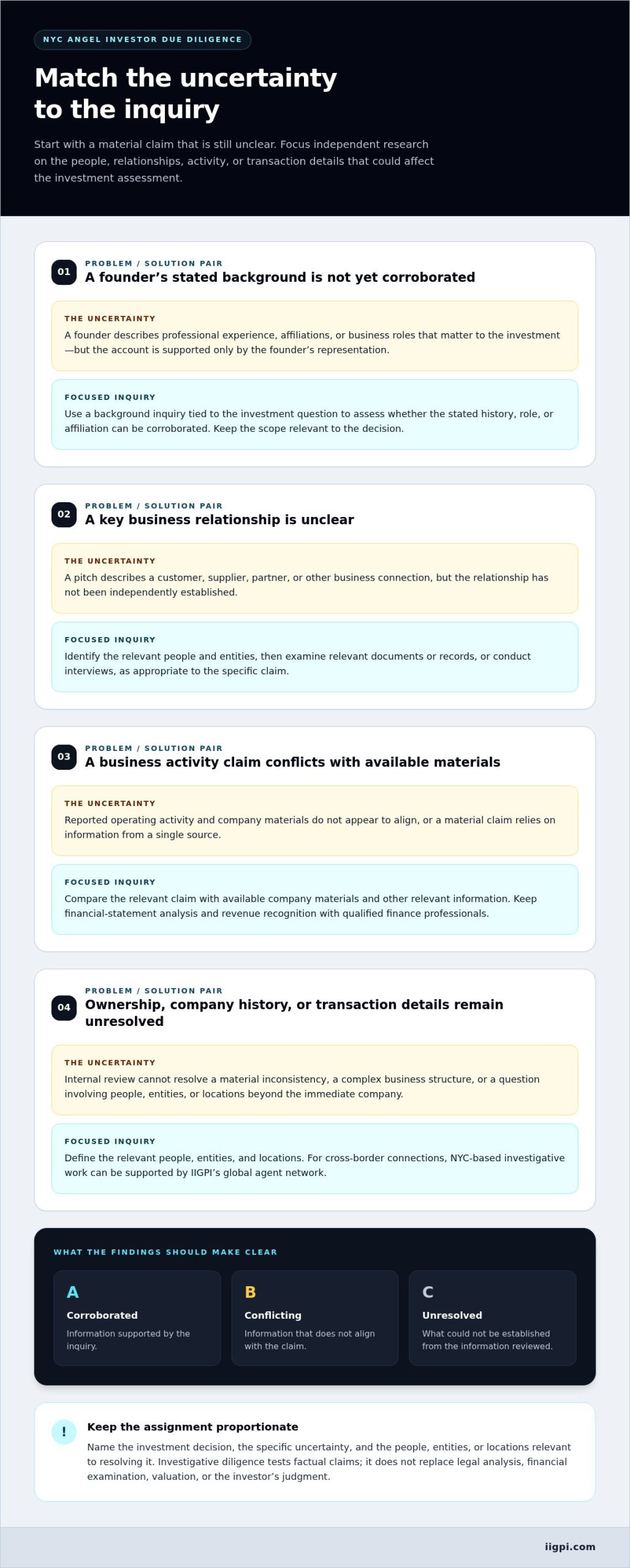
Independent inquiry can be useful when ownership, a company’s history, or a key relationship remains unclear, particularly when internal review cannot resolve a material inconsistency. Complex business structures or claims based on information from a single source may also warrant closer examination. Keep the scope proportionate: identify the decision, the specific uncertainty, and the people, entities, or locations relevant to resolving it. A focused assignment is more useful than collecting information without a defined question.
What NYC angel-investor due diligence services can investigate
Useful investigative work starts with a defined question, not a general request to “check out” a startup. For due diligence services for angel investors nyc, an assignment can connect a claim to an investigative method and a source that may help corroborate it. A founder’s stated employment history, for example, raises a different question from a discrepancy between reported business activity and available company materials. Findings should distinguish what was corroborated, what conflicts, and what could not be established from the information reviewed.
Depending on the question, investigative methods can include background inquiries, examination of relevant documents and records, interviews, or specialist review of digital material. The claim determines which sources are relevant. An investigator’s findings can inform an investor’s assessment, but they are not a legal opinion, financial audit, valuation, or recommendation to invest. Legal and accounting professionals retain their distinct roles in evaluating legal rights, financial statements, and matters within their expertise.
Founder, leadership, and business-background inquiries
Background inquiries can focus on material representations about a founder’s professional history, affiliations, or business roles. Tie the scope to the investment question and identify relevant people and relationships rather than treating every personal detail as pertinent. Online commentary or unverified allegations should not be presented as established fact. A responsible inquiry distinguishes sourced information from assertions and records what remains unresolved.
Regulatory status is a separate question from personal or business background. The SEC explains who may qualify as an accredited investor in its SEC Guidelines for Accredited Investors. That reference provides context about investor qualifications; it does not verify a startup’s claims or replace legal analysis. Keeping these questions distinct helps investors commission research that addresses the actual uncertainty instead of conflating separate diligence workstreams.
Business claims, financial concerns, and digital evidence
When a company’s statements appear inconsistent, turn the concern into a specific investigative question: Which representation differs? What information could test it? Why could the discrepancy affect the decision? A financial concern may call for a focused financial fraud investigation when the facts warrant one, but that work is not an audit and does not by itself establish wrongdoing. For broader context on investigative work involving suspected corporate fraud, see this corporate fraud investigation guide.
Computer forensics is relevant when the matter turns on digital evidence, such as records or communications requiring specialist examination. It is not a default step for every startup review. Define the concern first, then determine whether digital analysis belongs in scope and which material is relevant. International Investigative Group’s due diligence investigations can address investor questions through background, financial fraud, or computer-forensic inquiries, as appropriate.
Is investigative diligence excessive? How it complements legal and financial review
Investigative diligence isn’t necessary for every investment. Its value depends on whether a material question remains unresolved after the investor’s initial review and whether independent fact-finding could clarify it. A narrow inquiry can be proportionate when a founder’s stated affiliation, a company’s business history, or a significant relationship cannot be corroborated. Broad scrutiny without a defined investment question is less useful.
Each adviser works from a different mandate. The subject matter can overlap, but the purpose and conclusions differ. Company records, for example, may matter to an investigator, counsel, and an accountant, yet each examines them to answer distinct questions.
Investigative work versus legal and financial diligence
| Workstream | Primary purpose | Typical conclusion |
|---|---|---|
| Investigative fact-finding | Corroborate material claims about people, relationships, or business activity using relevant evidence. | What information supports, conflicts with, or leaves a factual question unresolved. |
| Legal review | Assess legal documents, rights, obligations, and potential legal consequences. | Legal analysis and advice from qualified counsel. |
| Financial review | Examine accounting records, financial statements, and financial assumptions. | Accounting analysis or other conclusions within the finance professional’s scope. |
These workstreams can coordinate without becoming interchangeable. An investigator may gather facts about a stated business relationship, while counsel evaluates the legal significance of relevant agreements and an accountant assesses how related transactions appear in the records. Investigators don’t provide legal opinions or conduct an accounting audit, and their findings shouldn’t be framed as an investment recommendation. Assigning each question to the appropriate professional helps prevent duplicated work and unclear conclusions.
Proportionate scope, confidentiality, and responsible boundaries
A well-defined assignment begins with the investment decision and the material uncertainty that could affect it. Identify relevant people, entities, or representations rather than expanding into unfocused personal scrutiny. This keeps due diligence services for angel investors nyc tied to the investment question and helps separate pertinent facts from information that does not bear on the assessment.
Confidentiality is an important professional consideration when sensitive company or personal information is involved, but it shouldn’t be treated as a promise of absolute secrecy or a substitute for clear instructions about handling information. Define the assignment’s purpose, boundaries, and reporting expectations in advance. Questions about legal rights, regulatory obligations, or the consequences of particular conduct belong with qualified counsel. Investigative findings can provide factual context for that advice, but this discussion is not legal advice.
How to scope an angel-investor investigation in New York City
A focused investigative assignment begins with the investment decision, not a broad request to collect information. Identify what internal review has not resolved, why the uncertainty matters, and what evidence could address it. For due diligence services for angel investors nyc, this framing connects the work to a real decision while reducing overlap with counsel’s legal review and finance professionals’ analysis.
In a New York City investment, relevant information may involve local founders and companies as well as entities, business relationships, or records connected to other locations. Give the investigator enough context to distinguish the startup, its principals, and similarly named organizations. Identify known cross-border connections that could affect the inquiry.
Prepare a focused NYC investor diligence brief
Summarize the opportunity and explain how each concern could influence the investment assessment. List relevant people, business entities, known locations, and source materials, such as company-provided documents or communications. Prioritize questions by materiality, then specify which matters call for investigative fact-finding and which belong with legal or financial advisers.
A practical brief can state:
- Decision context: What investment decision is being considered, and which uncertainty could affect it?
- Subjects and connections: Which founders, executives, entities, locations, or cross-border relationships are relevant?
- Available materials: What documents or internal review have already addressed the question, and where are the gaps?
- Boundaries: Which factual questions are in scope, and which legal, accounting, or investment judgments are outside it?
This structure helps separate a priority concern from a peripheral detail. If, for example, an investor questions a stated business affiliation, name the person and representation at issue instead of requesting an unrestricted review of everyone connected to the company.
Reviewing findings alongside the investment team
Ask that findings distinguish documented observations from allegations, interpretation, and information that remains unverified. A clear account of sources and limitations helps investors understand what the inquiry established, what it did not establish, and where further professional analysis may be appropriate.
Bring relevant factual findings to counsel or other advisers when they bear on legal or financial questions. The investigator reports on the assigned inquiry; qualified advisers interpret its significance within their professional scope. This division preserves the value of each workstream. For more context on an investigator’s function, consult private investigator responsibilities and scope.
For a tailored assignment, prepare a focused summary of the questions your investment review has identified and the information already available.
How IIGPI supports angel-investor due diligence in NYC
International Investigative Group (IIGPI) is a New York City-based private investigation firm providing Due Diligence / Corporate & Business Investigations. For angel investors, its role is to address defined factual questions about a prospective investment, complementing legal and financial review rather than replacing counsel, accountants, or the investor’s judgment. IIGPI is Licensed, Bonded, Insured.
Relevant capabilities include background investigations, financial fraud investigation, and computer forensics. Each serves a different purpose: background inquiries can address specified representations about people or business affiliations; financial fraud investigations can examine concerns framed around particular inconsistencies; and computer forensics can examine relevant digital evidence. Define the question each workstream is intended to address rather than assuming every investment requires every service.
A customized investigative scope for investor questions
IIGPI creates customized packages, billing clients only for the services they require. Scope can be tailored to the investment questions and relevant locations, supporting local inquiries as well as assignments involving international connections through the firm’s global agent network. IIGPI reports Over 30 Years of Service and 10,000+ Cases Solved. That investigative experience supports its work while the assignment remains grounded in the investor’s specific concerns.
An investor may need to clarify a founder’s stated business history, examine a particular concern about company activity, or determine whether digital evidence is relevant to an unresolved issue. A focused assignment defines the subjects, entities, locations, and questions involved, while leaving legal interpretations and accounting conclusions to the appropriate professional advisers. This makes investigative findings easier to consider alongside the rest of the investment review.
Discuss due diligence services for an NYC investment
Before commissioning an inquiry, summarize the opportunity, identify the claims that matter to your assessment, and specify what internal review has not resolved. That context helps establish a defined scope, including known local or cross-border connections, and clarifies where investigative fact-finding ends and other advisers’ work begins. The findings can add factual context without determining whether an investment should proceed.
To discuss a tailored investigative scope, discuss due diligence services with IIGPI. Center the conversation on the investment context, the specific claims or relationships requiring independent inquiry, and the services relevant to those questions. Due diligence services for angel investors nyc can support a more informed review, but the investment decision remains with the investor, and legal questions remain with qualified counsel.
Make the next investment question more precise
Before advancing a potential investment, identify the unresolved fact that could most affect your decision. A precise question creates a stronger basis for independent inquiry than a general request to validate a company. It also helps keep investigative work aligned with the roles of counsel, financial advisers, and the investment team.
For investors considering due diligence services for angel investors nyc, the next step is a concise scope discussion: outline the opportunity, the claims or relationships requiring verification, and what existing review has left unanswered. This gives the assignment a clear purpose and allows its boundaries to be set before research begins. The resulting work can inform deliberation without predetermining the investment decision.
Discuss a customized due diligence scope with IIGPI and identify the questions that warrant independent investigation. A well-framed inquiry can help you approach the decision with greater clarity.
Frequently Asked Questions
What do due diligence services for angel investors in NYC investigate?
Due diligence services for angel investors nyc can examine relevant background information, business representations, specific financial-fraud concerns, or digital evidence, depending on the assignment. An investor might seek corroboration of a founder’s stated business affiliation or clarification of a particular discrepancy. Select questions and methods based on material uncertainties rather than applying them automatically to every startup. Investigators gather facts; they don’t provide legal or accounting advice or recommend whether to invest.
When should an angel investor hire an investigator for startup due diligence?
Consider an investigator when a material claim, business history, or relationship remains unclear, or when internal review cannot resolve a specific inconsistency. For instance, an investor may need independent inquiry into a leadership representation that bears directly on the company’s credibility. Not every early-stage investment warrants this work. Define the question and its relevance to the decision, then coordinate separate legal or financial analysis with the appropriate advisers.
Can an investigator replace a startup’s lawyer or accountant during due diligence?
No. Investigative services don’t replace legal representation, legal advice, accounting review, or the investor’s judgment. An investigator gathers and assesses information within a defined assignment, while counsel analyzes legal documents and questions, and finance professionals review accounting matters. If a finding raises questions about rights, obligations, or legal consequences, qualified counsel should interpret them. This division lets each professional address the matter within their expertise without treating investigative findings as legal or financial conclusions.
How does NYC investigative due diligence differ from a standard startup checklist?
A checklist organizes topics for review; investigative due diligence can independently examine selected factual questions. Depending on the assignment, those may involve a person’s stated background, a business representation, a specific financial concern, or relevant digital evidence. The inquiry is shaped by the question rather than a fixed list of startup categories. Local or international elements can be considered when they relate to the facts, but no particular evidence or discovery is assured.
Can angel-investor due diligence include international investigations?
Yes. International Investigative Group conducts local and international investigations through a global agent network. A cross-border element may matter if a founder, business entity, or relevant activity is connected to more than one location. Identify those connections at the outset and explain how they relate to the investment question. The inquiry’s geographic scope and methods depend on the assignment; international involvement alone does not establish a concern or predict a result.
How are investigative findings used in an angel investment decision?
Findings can help an investor assess material claims, identify unanswered questions, and determine what information may need further review. A useful report distinguishes documented observations from allegations and information that remains unverified, so the investment team can weigh each appropriately. Investors can share relevant findings with advisers for analysis within their professional roles. The investigator doesn’t decide whether to proceed or guarantee a particular outcome, and legal interpretation belongs with qualified counsel.