
What makes surveillance evidence useful is often not a dramatic image, but a clear record of activity relevant to a specific investigative question. The question behind “Surveillance, Lance Ribacoff” is how observation can support an inquiry while producing focused, understandable documentation. It is reasonable to want to know what professional surveillance can establish, how it is conducted, and where its limits lie.
This guide explains how surveillance methods can be matched to investigative objectives rather than chosen for novelty. It covers human observation, photography, video, unmanned drones for electronic surveillance, and GPS satellite tracking systems, and describes how these capabilities may support personal, corporate, or insurance matters. It also explains why careful documentation matters and what surveillance cannot establish on its own. Use the guidance to identify the question your investigation needs to answer and consider a next step that fits the circumstances.
Key Takeaways
- Separate documented observations from assumptions, allegations, and legal conclusions when assessing what surveillance can establish.
- Consider how human observation, photography, video, drones, and GPS monitoring may contribute to different investigative questions.
- Use this Surveillance, Lance Ribacoff guide to understand how investigative objectives can shape a practical surveillance approach.
- Clarify the inquiry’s objective, setting, and evidence needs to help define a customized investigative scope.
- International Investigative Group, Ltd. conducts local and international investigations for personal, corporate, and insurance matters.
What surveillance can establish in an investigation, and what it cannot
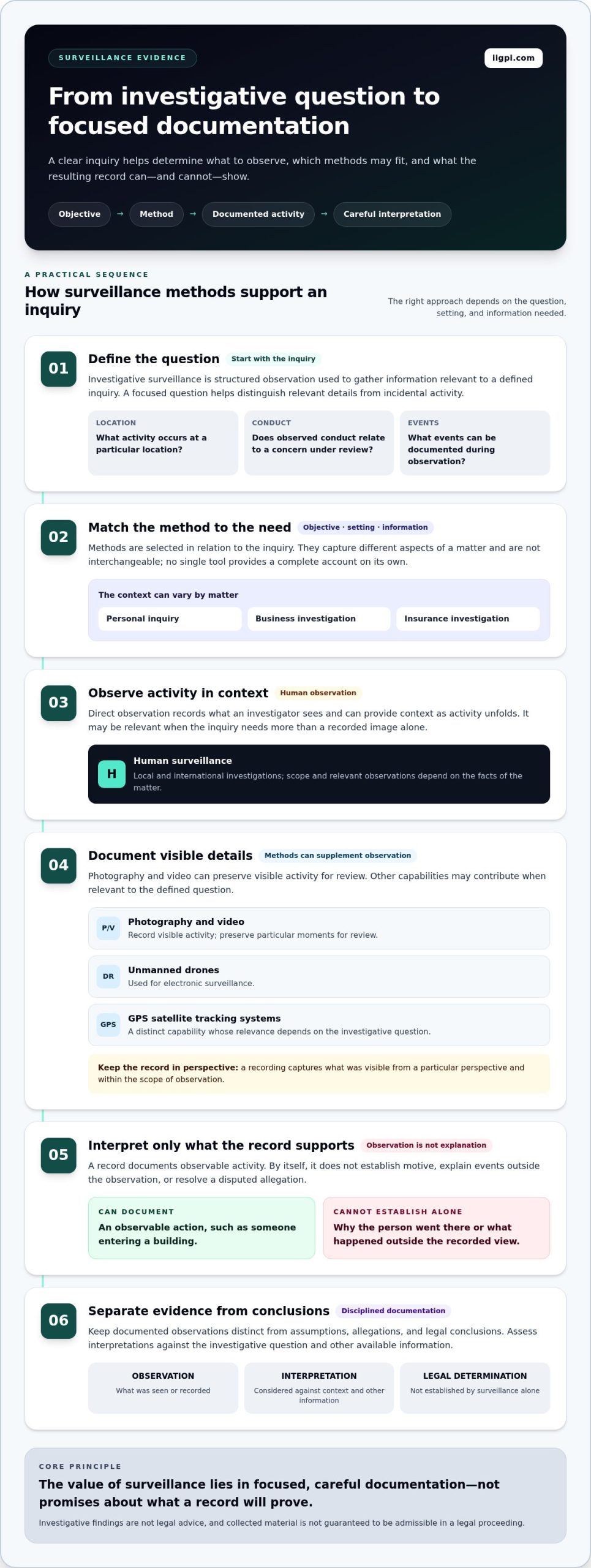
Investigative surveillance is structured observation used to gather information relevant to a defined inquiry. It documents observable activity in relation to a specific question; it does not turn an impression into a finding of fact. The practical question behind “Surveillance, Lance Ribacoff” is not just what can be observed, but how those observations relate to the purpose and scope of the investigation.
Surveillance can support personal, business, and insurance matters, though the objective differs in each. A personal inquiry might focus on a person’s observed activities. A business investigation might examine activity relevant to an identified operational concern, while an insurance investigation might document conduct connected to a claim. These are examples of questions observation may help address, not predictions of what it will establish. The facts, setting, and scope of the matter determine which approach is relevant.
Which investigative questions can surveillance help address?
Start with a question that can be examined through observation. For example: What activity occurs at a particular location? Does observed conduct relate to a specific concern under review? What events can be documented during an observation? Framing the objective clearly helps separate relevant details from incidental activity and gives the inquiry a practical focus.
Surveillance cannot answer every question. It may clarify what was observable in a particular context, but it cannot, by itself, establish a person’s motive, explain events outside the observation, or resolve a disputed allegation. Personal, corporate, and insurance matters each have their own circumstances. A method that is relevant to one inquiry may not fit another.
What surveillance evidence can, and cannot, show
Photographs and video can record visible activity, while an investigator’s observations can provide context about what was seen. Together, these materials may help document activity for review. But a recording captures only what was visible from a particular perspective and within the scope of the observation. It is not a complete account of circumstances that were not documented.
For example, a record of someone entering a building documents an observable action. It does not, on its own, establish why the person went there or what happened outside the recorded view. Interpretations need to be assessed against the investigative question and other available information. Allegations remain claims until assessed, and investigative findings are not legal determinations.
The broader Surveillance overview describes the varied methods and purposes associated with the practice, as well as its criticisms. This context highlights the importance of considering both the information sought and the boundaries of observation. Investigative findings are not legal advice, and collected material is not guaranteed to be admissible in a legal proceeding. The value of surveillance lies in disciplined documentation, not promises about what a record will prove.
How human observation and surveillance technology work together
Surveillance methods are selected in relation to the inquiry’s objective, setting, and information needs. Human observation can provide context as activity unfolds, while photographic and video documentation can preserve visible details. Technology-enabled methods may also contribute, but they are not interchangeable with direct observation. Each captures a different aspect of an inquiry and should be considered for its relevance to the question.
Direct observation records what an investigator sees; technology-assisted methods can add photographic, video, aerial, or GPS-based documentation. Neither approach is a complete account on its own. The key is to consider how a method may support the defined objective without assuming that any particular tool will produce a specific conclusion.
When human surveillance is relevant
International Investigative Group, Ltd. conducts human surveillance locally and internationally. Direct observation can be relevant when an inquiry needs activity documented in its surrounding context, rather than relying solely on a device or recorded image. The scope varies: personal, corporate, and insurance inquiries can involve different questions, settings, and relevant observations.
Investigators relate observations to the stated objective so the inquiry stays focused on information relevant to the matter. Surveillance planning is part of a professionally scoped investigation, not a guide to tracking or approaching someone independently. The firm’s local and international reach supports investigations across locations, while the appropriate methods depend on the facts and scope of each case.
How photographic, video, drone, and GPS capabilities fit
International Investigative Group, Ltd. can collect photographic and video evidence to record visible activity for review. These formats may supplement human observation by preserving particular moments, but they cannot provide context beyond what they capture. An image or recording documents observable material; it does not automatically explain what happened.
The firm also uses unmanned drones for electronic surveillance and provides Activity Monitoring with GPS Satellite Tracking Systems. These are distinct capabilities, and their relevance depends on the investigative question. The capability descriptions should not be taken to imply particular technical specifications, operating conditions, or functions such as alerts or geofencing.
For example, an inquiry may call for direct observation to understand activity in context, while another evidence need may make photographic or video documentation relevant. GPS-based activity monitoring is a separate capability to consider in relation to the inquiry’s purpose. Combining methods should be a deliberate decision, not a default assumption that more technology will produce a clearer finding.
The phrase “Surveillance, Lance Ribacoff” points to a practical principle: choose methods for the question they are intended to address, then assess what each method can actually document. International Investigative Group, Ltd.’s surveillance services can be scoped around the matter’s stated objective.
Choosing a surveillance approach by objective, setting, and evidence needs
Compare methods by starting with the information the inquiry needs, not the technology available. The setting, activity under review, and useful form of documentation all affect the scope. The distinctions below are a starting point, not a fixed decision rule. A method that suits one matter may not be appropriate for another.
| Investigative question | Setting or focus | Potential documentation |
|---|---|---|
| What activity can be observed in context? | A location or situation relevant to the inquiry | Human observation and recorded observations |
| What visible activity may need a visual record? | Activity where photographic or video documentation is relevant | Photographs or video of observable events |
| Could an aerial perspective relate to the objective? | A setting where drone use is considered within the investigation’s scope | Electronic surveillance using an unmanned drone |
| Is activity monitoring relevant to the inquiry? | A matter scoped around GPS-based monitoring | Activity Monitoring with GPS Satellite Tracking Systems |
Matching the method to the question
Human observation may fit an inquiry that requires activity to be considered in context. Activity monitoring serves a different investigative focus, while photographs or video may provide a visual record of observable events. These approaches are not interchangeable, and none is universally appropriate. The location, activity under review, and purpose of the inquiry help determine the scope.
An inquiry focused on what occurs at a particular setting, for instance, may have different documentation needs from one focused on monitored activity. This comparison helps define the question; it does not promise that a selected method will resolve it. International Investigative Group, Ltd. tailors customized packages to the services a client requires. For more context, see this overview of professional surveillance services.
Considering privacy, context, and evidentiary limitations
Surveillance should account for privacy, context, and applicable legal and ethical boundaries. Considerations vary with the setting and circumstances, so a general comparison cannot determine what is permitted in a particular matter. An attorney can advise on legal questions; investigators document and report findings rather than provide legal advice.
Documentation has limits, too. A photograph, video, or observation reflects what was recorded within the scope of the inquiry, not every surrounding circumstance. Consider what a method can capture, what it may leave out, and how the material relates to the investigative objective. The private investigator overview offers broader context about the investigator’s role in an inquiry.
For readers exploring “Surveillance, Lance Ribacoff,” the central takeaway is to match the method to the question and treat documentation as information for review, not a guaranteed conclusion. International Investigative Group, Ltd.’s surveillance services can be scoped around the circumstances and evidence needs of a particular matter.
What to clarify before a surveillance investigation begins
Preparation turns a broad concern into a more workable investigative objective. Before surveillance begins, organize what you know, what you need to understand, and which details remain uncertain. This helps define the inquiry without presuming what investigators will observe or how the matter will proceed. A defined investigative question helps guide method selection and documentation.
Define the objective and relevant context
State the central question in concrete terms, then explain the circumstances that make it relevant. For example, distinguish a request to document a particular activity from a general concern that something may be happening. Include the setting and relevant background, but avoid assuming what an observation will prove. International Investigative Group, Ltd. tailors customized packages to the services a client requires, so a clearly stated objective helps shape an appropriate scope.
A useful preparation sequence is:
- Identify the question. Describe what you need the investigation to clarify in specific terms, rather than using conclusions or labels.
- Organize the background. Share relevant dates, locations, events, and other context that explains the inquiry’s purpose.
- Separate knowledge from inference. Identify which details you witnessed directly, which came from another source, and which remain assumptions or unverified concerns.
- Set the boundaries. Explain what information is relevant and identify circumstances that could affect the inquiry’s scope.
This preparation is not a script for how an investigation must unfold. It helps communicate the issue accurately so the services can be considered in relation to the facts and information sought. Personal, corporate, and insurance inquiries can require different context and scope.
Understand communication, documentation, and limits
Clarify how information about the inquiry will be shared and what documentation may relate to its objective. The firm can collect photographic and video evidence, but whether either method is useful depends on the circumstances and available observations. No particular record or finding can be assumed in advance. What is gathered depends on the inquiry and what can be observed within its scope.
Keep expectations measured. Share changes in circumstances or relevant background as they arise, and distinguish new firsthand information from interpretation. This helps maintain clarity without treating an unverified concern as an established fact. In the context of “Surveillance, Lance Ribacoff,” preparation means defining the question and communicating relevant context, not predicting an outcome.
Investigative services are not legal representation or legal advice. Consult an attorney for advice about legal questions related to your matter. To discuss how a defined objective may inform an investigation, outline your surveillance needs to International Investigative Group, Ltd.
How Lance Ribacoff and IIGPI fit into a surveillance inquiry
Surveillance may support personal, corporate, and insurance matters. International Investigative Group, Ltd. is a New York-based private investigation firm with global investigative reach, and Lance Ribacoff is listed as part of the family-owned and operated firm. Frame an inquiry around its objective and the information sought, rather than assumptions about what a particular method will establish.
The firm states that it is Licensed, Bonded, Insured and reports 10,000+ Cases Solved. These are firm credentials and figures, not a guarantee that a particular investigation will produce a specific finding or outcome. When considering surveillance, focus the initial discussion on the circumstances, the question to be examined, and the documentation that may be relevant.
What the firm’s confirmed surveillance capabilities include
International Investigative Group, Ltd.’s surveillance capabilities include local and international human surveillance, photographic and video evidence, unmanned drones for electronic surveillance, and Activity Monitoring with GPS Satellite Tracking Systems. These capabilities offer different ways to approach an inquiry. Their relevance depends on its objective, setting, and scope.
One matter may call for human observation, while another may involve photographic or video documentation or a technology-enabled method. These examples describe possible approaches, not prescribed solutions. The investigative question and case context inform which capabilities are relevant, and no method guarantees a particular record or conclusion. This is central to understanding “Surveillance, Lance Ribacoff” as a practical guide: methods are selected in relation to the inquiry, not as a promise of results.
Discussing a customized investigative scope
A focused initial discussion helps establish what needs to be investigated and which services relate to that objective. The firm offers highly customized packages, with clients billed only for the services they require. This lets the scope reflect the matter without assuming a fixed plan, timeline, or result.
The firm’s global agent network supports local and international investigations. The relevant locations and circumstances vary by case, so include them when describing the inquiry. Clients can help clarify the scope by separating firsthand information from assumptions, identifying the central question, and sharing background that explains the purpose of the investigation.
To discuss a customized surveillance inquiry, share your investigative objectives with International Investigative Group, Ltd. A focused conversation can connect the matter’s needs with relevant investigative services and keep expectations grounded in the facts and scope of the individual case.
Turn the investigative question into a clear next step
Uncertainty can make it difficult to decide what to do next. Start by identifying what you need the investigation to clarify and why that information matters. With that purpose in view, you can consider surveillance as an investigative step without expecting any single method to answer every concern.
This Surveillance, Lance Ribacoff guide offers a grounded way to approach that decision: define the issue, share relevant context, and keep expectations tied to what an investigation can observe and document. A focused discussion can help translate those details into a customized scope for your matter.
Take the next step by discussing a customized surveillance investigation with IIGPI. Share the question you need addressed and the background you believe is relevant. Contact International Investigative Group, Ltd. to discuss your investigative objectives and the surveillance services that fit your inquiry.
Frequently Asked Questions
What is surveillance in a private investigation?
Surveillance in a private investigation is a planned way to gather information about activity relevant to an inquiry. A personal, corporate, or insurance matter, for example, may raise a specific question about conduct or events that observation could help clarify. The investigator focuses on information relevant to that question and reports what is observed, rather than treating an observation as proof of motive or a final determination.
Can surveillance be conducted internationally?
Yes. International Investigative Group conducts human surveillance locally and internationally, supported by a global network of agents. International scope may be relevant when an inquiry involves activity across locations, but the purpose and circumstances of each matter guide the approach. Identify the locations and background relevant to the question without assuming the same investigative plan applies everywhere.
Can investigators collect photographs and video during surveillance?
Yes. The firm can collect photographic and video evidence during surveillance. These formats may document visible activity or a sequence of observable events for later review. What they capture depends on the circumstances and scope of the inquiry. Images and recordings do not necessarily explain why an event occurred or establish facts beyond what they show, so their relevance must be assessed in relation to the investigative question.
Does surveillance include GPS satellite tracking?
Yes. The firm’s stated capability is Activity Monitoring with GPS Satellite Tracking Systems. This distinct capability may be considered when activity monitoring relates to the inquiry’s objective. The name describes the capability and does not imply unlisted functions or a particular result. Its relevance depends on the individual matter and the scope of services required.
Can unmanned drones be used for electronic surveillance?
Yes. International Investigative Group uses unmanned drones for electronic surveillance. Whether this method relates to a particular inquiry depends on its objective and circumstances. The capability does not specify technical features, operating conditions, or what a drone may record in a given case, so those details should not be assumed. Documentation remains tied to the scope of the matter.
Who is Lance Ribacoff at International Investigative Group?
Lance Ribacoff is listed as part of the family-owned and operated International Investigative Group. The firm is a New York-based private investigation firm with global investigative reach. The phrase “Surveillance, Lance Ribacoff” connects his name with this guide’s subject, but it does not establish a specific title or individual responsibility. The investigation is scoped around the matter’s needs and the firm’s relevant capabilities.
How does IIGPI tailor surveillance services to an investigation?
IIGPI offers highly customized packages, with clients billed only for the services they require. A useful starting point is to describe the question under review, share relevant background, and distinguish firsthand information from assumptions. That context helps relate the scope to the inquiry instead of assuming every case requires the same surveillance methods. Findings depend on the circumstances and available observations.