
What should a Wall Street firm do when a confidential deal, client record, or internal discussion may have been exposed? Executives searching for “Lance Ribacoff, corporate counter-espionage services wall street” are often asking a practical question: does the concern warrant an investigation, and how can it be assessed without disclosing more sensitive information?
Start with evidence, not assumptions. International Investigative Group is a New York-based private investigation firm, and Lance Ribacoff is listed as a member of its family-owned-and-operated leadership. The firm is Licensed, Bonded, Insured. Its relevant services include electronic bug sweeps and technical surveillance countermeasures, surveillance, vulnerability assessments, and computer forensics. Each addresses a different question: whether technical surveillance may be present, what activity can be documented, or whether digital evidence warrants examination. These investigative services are distinct from cybersecurity software and network protection.
This guide explains how to match investigative methods to a defined concern, assess credentials and scope, and prepare for a discreet discussion about a specific business issue. The aim is a measured next step, not a promise about what an investigation will establish.
Key Takeaways
- A concern about unauthorized information gathering is a reason to assess the facts, not proof that misconduct occurred.
- Physical observation, electronic bug sweeps, and computer forensics address different investigative questions and evidence needs.
- Consider credentials, including IIGPI’s Licensed, Bonded, Insured status, when assessing an investigator for a sensitive corporate matter.
- Prepare for a discreet inquiry by recording the concern, preserving relevant information, defining your objective, and respecting access boundaries.
- Understand how Lance Ribacoff, corporate counter-espionage services wall street, relates to IIGPI’s investigative capabilities and a carefully scoped next step.
What Corporate Counter-Espionage Means for Wall Street Businesses
In a private-investigation context, corporate counter-espionage means assessing a defined concern about possible unauthorized information gathering and choosing investigative methods suited to the question. It does not mean treating suspicion as established misconduct. If a confidential document appears outside its intended circle, for example, that may raise questions about access or exposure. On its own, it does not establish who was responsible, why it happened, or whether espionage occurred.
Wall Street businesses handle sensitive commercial and financial information, so a potential exposure can merit careful assessment without implying that a specific threat exists. Industrial espionage refers to different ways of acquiring business information; Industrial Espionage Explained provides context for the term. For an investigation, narrow the starting point: identify what was observed, what information may be involved, and what the business needs to establish.
Which corporate concerns can prompt an investigation?
Reported surveillance, unexplained information exposure, or concerns about unauthorized access may prompt a business to seek investigative assistance. Make the concern actionable by separating direct observations from interpretations. Finding a meeting-room door open is an observation. Concluding that a named person entered to collect information is an assumption unless evidence supports it.
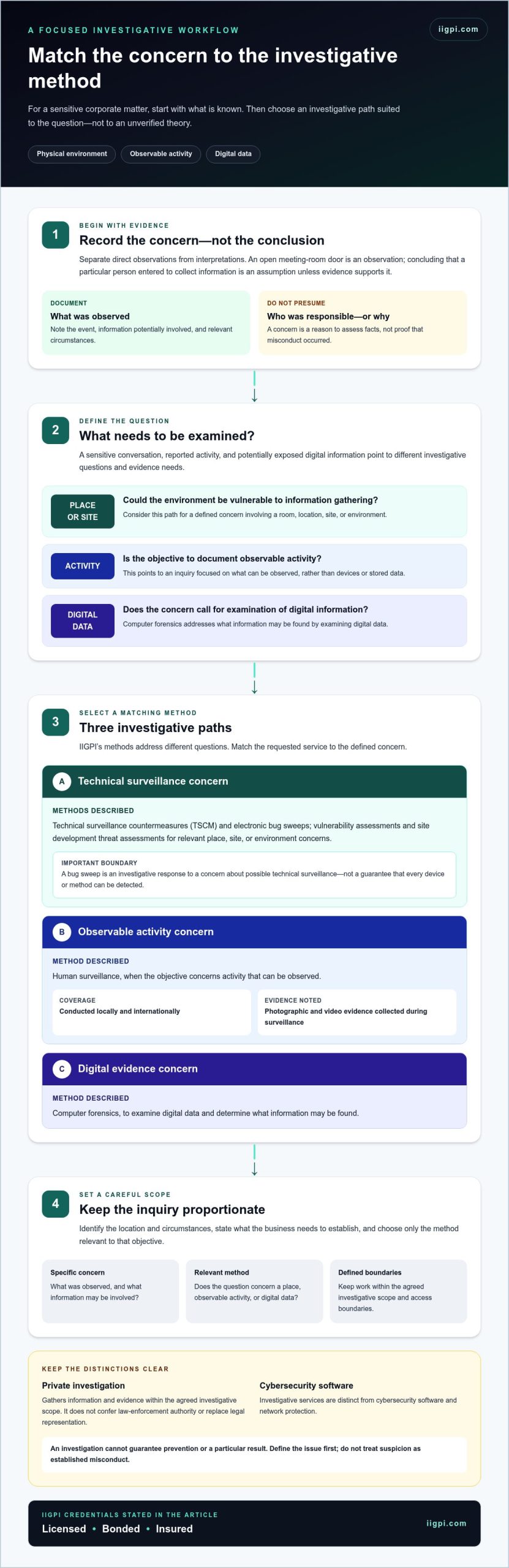
Define the question before selecting a method. Is the concern about possible monitoring in a physical space, activity that can be observed, or digital evidence that requires examination? A precise objective keeps an inquiry relevant and prevents an unverified theory about motive or responsibility from directing the work.
What does counter-espionage mean in a private-investigation context?
IIGPI offers technical surveillance countermeasures and electronic bug sweeps for concerns about possible technical surveillance. These services differ from surveillance and computer forensics, which address other investigative questions. Set the scope according to the specific concern and requested services, rather than assuming every unusual event has the same cause.
Private-investigation counter-espionage assesses suspected information gathering through appropriate investigative methods; it does not confer law-enforcement authority. A private investigator gathers information and evidence within the agreed investigative scope. This work is distinct from law enforcement, legal representation, and cybersecurity software. It does not replace official authority, provide legal advice, or function as a network-protection product. An investigation also cannot guarantee prevention or a particular result.
The search phrase “Lance Ribacoff, corporate counter-espionage services wall street” points to a practical decision: how to examine a concern discreetly and proportionately. Begin with a documented issue and an objective that can guide method selection. If the facts do not yet establish what happened, an investigation can focus on clarifying that uncertainty rather than presuming misconduct.
How IIGPI’s Investigative Methods Address Corporate Security Questions
Investigative methods are most useful when they match the question. A concern about activity in a meeting space differs from suspected technical surveillance, and both differ from a need to examine digital data. IIGPI provides services addressing these distinct areas. Defining the issue first helps keep the inquiry proportionate and focused on the client’s needs.
For a Wall Street business, this distinction matters when a reported incident involves a sensitive conversation, an unexplained disclosure, or information that may be stored digitally. None establishes a cause on its own. Each points to a different line of inquiry and a different type of relevant evidence.
When are technical surveillance countermeasures and bug sweeps relevant?
Technical surveillance countermeasures (TSCM), electronic bug sweeps, vulnerability assessments, and site development threat assessments are relevant when a defined concern involves a place, site, or environment that may be vulnerable to information gathering. An electronic bug sweep is an investigative response to a concern about possible technical surveillance, not a guarantee that every device or method can be detected.
Set the scope to fit the setting and question. A concern about one room differs from a broader assessment of a site under development. Identifying the location and circumstances helps determine which service is relevant, without presuming that surveillance equipment is present or that an assessment eliminates all risk.
When can surveillance or computer forensics contribute?
Human surveillance may be relevant when the objective concerns observable activity rather than devices or stored data. IIGPI conducts human surveillance locally and internationally, with photographic and video evidence collected during surveillance. Tie the method to a defined investigative objective rather than using it as a substitute for examining a technical concern.
Computer forensics addresses a different question: what information may be found by examining digital data. IIGPI’s computer forensic services include examination of data on Windows, iOS, Android, and Ubuntu platforms. The work is investigative, not cybersecurity software or a replacement for network protection. Readers seeking more context on computer forensics services can consider how digital examination fits alongside other investigative methods. The appropriate scope depends on the concern and requested services.
IIGPI builds customized packages around the services a client requires, rather than assuming every corporate concern calls for the same combination of methods. Start by identifying whether the question involves physical observation, suspected technical surveillance, or digital evidence, then define the investigative work accordingly. For readers searching “Lance Ribacoff, corporate counter-espionage services wall street,” matching the method to the question is a practical way to understand what an inquiry may involve.
A discreet discussion can begin with the known facts, the information or setting involved, and the specific question the business needs examined. This keeps the proposed scope centered on the concern, without treating suspicion as a conclusion or overstating what an investigative method can establish.
How to Assess an Investigator for a Wall Street Corporate Matter
Assessing an investigator for a sensitive business matter means more than matching a service label to a concern. Decision-makers should be able to connect the issue to a relevant method, understand what kind of evidence the work may produce, and distinguish firm credentials from claims about an individual investigator. This approach supports a proportionate scope without assuming that a suspicion proves misconduct.
What credentials and experience should the reader understand?
International Investigative Group describes itself as Licensed, Bonded, Insured and reports 10,000+ Cases Solved. Former law-enforcement experience is attributed to the team, not automatically to every investigator. These firm-wide details provide context, but they do not prove that a particular individual handled a particular case or has a specific role in a proposed inquiry.
Lance Ribacoff’s association with the family-owned-and-operated firm is separate from claims about individual case involvement. A firm’s overall experience and an investigator’s personal participation are different facts. For a Wall Street matter, assess whether the proposed investigative scope matches the business concern and identifies the evidence sought.
How should investigative scope and evidence be compared?
The comparison below connects common corporate questions to relevant methods and potential evidence categories. Use it as a planning framework, not a promise that an inquiry will produce a specific finding or form of evidence.
- Question: Is activity relevant to the concern observable? Method: Human surveillance. Evidence type: Photographic or video evidence may be collected during surveillance.
- Question: Is there a defined concern about possible technical surveillance? Method: Technical surveillance countermeasures or an electronic bug sweep. Evidence type: Findings from the assessment relevant to the concern and scope.
- Question: Does digital information require investigative examination? Method: Computer forensics. Evidence type: Relevant digital data examined within the agreed scope.
- Question: Does the matter concern suspected business fraud? Method: Corporate investigations. Evidence type: Information gathered in relation to the defined investigative objective.
Photographic and video evidence are listed capabilities, but their presence does not establish how a court or other decision-maker will treat particular material. Questions of legal interpretation and use belong with the business’s legal counsel; the investigator’s role is to conduct investigative work within the agreed scope. For related business concerns, International Investigative Group’s corporate fraud investigations provide a relevant investigative context.
Before proceeding, clarify the concern, the proposed method, the evidence sought, and the boundaries of the work. Readers researching “Lance Ribacoff, corporate counter-espionage services wall street” can use these criteria to distinguish documented firm credentials from assumptions and assess whether an investigative approach fits the question.
How to Prepare for a Discreet Corporate Counter-Espionage Inquiry
A focused inquiry begins before investigators select methods. A clear record of what happened, careful preservation of relevant information, a defined objective, and a discussion of scope help keep the engagement proportionate to the concern. Limit unnecessary disclosure by sharing only information relevant to the inquiry, through authorized channels, and with appropriate people.
What information helps define the investigative question?
Record dates, locations, observed events, and the business impact in neutral language. Separate direct observations from second-hand reports and interpretations. For example, note that confidential material appeared in an unexpected location if that is what was observed, without assigning responsibility or motive unless evidence supports it. Then state what the investigation is intended to clarify.
Use this sequence to organize an initial inquiry:
- Record the concern. Note what was reported or observed, when and where it occurred, and why it matters to the business.
- Preserve relevant information. Retain materials already available to authorized personnel. Do not alter, access, copy, or share information outside your authority.
- Define the objective. Describe the question that needs examination, such as whether activity was observable or whether digital information requires investigative review.
- Discuss the scope. Identify the services relevant to that objective and the information needed to frame the work.
How can a company support a focused engagement?
Identify appropriate points of contact and materials that can be shared for the inquiry. Explain the sensitivity of the matter and any confidentiality expectations, including who within the organization is authorized to participate. This limits unnecessary circulation of sensitive details and gives the discussion a clear operational purpose.
If surveillance is relevant, define the activity or question that requires observation rather than requesting broad monitoring without a specific objective. IIGPI’s professional surveillance services include human surveillance and may involve photographic or video evidence. The appropriate scope depends on the concern, objective, and requested services.
IIGPI tailors customized packages to the investigative services a client requires. A focused discussion can distinguish whether the concern calls for surveillance, an electronic bug sweep, computer forensics, or another relevant investigative method. The scope should remain tied to the question and available information, without assuming a particular timeline or finding.
For executives using the search phrase “Lance Ribacoff, corporate counter-espionage services wall street,” preparation can make a sensitive first discussion more precise. Present the concern neutrally, identify what the business needs clarified, and describe boundaries around information sharing. To discuss a specific corporate concern and its investigative scope, contact IIGPI about a corporate investigation.
Lance Ribacoff and IIGPI: A Relevant Next Step for Wall Street Businesses
After identifying a concern, a Wall Street decision-maker can connect it to a specific investigative question that can be discussed and scoped. International Investigative Group is a New York-based private investigation firm with services relevant to corporate matters, including corporate investigations, technical surveillance countermeasures, electronic bug sweeps, surveillance, and computer forensics. The right combination depends on what the business needs examined.
What does IIGPI bring to a complex business inquiry?
Different concerns call for different investigative approaches. Corporate investigations can address a defined business inquiry; technical surveillance countermeasures and electronic bug sweeps relate to suspected technical surveillance; human surveillance concerns observable activity; and computer forensics examines digital data. Distinguishing these purposes helps decision-makers describe the issue without assuming one method can answer every question.
IIGPI’s international agent network supports local and cross-border investigative work. This reach may be relevant when a corporate concern involves activity or information connected to more than one location. The scope remains tied to the specific question and requested services. IIGPI offers customized packages tailored to the services a client requires, rather than assuming every matter needs the same combination of methods.
Lance Ribacoff is listed as a family member in the family-owned-and-operated firm. That is the relevant connection to IIGPI; it should not be taken as a claim about his personal involvement in a particular case or a specialized role. The firm’s investigative capabilities and network provide context for considering how a corporate concern may be approached.
What is the next step for a Wall Street decision-maker?
A useful initial description can be concise. State what was observed or reported, identify the business information or setting involved, and explain what the organization wants clarified. Separate direct observations from interpretations and avoid including sensitive material beyond what is appropriate to share. This gives the discussion a defined starting point without presenting suspicion as a conclusion.
For readers searching “Lance Ribacoff, corporate counter-espionage services wall street,” the practical next step is to discuss the concern and the investigative question it raises, not to presume an outcome. IIGPI can tailor a package to the investigative services required, with the scope reflecting the issue rather than a predetermined promise about results.
If your organization has a specific corporate concern, contact IIGPI to discuss an investigation and describe the question you need examined. A focused discussion can help identify which investigative services are relevant to the matter.
Move Forward With a Clear Investigative Question
A sensitive concern does not have to become an immediate conclusion or a broad internal response. Identify what decision the business needs to make and what information could help inform it. This focus can keep the inquiry proportionate, limit unnecessary circulation of sensitive details, and give decision-makers a more disciplined basis for determining what comes next.
For leaders searching “Lance Ribacoff, corporate counter-espionage services wall street,” the priority is a measured conversation about the specific concern, not an assumption about who is responsible or what an investigation will establish. A clear account of the issue and the question the organization needs answered creates a practical starting point for discussing investigative scope.
IIGPI’s Licensed, Bonded, Insured status and 10,000+ Cases Solved provide relevant firm credentials, while customized packages are tailored to the investigative services required. If your organization is ready to discuss a defined corporate concern, contact IIGPI about your investigative needs.
Frequently Asked Questions
Is corporate counter-espionage the same as cybersecurity?
No. Cybersecurity software is designed to help protect systems and networks, while a private investigation examines a defined concern and gathers relevant information. For example, a company responding to a suspected disclosure might need computer forensic examination of digital data, while a concern about a device in a meeting room raises a different investigative question. These approaches address distinct issues, but investigative services aren’t a substitute for cybersecurity protection.
Can a private investigator conduct a corporate bug sweep in New York City?
Yes. International Investigative Group is based in New York City and offers electronic bug sweeps. A business can identify the location and circumstances prompting concern, such as a conference room where sensitive discussions occur, to help frame the inquiry. A sweep is an investigative response to a defined concern, not a guarantee that every possible surveillance device or method will be detected.
What does a technical surveillance countermeasures assessment examine?
A technical surveillance countermeasures assessment addresses a defined concern about possible technical surveillance in a relevant setting. Its scope can focus on the location or environment the business wants assessed. Vulnerability assessments or site development threat assessments may address other site-related questions. The investigative focus depends on the concern presented; an assessment is not proof that surveillance exists or a guarantee that all risk is removed.
Can investigators collect photographic or video evidence internationally?
Yes. IIGPI conducts human surveillance locally and internationally, and photographic or video evidence may be collected during surveillance. The assignment’s objective and scope help determine what activity is relevant to document. For a matter involving more than one location, clearly identifying the investigative question helps frame the work. Evidence collection does not by itself determine the material’s legal significance or how it may be used.
How does IIGPI tailor investigative services for a corporate matter?
IIGPI tailors customized packages to the investigative services a client requires. A concern involving activity at a physical location may call for a different scope than one requiring examination of digital data. Describing the issue, the business impact, and the question to be clarified helps identify relevant services and avoid unnecessary ones. The scope is based on the client’s needs, not a standard combination of methods.
Does IIGPI provide legal advice or represent businesses in court?
No. IIGPI provides private investigative services, not legal advice or legal representation. Its investigative work may gather information relevant to a business concern, but legal interpretation and decisions about legal proceedings belong with the company and its legal counsel. If an investigation produces photographic material or digital findings, counsel can advise the business on the appropriate legal significance and use of that information.
How can a Wall Street company discuss a suspected information leak discreetly?
Begin with a concise description of what was observed or reported, when it occurred, and what business information may be involved. Separate firsthand facts from assumptions, state what the company hopes to clarify, and share only information you’re authorized to disclose. For executives searching “Lance Ribacoff, corporate counter-espionage services wall street,” this focused approach can support an initial discussion with IIGPI about the concern and relevant investigative scope.