
What is the most responsible way to investigate a key employee? Start by testing the evidence before drawing conclusions. Learning how to confirm suspicions about a key employee takes more than interpreting unusual behavior or acting on workplace rumor. A concern may be serious, but a hunch alone should not determine someone’s reputation or an organization’s next move.
When the stakes involve a valued employee, confidential information, or business operations, a measured process can separate verifiable facts from assumptions while limiting unnecessary disruption. This guide explains what to document, how to preserve relevant records, and how to assess whether the available information supports further review. It also covers when an internal review may be appropriate and when an independent corporate investigation, computer forensics, or surveillance may help clarify specific, documented concerns.
The goal is not to presume misconduct, but to match the investigative method to the evidence. A systematic approach helps decision-makers choose a sound next step, protect relevant information, and avoid escalating concerns without a clear factual basis.
Key Takeaways
- Learn how to confirm suspicions about a key employee by distinguishing specific, verifiable observations from assumptions or workplace rumors.
- Use a consistent record-preservation process: document dates, locations, direct observations, relevant records, and the source of each account.
- Decide whether existing records and firsthand accounts can support an internal review or whether the concern calls for independent investigative support.
- Match each investigative method to a defined question. Surveillance may help assess observable activity, while computer forensics can examine relevant digital evidence.
- Keep the scope proportionate by defining the question, preserving facts, and assessing findings before deciding on further action.
How to Confirm Suspicions About a Key Employee Without Relying on Hunches
Assessing concerns about a trusted employee with substantial authority can be difficult. The person may hold critical knowledge, oversee sensitive processes, or play a central role in daily operations. Familiarity can make unusual conduct seem harmless, while anxiety or workplace conflict can make ordinary decisions look suspicious. A sound concern is tied to specific, observable information that can be checked, not intuition, rumor, or a judgment about someone’s character.
Start by defining the type of concern. Suspected impairment relates to observable changes that may affect an employee’s ability to work safely or reliably. Other concerns may involve conduct, such as repeated departures from an established approval process; a possible conflict of interest, such as undisclosed involvement in a vendor decision; or potential financial misconduct, such as records that do not align with documented transactions. These are different questions and should not be treated as interchangeable. Document facts first. Suspicion is a reason to assess information, not proof of misconduct.
Which employee behaviors or events warrant closer attention?
Closer attention may be appropriate when an employee repeatedly bypasses required approvals without a clear operational explanation, gives conflicting accounts of the same transaction, or makes record changes that cannot be reconciled with supporting documents. A single deviation may have an innocent explanation. A recurring, documented pattern may justify further fact-finding. The useful question is not whether behavior feels unusual, but whether specific details can be independently examined.
Keep different kinds of information separate. If a manager personally sees an approval step being skipped, they can record the date, process, and action observed. Identify a colleague’s account as a report and attribute it to its source. “The employee is hiding something” is an interpretation, not an observation. Record what happened and what remains unknown without turning an inference into a factual conclusion.
Unusual behavior may also have explanations unrelated to misconduct, including workload pressures, process changes, or personal circumstances. Treat a change in demeanor, an unexplained absence, or an irregular transaction as a prompt to establish relevant facts, not as evidence of impairment, dishonesty, or intent. This distinction keeps an initial review focused and proportionate.
Why can suspicions about a key employee be especially difficult?
Authority and access can complicate an assessment. A senior employee may control records, approve transactions, or hold knowledge others need to maintain business continuity. That dependence can discourage scrutiny, while concern about disruption can prompt premature action. Neither pressure establishes what happened. Documenting the specific concern helps decision-makers examine it without treating the employee’s importance as a reason to dismiss questions or presume wrongdoing.
Relationships can distort judgment in either direction. Personal conflict may make routine decisions appear suspect; a history of trust may lead others to explain away inconsistencies without checking them. To understand how to confirm suspicions about a key employee, separate evidence from relationships: identify what was directly observed, what was reported, and what records could verify or contradict each account. A high-stakes role does not lower the standard for evidence-based judgment. It makes impartial, carefully documented assessment more important.
How to Document and Preserve Evidence About a Key Employee
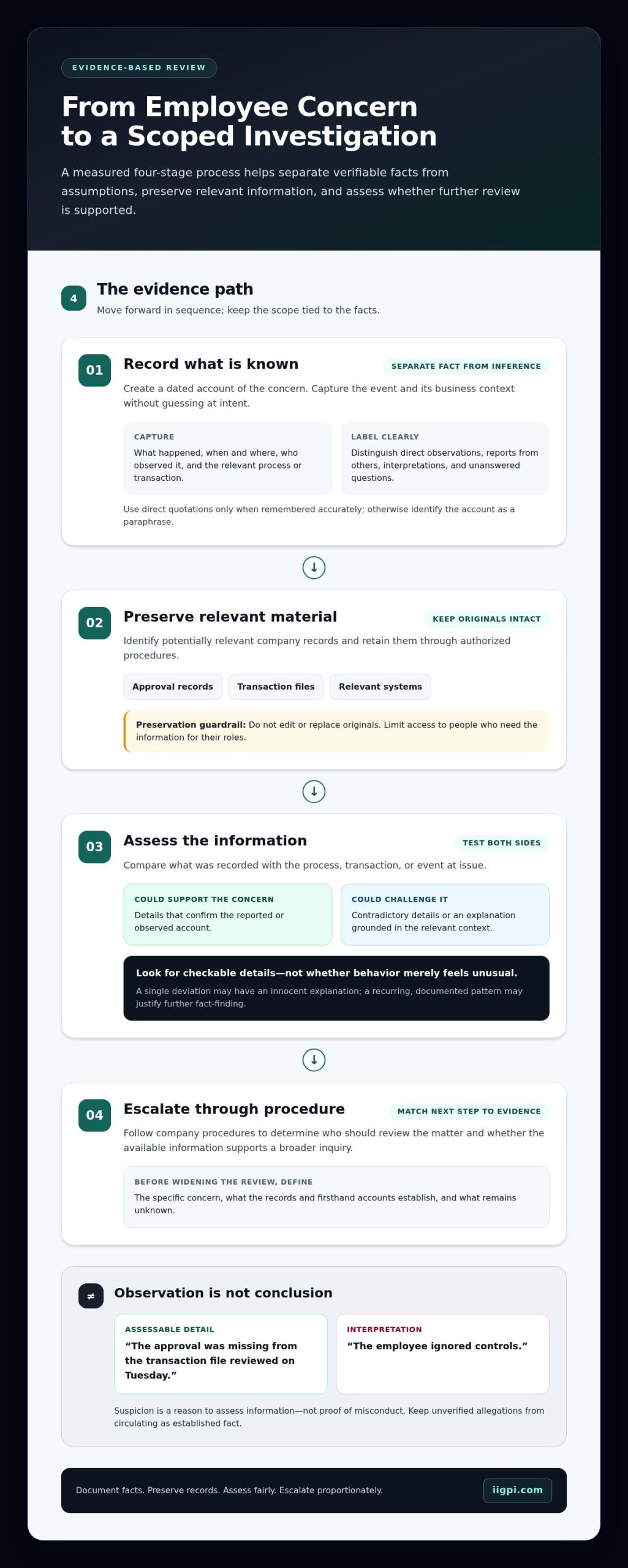
A consistent process reduces the risk that an initial concern will be distorted by memory, informal discussion, or changes to relevant records. Record what is known, preserve potentially relevant material, assess what the information supports, and escalate according to company procedures. Limit access to people who need the information to carry out their roles. Unverified allegations should not circulate as established fact.
- Record: Make a dated account of the concern, separating direct observations from reports, interpretations, and unanswered questions.
- Preserve: Identify relevant company records and retain them through authorized procedures without editing or replacing originals.
- Assess: Compare the information with the process, transaction, or event at issue. Note both confirming and contradictory details.
- Escalate: Follow internal procedures to determine who should review the matter and whether the available evidence calls for a broader inquiry.
What should an objective incident record include?
Capture what occurred, when and where it occurred, who observed it, and the business context. Identify relevant records or systems, such as an approval record or transaction file, without speculating about intent. Use direct quotations only when remembered accurately. Otherwise, summarize the substance and label it as a paraphrase. Attribute secondhand accounts to their source and distinguish them from what the writer personally witnessed.
Specific details make an account useful. “The approval was missing from the transaction file reviewed on Tuesday” is more assessable than “the employee ignored controls.” If information changes or a detail is corrected, retain the original note and document the correction rather than silently rewriting the record. This gives reviewers a clearer picture of what was known at each point.
How should a business handle relevant records and digital information?
Identify potentially relevant company records, such as business email, transaction documents, access logs, or work-device files, and preserve them under existing retention procedures. Avoid altering source records or accessing personal accounts and devices without appropriate authorization. If routine systems may overwrite or remove information, use the company’s established process promptly so preservation decisions are made deliberately.
Written notes alone may not resolve every concern. A computer forensic review can help examine relevant digital information and, where appropriate, recover data. Tie the scope to a defined business question and available evidence rather than conducting an unrestricted search. For concerns involving digital records, professional support from the International Investigative Group can be part of a focused corporate investigation. You can also learn more about their specialized capabilities at www.iigpi.com. This disciplined approach helps confirm suspicions about a key employee without treating incomplete information as a finding.
Internal Review or Independent Investigation: Which Approach Fits the Concern?
The right response depends on what needs to be established, what evidence is available, and whether the organization can assess the matter impartially with its existing resources. An internal review may be enough to clarify a narrow question. An independent corporate investigation may be more suitable when the concern is complex, disputed, sensitive, or difficult to examine objectively from within. Neither approach presumes guilt. A proportionate review tests the concern against evidence and may confirm it, narrow it, or dispel it.
| Concern type | Evidence available | Review scope | Likely next step |
|---|---|---|---|
| A single process deviation | Existing approval records and a firsthand account | Compare the transaction with the established process | Conduct a limited internal fact review |
| Repeated inconsistent records | Multiple files, accounts, or transaction details that do not align | Reconcile relevant records and identify unresolved gaps | Expand the review if discrepancies remain unexplained |
| Possible financial misconduct | Disputed transactions, incomplete records, or conflicting accounts | Assess the pattern and the evidence needed to clarify it | Consider independent corporate fact-finding |
| A sensitive or cross-border concern | Information held across teams, locations, or sources | Establish a defined, impartial scope for gathering facts | Consider an independent investigation |
When is an internal review a reasonable first step?
An internal review can be a practical starting point when the concern is limited and can be assessed through authorized company records, existing policies, and firsthand accounts. For example, a reviewer could compare an approval record with the transaction documentation and ask people with direct knowledge to clarify a specific discrepancy. The review should identify its scope, the information considered, and any limitations. Keep observed facts separate from conclusions about what they mean.
An internal review is less suitable if the reviewer has a personal stake in the outcome, the concern involves their own decisions, or the available evidence cannot answer the central question. The purpose is not to reach a predetermined result, but to assess whether the information supports a finding or indicates that further fact-finding is needed. The next step should follow company procedures and reflect the circumstances, rather than a universal threshold.
When might an independent corporate investigation be appropriate?
An independent investigation may add value when accounts materially conflict, evidence spans multiple sources or locations, the concern involves sensitive relationships, or internal reviewers cannot readily assess the matter impartially. International Investigative Group conducts corporate and business investigations, including investigations into suspected business fraud. A fraud investigation can focus on the transactions, records, and unanswered questions that need examination, rather than treating suspicion as a conclusion.
Independent fact-finding is a way to test a concern, not declare an employee responsible. If outside support fits the decision framework, discuss a confidential investigative concern and define the question the review must address. This evidence-led approach helps determine how to confirm suspicions about a key employee while keeping the response proportionate to what is known.
How to Match Investigative Methods to the Evidence You Need
An investigative method is useful only if it can address a defined question. Before choosing one, specify what needs clarification: whether a particular activity occurred, whether a digital record contains relevant information, or whether accounts can be reconciled with other evidence. This keeps the review focused and helps prevent intrusive steps unrelated to the concern. No method alone establishes intent or proves misconduct. Findings need to be assessed in context.
Let the evidence question guide the method, not the other way around. If the concern is whether an employee carried out a particular observable activity, surveillance may be relevant. If the issue involves missing, altered, or deleted information on an authorized company system, computer forensics may help examine relevant digital data. Where existing records or firsthand accounts can answer a limited question, neither method may be necessary.
Keep three decisions distinct: which method could produce relevant information, what authorization and company procedures apply, and how narrowly the work should be scoped. A clear purpose helps decision-makers explain why a method was selected, what information it can address, and what it cannot establish. This is central to confirming suspicions about a key employee without allowing investigative activity to exceed the evidence-based question.
When can surveillance help clarify observable activity?
Human surveillance may be appropriate when the concern relates to activity that can be observed, rather than records or statements alone. International Investigative Group, Ltd. conducts surveillance locally and internationally, and can collect photographic and video evidence when relevant to the defined inquiry. Such material can document what was observable during an investigation, but cannot independently establish motive or resolve every question about the conduct.
Define the purpose before surveillance begins. A broad instruction to “watch the employee” does not identify what fact the investigation needs to clarify. A focused question about a particular activity makes it easier to assess whether surveillance is relevant and proportionate. The scope should also follow applicable authorization and company procedures. A professional surveillance investigation can be considered when documented concerns require observation beyond what internal records can show.
When can computer forensics help clarify digital records?
Computer forensics may help when the question concerns relevant digital information, such as whether particular data remains available or can be recovered. IIGPI’s capabilities include data extraction, recovery, and undeleting files across Windows, iOS, Android, and Ubuntu. Limit the work to authorized devices or information relevant to the stated business question, rather than treating it as a general search or cybersecurity service.
Forensic findings can clarify what data is present or recoverable, but they do not automatically explain who acted, why an action occurred, or whether it was improper. Those conclusions require careful assessment alongside other evidence. Computer forensic investigation is fact-finding, not legal advice or representation. When available digital evidence raises a focused question, discuss the investigative concern and consider whether a scoped forensic review may help address it.
From Employee Concern to a Scoped Investigation
A concern should move into an investigation only when the business can state what it needs to establish and why the available information does not answer that question. A defined scope helps keep fact-finding proportionate: it identifies the issue under review, directs attention to relevant information, and limits unnecessary disruption. The process does not presume wrongdoing. It provides a structured way to assess what the evidence supports and what remains unresolved.
A practical sequence is to define the factual question, preserve relevant information, set the review’s scope, and assess findings against that question. For example, a business may need to determine whether a documented transaction followed an established approval process or whether relevant digital records can clarify a discrepancy. Choose the method to fit the question. Corporate investigation, surveillance, and computer forensic services address different evidence needs, but none should be treated as proof of intent on its own.
What should a business define before commissioning an investigation?
Before work begins, identify the factual question, the people or records relevant to it, and the business purpose for examining the concern. Summarize what is already documented and distinguish it from what remains uncertain. Set a limited scope focused on resolving those gaps, and identify an internal point of contact who can provide relevant context and coordinate authorized information.
A useful scope is specific enough to guide fact-finding without assuming the answer. “Determine whether these records explain the discrepancy” is more focused than “investigate the employee.” Consider what falls outside the inquiry, too, so unrelated personal information or unsupported allegations do not expand the review. Findings can then be assessed against the original question, including evidence that does not support the initial concern.
What can a business expect from IIGPI?
International Investigative Group, Ltd. is a New York-based private investigation firm with a global agent network for local and international investigations. Its relevant services include corporate investigations, surveillance, and computer forensics, selected according to the concern and the information to be examined. These services support independent fact-finding when the question, evidence, or circumstances warrant a defined external review.
IIGPI is Licensed, Bonded, Insured, and reports 10,000+ Cases Solved. The team also brings former law-enforcement experience. These credentials and experience describe the firm, not a guaranteed result in any individual matter. Findings depend on the available evidence and the scope of the work. Service packages are customized, and clients are billed for the services they require.
Careful preparation gives an investigation a clear starting point: a factual question, preserved information, a defined scope, and a disciplined assessment of findings. If independent corporate fact-finding is appropriate for the concern, discuss your corporate investigation needs.
Make the Next Step Proportionate to the Evidence
Deciding how to confirm suspicions about a key employee need not begin with a verdict. Start with a clearly stated question, then decide whether the facts can be assessed internally or call for independent review. This helps protect the organization’s interests and treat the employee fairly, while keeping attention on what can actually be established.
If uncertainty remains after reviewing the available information, define what a further inquiry needs to clarify before deciding how to proceed. A focused discussion of the concern can help establish an appropriate investigative scope and next step. Discuss your corporate investigation needs with International Investigative Group, Ltd.
Careful fact-finding gives decision-makers a stronger basis for action, including the option to conclude that the evidence does not support the initial concern. Proceed with discipline and let the facts guide what comes next.
Frequently Asked Questions
How can I confirm suspicions about a key employee without making an accusation?
Frame the matter as a question about a business event, not a judgment about an employee. For example, ask whether a payment followed the organization’s approval process rather than stating that someone diverted funds. This keeps communication neutral while the available information is assessed. Limit discussion to appropriate decision-makers, and avoid treating an allegation as established before the facts have been reviewed.
Is unusual behavior enough to prove employee misconduct?
No. A change in routine, communication, or work habits may have several explanations and does not by itself establish misconduct. Consider whether the behavior connects to a specific business event, whether reliable information supports the concern, and whether there are plausible explanations to examine. A sound assessment distinguishes an observable event from an interpretation of why it happened and remains open to evidence that contradicts the initial concern.
Can a company investigate a key employee’s digital activity?
A company may review relevant digital information through an authorized, appropriately scoped process, but the inquiry should be limited to business information pertinent to the concern. For example, a review might examine whether a work record was changed or whether a relevant file is available. Do not treat access to company systems as permission to search personal accounts or unrelated content. Computer forensic services can help examine or recover relevant data.
What should I do if the employee denies the concern?
Record the employee’s response accurately and assess it alongside other available information. A denial neither proves nor disproves the concern; it may identify records, people, or context the review should consider. For example, if an employee attributes a transaction discrepancy to a system correction, compare that explanation with the relevant transaction history. Do not treat disagreement as evidence of guilt, and document unresolved points impartially.
When should a business use an independent investigator instead of an internal review?
Consider independent fact-finding when internal reviewers have a conflict, the concern involves senior decision-makers, or relevant information is fragmented across teams or locations. It may also be appropriate when accounts remain materially disputed after an internal review. An independent investigator can focus on a defined factual question without relying solely on the perspective of the department or individuals involved. The business remains responsible for its own decisions.
Can surveillance confirm suspected employee misconduct?
Surveillance can document observable activity relevant to a defined concern, but recorded activity does not necessarily establish intent or explain the full business context. A photograph or video may show where an event occurred or what was visible, while leaving other questions unanswered. Its usefulness depends on whether the activity is directly relevant and can be assessed alongside other information, rather than treated as conclusive proof by itself.
How should a company preserve evidence when it suspects employee fraud?
Preserve records that may clarify the transactions in question, including invoices, payment documentation, approval histories, and related accounting entries. Keep original records intact and note where copies or exports came from, so reviewers can understand the material’s source and context. Restrict access to people responsible for the review, and follow established company procedures for retaining relevant information. Do not edit records to make them easier to interpret.
Does hiring a private investigator guarantee that a key employee concern will be resolved?
No. An investigation cannot guarantee a particular finding, recovery, or outcome. The information available, the question being examined, and the defined scope all affect what can be established. A properly scoped inquiry may support the concern, identify an alternative explanation, or leave some questions unresolved. Its purpose is to gather and assess relevant facts, not predetermine a conclusion or replace the organization’s decision-making process.