
Your new nanny says she left the park at 3 p.m., but a message you received suggests otherwise. A discrepancy like this can be unsettling when your child’s safety and your household’s trust are involved. Still, an inconsistency is a reason to clarify what happened, not proof of dishonesty. If you’re weighing what to do if you think your new nanny is lying, start by separating what you directly observed from what you suspect.
It’s reasonable to want clear answers, and it’s understandable to worry that a direct conversation could create tension. A measured response can help you protect your child without making an unfair accusation. Start by documenting the specific concern, checking it against information you can legitimately access, and asking a calm, focused question. If serious concerns remain unresolved, professional investigative support may be an option. Any recording or monitoring can raise legal concerns, so direct questions about what is permitted to a qualified attorney.
Key Takeaways
- If you’re considering what to do if you think your new nanny is lying, distinguish firsthand observations from assumptions before deciding how to respond.
- Assess inconsistencies in context and look for corroboration; demeanor alone is not a reliable measure of honesty.
- Compare a calm conversation, a review of records you can legitimately access, and professional support to choose a proportionate next step.
- Prioritize your child’s immediate welfare while respecting privacy. Recording or tracking may raise legal concerns, so direct legal questions to a qualified attorney.
- When serious or repeated concerns remain unresolved, International Investigative Group can provide professional investigative support, without guaranteeing a particular finding.
If Your Nanny Is Lying: Start With What You Know
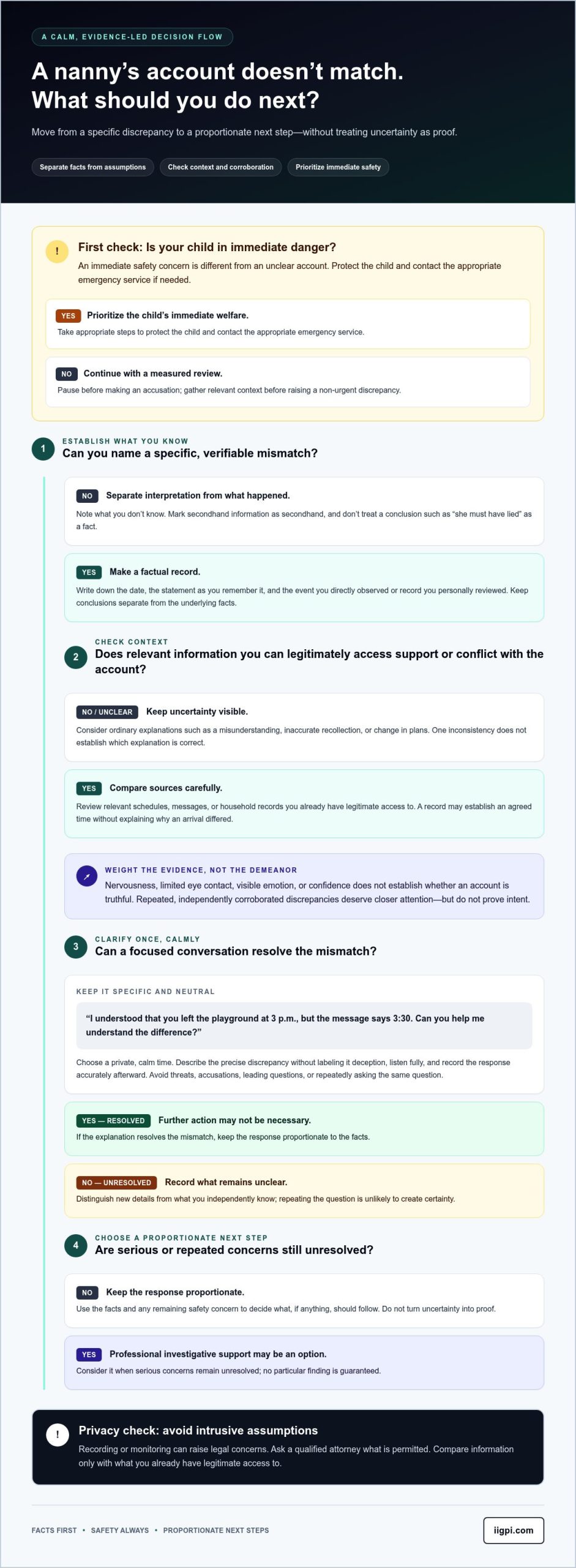
A discrepancy can have several explanations: a misunderstanding, an inaccurate recollection, a change in plans, or a deliberate falsehood. One inconsistency doesn’t establish which explanation is correct. If you’re deciding what to do if you think your new nanny is lying, pause before making an accusation. Identify exactly what you know, how you know it, and what remains uncertain.
A concern is a verifiable inconsistency between an account and known information, not a conclusion about someone’s honesty or intent. That distinction matters because suspicion can feel convincing while still resting on incomplete details. A factual record helps you review what happened without letting anxiety or someone else’s interpretation stand in for evidence.
Separate observed facts from interpretation
Write down the date, the nanny’s exact statement as you remember it, and the event you directly observed or the record you personally reviewed. Mark anything you heard from someone else as secondhand. Keep conclusions such as “she must have lied” separate from the underlying facts. One mismatch is not automatically a pattern. Note what you don’t know and consider ordinary explanations, such as a schedule change or a misunderstanding about timing.
Context matters, too. A nanny’s responsibilities depend on the family’s arrangements and the specific role; a general overview of the Nanny role illustrates that duties vary. Compare the statement with information you already have legitimate access to. Don’t fill gaps with speculation or seek information through intrusive means.
Assess whether the concern is urgent
First consider whether your child may be in immediate danger. If so, take appropriate steps to protect the child and contact the appropriate emergency service. For a non-urgent discrepancy, gather relevant context before raising it with the nanny. Responding to an immediate safety concern is different from confronting someone about an unclear account.
A measured sequence can keep your response proportionate:
- Pause. Avoid sending an accusatory message while upset.
- Record. Note dates, statements, and firsthand observations accurately.
- Assess context. Identify what supports the concern, what conflicts with it, and what may have another explanation.
- Clarify. Ask a neutral, specific question and give the nanny an opportunity to explain.
- Decide what follows. Consider the explanation alongside the facts and any remaining safety concern.
For example, if a pickup time differs between a message and your recollection, record both accounts and check the schedule or communications already available to you. If the explanation resolves the mismatch, further action may not be necessary. If concrete concerns remain, document what is unresolved and consider a proportionate next step rather than treating uncertainty as proof.
Check a Nanny’s Story Without Jumping to Conclusions
Once you’ve identified a specific discrepancy, assess the information rather than trying to read the nanny’s character from one conversation. Nervousness, limited eye contact, visible emotion, or a confident manner can have many causes; none establishes whether an account is truthful. A fair assessment considers context, consistency, and whether independent information supports or conflicts with the account.
Repeated, independently corroborated discrepancies warrant more attention than one unclear detail. That does not mean a pattern proves intent. It means the concern deserves a closer review before you decide whether further action is proportionate.
Look for context, consistency, and corroboration
Compare the account with relevant schedules, messages, or household records you already have legitimate access to. Keep each source distinct: a written pickup plan may establish the agreed time, for example, but not explain why an arrival differed from it. Consider whether details change across conversations and whether a practical explanation could account for the difference. Don’t treat an inference as corroboration.
Repeated or leading questions can make a discussion feel like an interrogation and blur which details came from the original account versus later questioning. Rather than asking the same question in several forms, note what remains unclear and ask for one focused explanation. When you’re deciding what to do if you think your new nanny is lying, rely on specific, comparable information rather than demeanor or intuition alone.
Prepare a fair, specific conversation
Choose a private, calm time when neither of you is rushing to manage a child’s immediate needs. Describe the precise discrepancy without labeling it deception, then invite an explanation. For example: “I understood that you left the playground at 3 p.m., but the message says 3:30. Can you help me understand the difference?” Listen fully and record the response accurately afterward, rather than relying on memory.
Keep the conversation focused on facts, not on catching someone out. Avoid threats, accusations, or questions that imply the answer you expect, such as “You weren’t really at the park, were you?” If the explanation introduces information you hadn’t considered, distinguish that new detail from what you independently know. If it doesn’t resolve the mismatch, note what remains unclear; repeating the question is unlikely to create certainty.
- Keep the comparison narrow. Match the specific statement to the relevant schedule or message, not to unrelated household events.
- Check for independent support. A second source is most useful when it was created separately from the account being assessed.
- Allow for uncertainty. A discrepancy can remain unresolved without establishing that anyone deliberately misled you.
If documented concerns remain unresolved after a fair conversation, professional support may help you assess the available information. International Investigative Group is a private investigation firm, Licensed, Bonded, Insured, that provides personal and domestic investigations. Investigative support can help gather relevant information, but it cannot guarantee a particular finding.
Direct Conversation, Records, or Investigation: Compare Your Options
The proportionate next step depends on what remains uncertain, how serious the concern is, and whether useful information is already available. A calm discussion or review of household records may resolve a narrow question. Professional investigative support may be appropriate when significant concerns persist after reasonable clarification. Each option has limits; none should be treated as automatic proof of dishonesty.
| Option | Purpose | Limits and when it may fit |
|---|---|---|
| Direct discussion | Give the nanny an opportunity to explain a specific, non-urgent discrepancy. | It depends on a voluntary conversation and may not resolve conflicting accounts. It can fit when the concern is narrow and there may have been a misunderstanding. |
| Review of available records | Compare an account with relevant schedules, messages, or household records you’re entitled to access. | Records may clarify a time, plan, or communication, but usually can’t establish intent or explain every inconsistency. Use this option when relevant information already exists. |
| Professional investigative support | Seek structured information gathering when serious concerns remain unresolved. | An investigation may help clarify relevant facts, but can’t guarantee a particular finding. Consider it when discussion and available records leave material questions unanswered. |
When a conversation or existing records may be sufficient
For a specific, non-urgent concern that could have an ordinary explanation, begin with a private conversation and consult records already available to the household. Limit the review to information you’re entitled to access; suspicion does not mean you should access private accounts, devices, or communications. These steps may clarify what was agreed, reported, or recorded, but they can’t by themselves prove why an account differed or establish a person’s intent.
An informal reference conversation is distinct from a background investigation. A reference can offer that person’s account of a candidate’s work history, while a background investigation is a separate, structured investigative service. Neither should be treated as infallible. What each can establish depends on the information available and verifiable.
When professional investigative support may be appropriate
If documented concerns remain significant after reasonable clarification, professional support can provide a structured way to examine unresolved questions. International Investigative Group conducts Personal & Domestic Investigations and background investigations. Its investigators can collect photographic and video evidence through investigative services. The firm is Licensed, Bonded, Insured, and offers customized service packages. These capabilities do not promise a particular finding.
For further context on the investigative role, the sibling guide The Modern Personal Detective: Protocols for Private and Domestic Intelligence explores private and domestic intelligence. If professional support is warranted, personal and domestic investigations may be relevant to the concerns you’ve documented.
Protect Your Child and Privacy While You Decide
Uncertainty about a nanny’s account doesn’t require you to assume misconduct, but it can justify sensible steps to keep your child’s care clear and consistent while you assess the facts. Focus on arrangements that make sense regardless of the suspicion: who is authorized to care for your child, how changes to the routine are communicated, and what to do if a plan changes. If a child may be in immediate danger, contact the appropriate emergency service or child-protection resource.
Set practical household safeguards
Review the usual routine and authorized caregiver arrangements, then communicate any changes plainly to the people responsible for your child. For example, make clear who may pick up your child and how you’ll confirm a schedule change. Keep relevant messages or records in their original form, noting when and where they came from. Don’t edit them or present an assumption as an established fact. These steps support continuity of care without treating suspicion as proof.
Keep communications focused on your child’s welfare and the practical information needed to manage care. Avoid using a child to test the nanny’s account or asking leading questions that could create confusion or pressure. If you have an immediate safety concern, prioritize your child’s protection and seek appropriate emergency or child-protection assistance rather than trying to resolve the matter through private surveillance.
Keep privacy and legal questions within proper boundaries
Recording, monitoring, or GPS tracking can raise privacy and legal issues that depend on the circumstances and location. Don’t assume a camera, audio recording, or tracking method is lawful simply because it involves your household or your child’s caregiver. Avoid covert recording, secret tracking, and access to accounts or devices you aren’t authorized to use. If you’re considering monitoring or have questions about employment, privacy, or whether information can be used as evidence, consult a qualified attorney.
Professional investigative support is not a substitute for legal representation or legal advice. An investigator may gather information through investigative services, but questions about what you may lawfully record, monitor, or do with evidence belong with an attorney. Keeping those roles distinct can help you protect your child without creating a new privacy concern through an impulsive response.
If unresolved, documented concerns lead you to consider professional investigative support, International Investigative Group provides personal and domestic investigations and is Licensed, Bonded, Insured. Its investigators can collect photographic and video evidence through investigative services, without guaranteeing a particular finding or outcome. Discuss a personal investigation if you want to consider whether that option fits your situation.
When to Seek Professional Help for Concerns About a New Nanny
Professional investigative support may be worth considering when the concern involves a serious potential risk, discrepancies recur, information you can legitimately review corroborates part of the concern, or reasonable attempts to clarify the account leave an important question unresolved. These are reasons to assess your options, not proof that the nanny has acted dishonestly. The appropriate next step depends on your child’s immediate welfare and what you still need to understand.
Separate urgent safety matters from non-immediate uncertainty. If you believe your child is in immediate danger, prioritize the child’s protection and contact the appropriate emergency service. An investigation is not an emergency response. For unresolved concerns that do not require immediate intervention, organize notes about what happened, what supports the concern, and what remains unknown. This can help you explain the situation clearly when discussing possible next steps.
What to expect when discussing investigative support
Be prepared to describe the concern, distinguish firsthand facts from assumptions, and explain what clarification you’re seeking. International Investigative Group is a private investigation firm, not a law-enforcement agency. It provides Personal & Domestic Investigations and background investigations, and tailors packages to the services clients require. No particular finding or outcome can be guaranteed.
IIGPI is Licensed, Bonded, Insured, and reports 10,000+ Cases Solved. That figure is not a prediction or guarantee about an individual matter. The firm’s investigators can conduct local and international human surveillance and collect photographic and video evidence through investigative services. This is information-gathering support, not a determination of guilt or a substitute for an appropriate emergency response.
Make the next step deliberate and proportionate
Before proceeding, consider whether the concern is sufficiently serious, whether discrepancies are repeated and supported by information you can lawfully use, and whether a meaningful question remains after clarification. If the issue is non-urgent, take time to organize the facts and consider what information would actually help. For additional context on surveillance as an investigative method, see Professional Surveillance Services: A Comprehensive Guide for 2026.
A focused discussion can help establish whether investigative support fits the concern and what the requested clarification would involve. Contact IIGPI about your concerns to discuss a personal or domestic investigation. A careful review can guide a proportionate decision: suspicion alone is not certainty, and verification should take priority over accusation.
Choose a Next Step Grounded in Facts
The question isn’t only what to do if you think your new nanny is lying, but what information would help you make a fair, confident decision. Identify the specific uncertainty you still need resolved and what would count as a meaningful answer. That focus can prevent an open-ended suspicion from driving increasingly intrusive steps while keeping your child’s welfare central.
If the concern remains unresolved and you’re considering professional support, discuss the documented facts and the clarification you seek, not a predetermined accusation. Discuss whether investigative support fits your situation with IIGPI. A measured next step can help you move forward with greater clarity, leaving the evidence to inform your judgment.
Frequently Asked Questions
What should I do first if I think my new nanny is lying?
Start with a brief chronology that separates what you personally observed from what another person reported or what you inferred. Preserve the original message or schedule entry, and note uncertainty rather than filling gaps from memory. This gives you a clearer basis for deciding what to do if you think your new nanny is lying. If the concern involves immediate danger, seek appropriate emergency help instead of waiting to complete your notes.
Should I confront my nanny if I suspect she is lying?
A calm conversation can help clarify one specific, non-urgent issue. Choose a time when your child isn’t present, describe the point you’re trying to understand, and ask a neutral question. For example, clarify which schedule change the nanny understood to be in effect. Afterward, consider sending a short, factual message confirming any agreed routine or expectation, without framing the follow-up as an admission of wrongdoing.
How can I tell whether my nanny is lying or has made a mistake?
You generally can’t determine intent from one inconsistency or a person’s expression. Consider whether the discrepancy could result from a misunderstood time, a changed plan, or an imperfect recollection, then assess whether independent information supports the concern. A mistaken pickup time, for example, is different from a repeated mismatch between a stated route and records you’re entitled to review. Even corroboration can clarify events without proving why they occurred.
Can I secretly record or track my nanny to find out the truth?
Don’t assume secret recording or GPS tracking is lawful; privacy rules can depend on the method, location, and circumstances. Avoid accessing a nanny’s personal device, account, or location data without authorization, even if you believe it could resolve a concern. If you’re considering recording or monitoring, ask a qualified attorney about the specific situation before taking action. Limit your review to information you’re entitled to access and preserve it without alteration.
When should I consider a professional investigation into a nanny’s conduct?
Consider discussing professional support if a serious, concrete concern remains unresolved and the information available to you doesn’t answer an important question. Before taking that step, identify what you need clarified, such as whether a reported event can be independently examined. A private investigation is a fact-gathering option, not an emergency response or a legal determination. If immediate child safety is at stake, address that risk through appropriate emergency resources first.
Can a private investigator gather evidence about a nanny?
Yes. Investigative work can gather information relevant to a family’s stated concern, subject to appropriate boundaries and the facts of the matter. International Investigative Group provides Personal & Domestic Investigations, and its investigators can collect photographic and video evidence through investigative services. The possible scope depends on the question being examined; no particular finding should be assumed. For advice about whether a method is lawful in your circumstances, consult a qualified attorney.
What should I bring when discussing concerns with an investigator?
Bring a concise chronology and copies of relevant information you’re entitled to access, such as a schedule, a message about a change, or a written account of an event. Label what you witnessed directly and what came from another source. State the specific question you hope to resolve and what you’ve already done to clarify it. Don’t alter original records or attempt intrusive monitoring to create material for the discussion.