
What can a premarital background check clarify, and what should it leave to your own judgment? Before a wedding, unanswered questions about a prior marriage, identity, or a major life circumstance can feel consequential. At the same time, investigating someone you love can raise serious concerns about privacy and trust. A premarital background check nyc is most useful when it addresses a specific question through lawful, reliable sources, rather than treating uncertainty as a verdict.
It’s reasonable to want clarity and to proceed with care. A discreet, case-specific inquiry can help distinguish verifiable facts from assumptions, but no search can establish a person’s character or predict the future of a relationship. This guide explains what an investigation may clarify, where its limits are, and how to consider scope, privacy, and applicable rules. It also covers how to assess records that may be incomplete or require context, so you can consider verified information without letting it make a personal decision for you.
Key Takeaways
- A premarital background check nyc can help verify relevant information, but it cannot determine a partner’s character or predict a relationship’s future.
- Define the question you need answered before considering an inquiry, and keep the scope relevant and proportionate.
- Direct conversation, public self-searches, and professional investigation differ in reliability, context, and privacy exposure.
- Verify possible record matches and consider findings as information, not a verdict.
- International Investigative Group has more than 30 years of experience and reports resolving over 10,000 cases, including personal, matrimonial, and background investigations.
Premarital Background Check NYC: When Can More Information Help?
A premarital background check is a focused inquiry into relevant, verifiable information, not an unrestricted search through every aspect of a partner’s life. Its value depends on having a clear question. For example, you may want to determine whether a material statement about a prior marriage or major life circumstance can be corroborated through appropriate sources. Uncertainty before marriage is understandable, but it does not by itself show that a partner has been deceptive.
A responsible premarital check can help verify specific, relevant facts, but it cannot establish a person’s character, determine compatibility, or guarantee trustworthiness. It is a fact-finding measure, not a substitute for honest conversation, relationship counseling, or your own judgment about whether to marry. A private investigator may conduct inquiries within an appropriate scope. The purpose and limits of the work should remain clear from the outset.
When a premarital inquiry may be proportionate
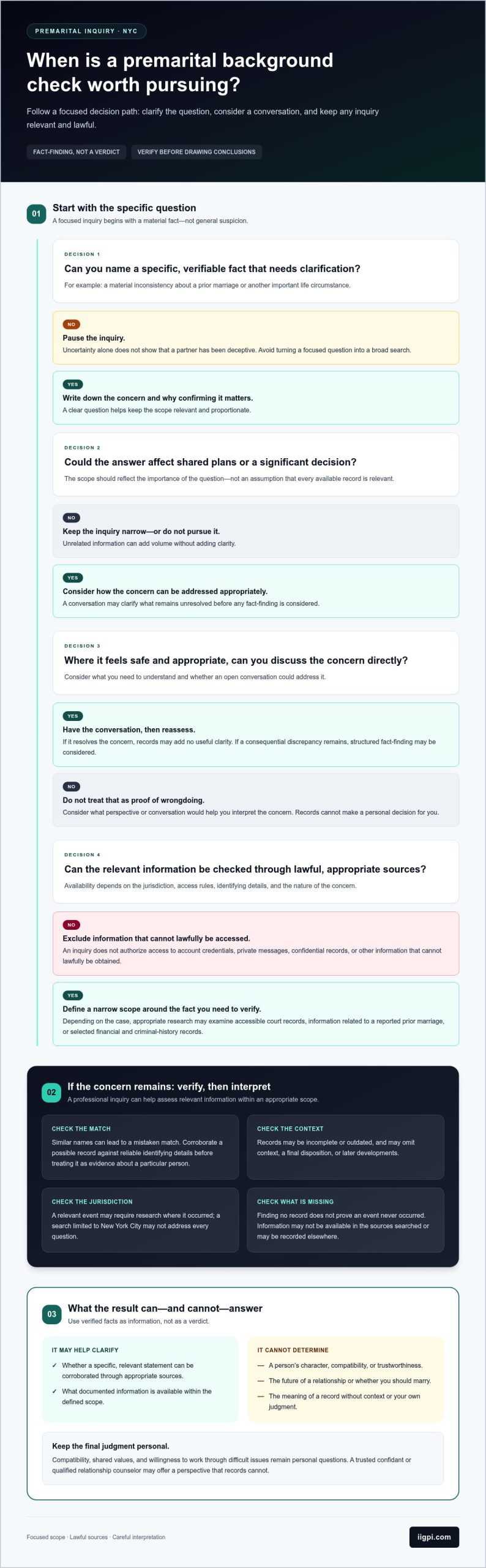
An inquiry may be proportionate when a material inconsistency remains unresolved, such as conflicting accounts of a past marriage or an important circumstance that could affect shared plans. Before pursuing a premarital background check nyc, write down the specific concern and why confirming it matters. This helps keep a focused question from expanding into general surveillance or an investigation of private matters without a clear reason.
Where it feels safe and appropriate, a direct conversation may be a good first step. Consider what you need to understand, what information would address the concern, and whether you can discuss it openly. If a discrepancy remains consequential, professional fact-finding can provide a structured way to assess relevant information without treating suspicion as proof.
Why a background check cannot decide whether to marry
Records document particular events or transactions. They do not tell the full story of the person involved. A record may be incomplete or outdated, and a similar name can result in a mistaken match. Verify findings carefully and consider their context before drawing conclusions about identity, intent, or character.
A practical decision framework starts with three questions: What fact needs clarification? How material is it to the life you intend to build together? What conversation or perspective would help you interpret the answer? These questions keep an inquiry proportionate and help separate a verified fact from an assumption about what that fact means.
Even accurate information cannot settle questions of compatibility, shared values, or willingness to work through difficult issues. Those judgments remain personal. Depending on the concern, a trusted confidant or qualified relationship counselor may offer a perspective that records cannot. The aim is not certainty about another person, but a clearer understanding of the facts that matter to you.
What Can a New York Premarital Background Check Examine?
The scope of a premarital background check nyc should reflect the question being asked, not an assumption that every available record is relevant. Depending on the case, lawful and appropriate research may examine accessible court records, information related to a reported prior marriage, or selected financial and criminal-history records. Sources vary according to jurisdiction, access rules, identifying details, and the nature of the concern.
Public-record research is different from access to private information. A background inquiry does not authorize someone to obtain another person’s account credentials, private messages, confidential records, or information that cannot lawfully be accessed. A responsible investigation stays within authorized sources and a defined purpose. The U.S. Bureau of Labor Statistics describes the duties of private detectives, including gathering and analyzing information. The relevance of any particular source depends on the case.
Records and history that may be relevant
Court-record research may help clarify a specific question, but access and search processes differ across courts and jurisdictions. Information about a prior marriage, for example, may require research where the event occurred rather than a search limited to New York City. Financial or criminal-history questions also call for care: records may be restricted, vary in availability, or be inappropriate to pursue without a clear, lawful purpose.
Before widening the scope, identify the fact you are trying to verify and what information would answer the question. An investigator can then assess relevant sources and whether they are appropriate to the inquiry. A focused search is more useful than collecting unrelated records that add volume without adding clarity.
What records cannot tell you
Record searches have limits. Finding no record does not prove that an event never occurred. The information may not be available in the sources searched, may be recorded in another jurisdiction, or may not be reliably matched. Records can also be incomplete or outdated, and an entry may omit context, a final disposition, or later developments.
Verify a record match against reliable identifying details before treating it as evidence about a particular person. Names can be shared, so an apparent match should not be considered conclusive without appropriate corroboration. A record may show that a documented event exists without explaining its circumstances or meaning. It cannot predict future conduct, reveal compatibility, or settle whether a relationship is sound.
Interpret findings in light of their source, date, jurisdiction, and available context, rather than reducing them to a label. If you need discreet assistance with a defined concern, International Investigative Group conducts background investigations tailored to the circumstances of each case.
DIY Search or NYC Private Investigator: Which Route Fits?
The right approach depends on the question, the sources involved, and your ability to distinguish a reliable match from a misleading result. A direct conversation may resolve a straightforward uncertainty. A public self-search can provide an initial orientation, while a professional inquiry can add structure when information spans jurisdictions or requires careful identity verification. The comparison below outlines practical trade-offs; no single approach fits every situation.
| Approach | Potential value | Limitations to consider |
|---|---|---|
| Direct conversation | Offers context and gives both people an opportunity to discuss a specific concern. | It depends on openness and may not independently verify a disputed fact. |
| Public self-search | Can provide a starting point through publicly accessible sources and help identify questions to clarify. | Results may be incomplete, outdated, difficult to interpret, or associated with someone else. |
| Scoped professional inquiry | Can bring structure to research and support careful assessment of relevant information and possible identity matches. | Its value depends on a defined purpose, appropriate scope, and access to relevant, usable sources. |
What a self-directed search can and cannot do
Publicly accessible court or government information may help orient a search, but no single online result should be treated as a complete, current account. Records may be spread across jurisdictions, and search tools may not show the context or later developments needed to interpret an entry. Duplicate names, spelling variations, and incomplete identifying details can lead to mistaken matches.
Keep any search within appropriate boundaries. Don’t try to enter restricted accounts or databases, or contact third parties deceptively to obtain information. If a result appears significant, consider whether you can reliably confirm that it belongs to your partner and understand what it documents. If you cannot, pause rather than treating an uncertain match as proof.
When professional investigative support may add value
Professional support may help when the question is consequential, information is fragmented, or you cannot confidently verify a possible match. A structured inquiry can stay tied to a stated concern, assess relevant identifying details, and distinguish sourced findings from unresolved gaps. Discretion and experience in personal investigations are also important when the subject is sensitive and the goal is clarification, not intrusion.
International Investigative Group conducts personal, matrimonial, and background investigations, and reports more than 30 years of experience and over 10,000 cases resolved. That experience does not make a search exhaustive or determine what a finding means for a relationship. It supports a careful, case-specific review. For a broader discussion of investigative practice in private and domestic matters, see The Modern Personal Detective: Protocols for Private and Domestic Intelligence.
For a premarital background check nyc, choose an approach that fits the question. A conversation may be enough to resolve a simple misunderstanding; a focused professional inquiry may suit a concern that requires structured research. Either way, use the information to guide thoughtful discussion and judgment, not replace them.
How to Arrange a Premarital Background Check in NYC Responsibly
A responsible inquiry starts before anyone reviews records. Define the concern, decide what information could address it, and keep the scope proportionate to the decision you face. For a premarital background check nyc, specify whether the question relates to New York City, another part of New York State, or events connected to another jurisdiction. Record availability and access rules vary, so location can guide an inquiry but does not guarantee that a particular record can be obtained.
Prepare a focused and proportionate request
Separate what you know from what you suspect. A discrepancy is a question to clarify, not proof of deception. A specific request helps keep fact-finding within its purpose. International Investigative Group conducts personal investigations according to the circumstances of each case, shaping the inquiry around the concern and relevant information.
- State the question. Describe the unresolved fact as clearly as possible, such as whether a specific statement about a past event can be verified. Avoid a broad request to investigate someone without identifying a relevant concern.
- Separate facts from interpretations. Note what you directly know, what your partner has told you, and what remains uncertain. For example, distinguish a confirmed date from your inference about why two accounts differ.
- Set the timeframe. Identify the period relevant to the question. A defined timeframe can focus research and help avoid unrelated information.
- Identify known jurisdictions. Share locations connected to the concern, such as a New York City borough, another New York State county, or another state or country. These details can orient research, but record systems and access differ by jurisdiction.
- Describe the desired scope. Clarify what information would answer the question and what falls outside it. A focused inquiry should not become an open-ended search into unrelated private matters.
Review findings carefully and preserve privacy
Before acting on a finding, review identifying details, dates, jurisdiction, source, and any available context. If information appears incomplete or inconsistent, treat it as unresolved rather than established fact. Consider what the record documents and distinguish that from assumptions about motive or character. Findings can inform a personal decision, but should not dictate it.
Handle sensitive material discreetly. Limit sharing to people whose perspective is genuinely useful, and avoid circulating unverified allegations or records more widely. If you need help defining a focused inquiry, discuss a discreet personal-investigation inquiry with IIGPI.
A Discreet NYC Investigation: What to Expect from IIGPI
Relationship questions can be difficult to raise, especially when a concern could affect shared plans. International Investigative Group conducts personal, matrimonial, and background investigations for people seeking help evaluating a specific, sensitive question. A premarital background check nyc is a defined fact-finding inquiry, not a search for certainty about a partner’s character or a substitute for direct communication and personal judgment.
A case-specific approach to personal investigations
International Investigative Group reports more than 30 years of experience and more than 10,000 cases resolved. The firm was founded by a former law-enforcement professional, a background that informs its investigative work without making it a law-enforcement agency. These reported credentials provide context, but do not guarantee a particular finding, a complete record, or a conclusion about an individual.
Each inquiry should begin with a clearly stated concern and proportionate scope. A question about a specific material statement, for example, calls for a different focus than a broad request to examine someone’s history. The appropriate approach depends on the circumstances, relevant jurisdictions, and information that can be examined lawfully. Privacy and applicable legal boundaries remain essential. An investigation should not be used to access restricted information or pursue unrelated personal details.
A measured process also means understanding what an inquiry is intended to clarify, what it cannot establish, and where uncertainty may remain. Findings are information to assess, not a verdict on character, compatibility, or the future of a relationship. An investigation can help evaluate relevant facts; deciding what they mean remains your responsibility.
Discuss your concern and determine a measured next step
Before speaking with an investigator, describe the issue in concrete terms. Identify what you know, what remains unresolved, the approximate timeframe, and any relevant locations. You do not need a complete theory. A clear question and its context can help shape an appropriate inquiry and keep its scope limited.
A professional discussion can clarify the realistic limits of research before you decide how to proceed. It should distinguish verifiable questions from assumptions, address relevant privacy boundaries, and avoid implying that records can provide certainty about another person. If you continue, keep the purpose focused on information relevant to your concern.
If you’re considering a personal investigation, contact IIGPI to discuss your concern discreetly and consider an appropriate next step.
Let Clarity Support Your Next Decision
The decision ahead belongs to you. No investigation can make it on your behalf. A carefully scoped inquiry may give you a firmer basis for reflection or conversation, while leaving room for context, mutual understanding, and your priorities. If a question remains important to your plans, first consider what answer would genuinely help and which boundaries you want respected.
A premarital background check nyc is most constructive when it serves that limited purpose: clarifying a relevant uncertainty without turning a relationship into an exercise in suspicion. Whatever you learn, choose a response that reflects both the evidence and the standards you want in a partnership. Your next step may be a candid conversation, time to consider new information, or deciding that no further inquiry is needed.
If professional guidance would help you identify a proportionate next step, discuss a discreet personal investigation with IIGPI. Contact IIGPI to discuss your concern and a focused next step.
Frequently Asked Questions
Is a premarital background check legal in New York?
A private inquiry must comply with the laws that apply to the information sought and the way it is obtained. Public availability does not automatically permit every use, and an investigator cannot be assumed to have access to restricted records. Because rules depend on the information and circumstances, treat this as general information, not legal advice, and verify current requirements before relying on a particular legal interpretation.
What does a premarital background check usually include?
There is no single standard package. Scope depends on the question, relevant jurisdictions, accessible records, and applicable rules. A focused inquiry might, for example, examine an accessible court record related to a specific question about a prior marriage. It cannot guarantee a complete personal history. Check any apparent match against reliable identifying details and consider the source’s limits before drawing conclusions.
Can a background check tell me whether my partner is trustworthy?
No. A background check cannot establish trustworthiness or reliably predict how someone will behave in a relationship. It may clarify a factual issue, but a record does not reveal the full circumstances behind an event or how a person has changed since then. Consider findings alongside direct communication and your own experience. If uncertainty is affecting the relationship, a qualified counselor may help you discuss concerns constructively.
How long does a premarital background check take in NYC?
There is no universal timeframe. A narrow inquiry involving one location may differ from research spanning several jurisdictions or requiring additional identity verification. Record availability and the need to resolve conflicting details can also affect the process. Before proceeding, describe the question and known locations so the investigator can explain the anticipated scope and limitations without promising a completion date.
Can I conduct a premarital background check myself?
You can review some publicly accessible sources yourself, but keep a record of where and when you searched and which identifying details you used. This helps distinguish a confirmed result from a search-engine summary or uncertain name match. Don’t use restricted databases, enter private accounts, or misrepresent yourself to obtain information. If results remain ambiguous, do not treat them as verified facts.
Will my partner find out about a premarital background check?
There is no responsible way to guarantee that a partner will never learn about an inquiry. The records involved, communications, and circumstances of the investigation may affect whether it becomes known. Before proceeding, consider how discovery could affect the relationship and whether a direct conversation is appropriate and safe. You can discuss discretion and boundaries with an investigator, but avoid unauthorized access or deceptive methods.
What should I do if a background check finds a concerning record?
Pause before acting. Confirm whether the record refers to the right person, then review its date, jurisdiction, and available case outcome. A name match without confirming details, for example, may not be enough to identify someone. Don’t circulate unverified material or treat an allegation as a proven finding. Once you better understand the information, consider whether a measured conversation or suitable professional guidance would help you decide what it means.