
What if the strongest record of possible parental alienation is not the most forceful accusation, but a careful account of what happened and how it affected your child? When documenting parental alienation for family court, it can be difficult to know what to record, how to preserve messages or missed parenting time, and how to keep distress from shaping the facts. A clear, dated chronology can help separate direct observations from interpretations while keeping your child’s wellbeing at the centre.
This guide explains how to document incidents objectively, preserve communications with relevant context, and avoid common mistakes that may weaken your record. It also covers ways to keep your child out of adult conflict, including avoiding leading questions and never asking them to gather evidence.
You’ll learn when professional investigative support, including a child custody investigation or a lawful review of digital material, may help document relevant events systematically. Court procedures and evidentiary requirements vary by jurisdiction, so case-specific legal advice may also be important. The goal is a credible, child-centred chronology, not a pile of accusations.
Key Takeaways
- Build a consistent log that identifies who was present, where an event occurred, its source, and its practical impact.
- When documenting parental alienation for family court, distinguish what a record directly establishes from what it cannot prove on its own.
- Assess communications, schedules, witness accounts, and professional observations in context. Each has different strengths and limitations.
- Keep evidence gathering proportionate and lawful. Intrusive or misleading collection can undermine the record and intensify conflict.
- Prepare for New York proceedings by organizing the chronology, preserving originals, indexing exhibits, and identifying questions for jurisdiction-specific legal advice.
Documenting Parental Alienation for Family Court: What a Record Can, and Cannot, Show
A changing parent-child relationship can be painful and difficult to interpret. A child’s reluctance, a tense exchange, or a missed visit may raise serious concerns, but no single event necessarily explains what is happening or why. Documenting parental alienation for family court means creating a dated, factual account of relevant events, communications, and observable effects. It does not mean treating a suspicion as a proven cause.
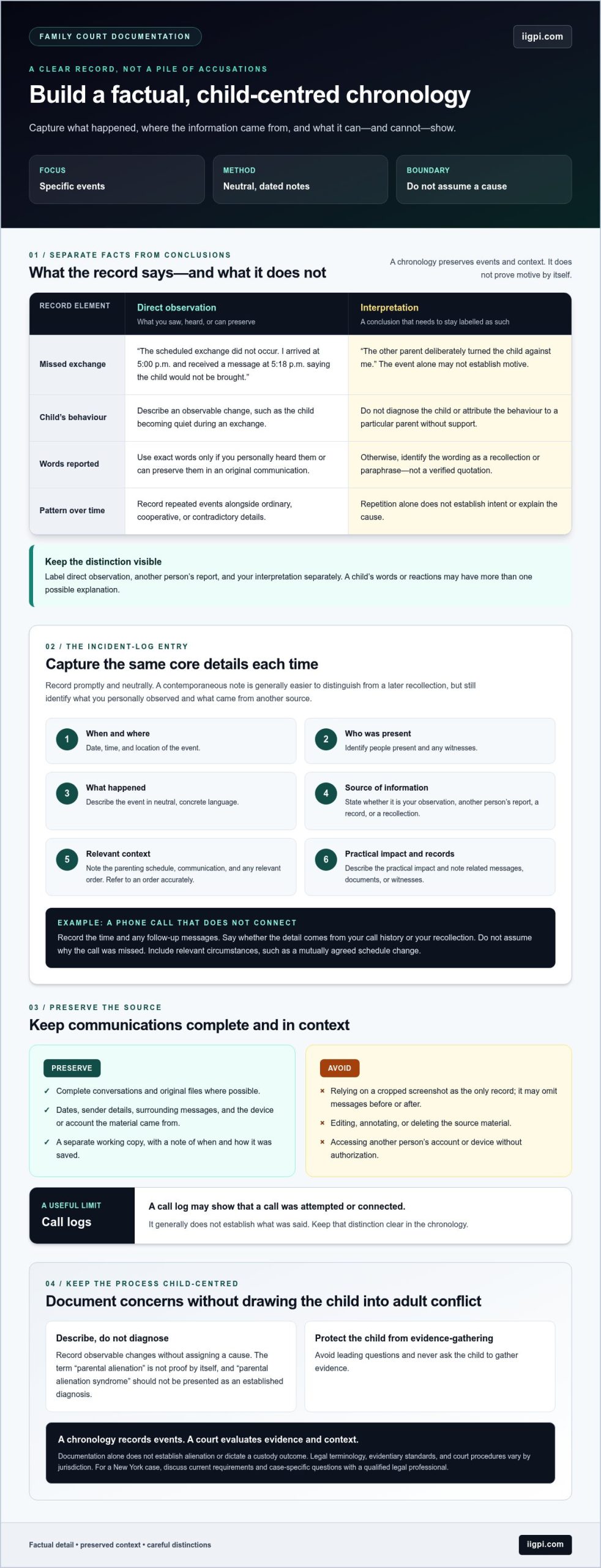
A useful record separates what you directly observed from what you infer. “The scheduled exchange did not occur. I arrived at 5:00 p.m. and received a message at 5:18 p.m. saying the child would not be brought” describes conduct and identifies its source. “The other parent deliberately turned the child against me” assigns a motive that the event alone may not establish. Include relevant context, such as schedule details, communications, and what happened before or after, without presenting conclusions as facts.
Which behaviors may warrant careful documentation?
Record concrete events such as denied parenting time, changes to agreed schedules, or interference with communication. Note the date, time, people present, and how you know what occurred. Use exact words only if you personally heard them or can preserve them in an original communication. Otherwise, label the statement as a recollection or paraphrase. Describe observable changes, such as a child becoming quiet during an exchange, without diagnosing the child or attributing the behavior to a particular parent.
A pattern may provide more context than an isolated incident, but repetition alone does not establish intent or explain the cause. Record ordinary or contradictory details as well as concerning ones. A balanced chronology is more informative than a file containing only events that support one interpretation.
Why is the term parental alienation not proof by itself?
The term describes a contested concept, not a substitute for specific evidence. The overview of parental alienation notes legal and scientific controversy. Avoid presenting “parental alienation syndrome” as an established diagnosis or using a label to explain a child’s behavior without qualified assessment. A child’s words or reactions may have multiple possible explanations. A careful record preserves that uncertainty instead of resolving it by assumption.
A chronology records events; a court evaluates evidence and context. Documentation can contribute to a broader assessment, but it does not, by itself, establish alienation or dictate a custody outcome. Legal terminology, evidentiary standards, and court procedures vary by jurisdiction. For a New York case, discuss current requirements and case-specific questions with a qualified legal professional. No single record format guarantees that material will be accepted or given particular weight.
How to Build a Clear Parental Alienation Documentation Log
A consistent log turns separate events into an organized chronology without turning suspicion into fact. When documenting parental alienation for family court, use the same process each time: record promptly, preserve original material, add context, and update the chronology as new information becomes available. A contemporaneous note is generally easier to distinguish from a later recollection, but it should still identify what you personally observed and what came from another source.
What should each incident-log entry include?
Write one entry for each event, using neutral language and identifying how you learned about it. Include the relevant parenting schedule or communication context, and refer to any order accurately rather than paraphrasing it from memory. Note witnesses and related messages or documents, then preserve those materials separately. Clearly label direct observation, another person’s report, and your interpretation. Keep interpretations identified as such rather than presenting them as established facts.
Minimum useful entry: date, time, location, people present, event, source, relevant schedule or communication context, practical impact, witnesses, and related records.
For example, if a scheduled phone call does not connect, record the time and any follow-up messages. Identify whether the information comes from your call history or your own recollection. Avoid assumptions about why the call was missed. Include ordinary cooperation and relevant circumstances, such as a mutually agreed schedule change, so the chronology does not record only conflict.
How should parents preserve texts, emails, and call records?
Keep complete conversations and original files where possible. A cropped screenshot can omit the exchange before or after a message, so don’t rely on it as your only record. Retain dates, sender details, surrounding messages, and the device or account from which the material came. Store a working copy separately from the original, and note when and how you saved it. Don’t edit, annotate, or delete the source material.
Call logs may show that a call was attempted or connected, but they generally don’t establish what was said. Keep that distinction clear. Never access another person’s account or device without authorization. If ownership, access, or collection of digital material is disputed, seek jurisdiction-specific legal guidance before acting.
As the record grows, update one chronological index and link each entry to its supporting material. Don’t rewrite earlier notes to make them appear more certain. Professional investigative services from the International Investigative Group can provide additional factual support through lawful and methodical evidence gathering.
Which Evidence Can Support a Family Court Record, and What Are Its Limits?
Different records can illuminate different parts of a custody concern. A message may show what was communicated; a parenting schedule can provide context for a missed exchange; a witness can describe what they personally saw; and a professional may document observations made within their role. When documenting parental alienation for family court, an item’s value depends on its content, source, completeness, context, and whether it can be used under the rules that apply to the case.
| Evidence type | Useful context | Common limitation | Preservation consideration |
|---|---|---|---|
| Texts and emails | Dates, participants, surrounding messages, and the issue being discussed | Account attribution, missing context, or incomplete conversations may be questioned | Keep original messages or complete exports where possible; don’t rely only on cropped screenshots |
| Parenting schedules and call records | The planned arrangement and documented attempts to communicate or complete an exchange | A record of a missed visit or call alone may not explain why it occurred | Retain the original schedule, relevant communications, and source records together |
| Firsthand witnesses | What the witness personally saw or heard, when and where it occurred | A witness generally cannot establish events outside their direct knowledge | Record the witness’s name and the specific event they observed; avoid coaching or embellishing accounts |
| Professional observations | Observations made in the professional’s role and documented in that context | Observations may not establish another person’s motive or explain a child’s behavior | Preserve original reports or notes lawfully available to you, with their dates and source |
Relevance does not guarantee admissibility or determine how much weight a court will give an item. Questions may arise about authenticity, completeness, how material was obtained, and whether it meets applicable evidence requirements. Don’t treat a screenshot, a child’s statement, or one missed visit as conclusive proof. Consider each alongside reliable context and other information.
How do digital records and witness accounts differ?
Digital messages can preserve exact wording, but the account holder, surrounding exchange, and integrity of the record may require scrutiny. A witness can offer a firsthand account of an observed event, but cannot reliably establish what happened outside their knowledge. For background on examining digital material, see this computer forensics guide for legal investigations.
Should a parent ask a child to provide evidence?
Don’t rehearse questions, stage or record statements, or ask a child to choose sides. If a child makes a spontaneous statement, document the date, circumstances, and exact words only when reliably recalled. Don’t use follow-up questions designed to confirm a theory. Courts and qualified professionals determine appropriate ways to hear a child’s perspective.
For New York-specific procedures, consult the New York State Unified Court System and obtain jurisdiction-specific legal guidance. Rules and requirements can vary, so verify which standards apply to the particular proceeding.
How to Document Concerns Without Escalating Conflict or Risking Your Case
More evidence isn’t automatically better. Material gathered intrusively, selectively, or in a way that increases conflict may distract from the underlying concern and raise new questions about how it was obtained. Documentation for family court should stay focused on relevant facts, the child’s wellbeing, and compliance with existing custody orders and applicable law.
Keep communications calm, brief, and practical. For example, confirm an exchange time or ask about a missed call without adding accusations or demanding an admission. Don’t trespass, access another person’s account or device without authorization, harass or repeatedly confront the other parent, or make public accusations about the case. Don’t coach the child, ask them to gather information, or pursue a particular statement. If you believe the child may be unsafe, prioritize immediate safety and appropriate professional guidance over evidence collection.
What documentation practices can undermine credibility?
Preserve original records without editing or annotating them. If you make a working copy, retain the unaltered original and identify any notes separately. Don’t present selected excerpts in a way that hides relevant context, speculate about motive as though it were fact, or use diagnostic labels as conclusions. Repeatedly provoking a response to create a record can escalate conflict and make the evidence harder to assess. Include relevant facts even when they complicate your interpretation.
Recording conversations or observing another person can raise legal and privacy questions. For New York matters, don’t assume a recording is lawful simply because you participated in the conversation or believe it may be relevant. Obtain jurisdiction-specific legal review before recording or using material where consent, privacy, or collection methods may be disputed.
When should professional investigative support be considered?
A child custody investigation can help document relevant facts systematically through objective methods, particularly when firsthand records leave important questions unresolved. Any surveillance must be lawful, proportionate, and appropriate to the circumstances. It should not involve unrestricted monitoring or access to private spaces, accounts, or communications. An investigator can document observations, but cannot guarantee a court will admit the resulting material or reach a particular custody decision. For an overview of the subject, read about professional surveillance services and methods.
International Investigative Group conducts child custody investigations, with a focus on lawful, factual observation and the child’s emotional safety.
Preparing Parental Alienation Documentation for New York Family Court
A well-organized record can make a legal consultation more productive, but preparation is not a substitute for advice about court procedure. Whether a message, log, recording, or report may be considered in New York Family Court depends on the circumstances and applicable rules. Ask your family-law attorney about relevant requirements, deadlines, and filing strategy before submitting material.
How can records be organized before a legal consultation?
Prepare a brief chronology and a separate index that connects each entry to its supporting records. Keep the account concise and factual. Preserve original files and maintain a backup, while noting how and when each item was obtained. Mark uncertain dates, gaps, and conflicting accounts rather than resolving them through guesswork. This lets counsel assess both the documented events and the limits of the available information.
- Number chronology entries and cross-reference related records in the index.
- Keep originals intact, with separate working copies for notes or organization.
- Identify unresolved questions and distinguish firsthand observations from reports or interpretation.
This approach supports documenting parental alienation for family court without implying that an organized file alone establishes alienation or determines an outcome. The New York State Unified Court System can provide jurisdictional information. Case-specific legal advice is important when deciding what to file and how to present it.
What can a private investigator contribute to a custody matter?
A child custody investigation may provide independent factual documentation of relevant events. Depending on the circumstances, investigative support may involve lawful, proportionate surveillance or computer forensic examination of digital material the client is authorized to access. This work can help establish what was observed or preserve relevant information. It does not provide legal analysis, determine whether alienation occurred, or guarantee that a court will admit evidence or change custody. An overview of personal and domestic investigation protocols offers additional context on investigative methods.
Before investigative steps begin, discuss the objective and proposed methods with your attorney, particularly where privacy, recording, or access to digital information may be at issue. Keep the purpose specific and the child’s wellbeing central.
If independent factual support would be useful, discuss a child custody investigation with International Investigative Group. Investigative findings can inform preparation, but legal decisions about evidence and court strategy remain with your attorney.
Build a Clearer Record, One Step at a Time
A useful family court record is not a collection of accusations. It is a balanced chronology that separates direct observations from interpretation and preserves relevant context. When documenting parental alienation for family court, record events promptly, retain original communications, and organize supporting material without putting your child in the middle of adult conflict.
Evidence can inform a broader assessment, but no single log, message, or missed visit guarantees a particular finding. New York court requirements depend on the case, so discuss evidence, privacy questions, and filing strategy with your family-law attorney. International Investigative Group conducts child custody investigations and provides surveillance and computer forensics to support factual information gathering.
Discuss a child custody investigation with International Investigative Group to explore investigative support for documenting relevant facts. Keep each step careful and child-centred, with your child’s wellbeing at the forefront.
Frequently Asked Questions
What evidence is useful for documenting parental alienation for family court?
Useful records can include complete text or email conversations, parenting schedules, call logs, firsthand witness accounts, and relevant professional observations. Each can help establish a different fact, such as what was communicated, whether an exchange was scheduled, or what a witness personally observed. Keep dates, sources, and context with each item. A child’s statement, screenshot, or missed visit alone doesn’t establish motive or prove alienation.
How should I document parental alienation incidents?
Record each incident promptly in a dated, chronological log using neutral language. Include the time, location, people present, what happened, how you learned about it, relevant schedule context, practical impact, witnesses, and related records. Clearly separate what you directly observed from another person’s report and your own interpretation. Preserve supporting originals separately, and include relevant cooperation or context rather than recording only events that support one conclusion.
Can text messages be used as evidence in a child custody case?
Text messages may be relevant, but whether a court considers them depends on the case and applicable rules. Keep the complete conversation where possible, including dates, sender details, surrounding messages, and the device or account source. A cropped screenshot may omit context, and a message may raise questions about authenticity or attribution. In New York, ask your family-law attorney about current requirements before relying on or filing digital communications.
Should I record my child talking about the other parent?
Generally, don’t prompt, rehearse, or record a child to obtain a statement for court, and don’t ask them to choose sides or gather evidence. These actions can increase pressure and conflict. If a child spontaneously says something relevant, document when and where it occurred, who was present, and the exact words only if reliably recalled. Courts and appropriate professionals determine how a child’s perspective should be heard.
Does documenting parental alienation guarantee a custody change?
No. Documentation can help present a pattern of events and relevant context, but it doesn’t prove alienation by itself or guarantee a custody change. A court assesses the evidence and circumstances under the rules that apply to the case. Keep records factual and balanced, and consult a family-law attorney about how your jurisdiction evaluates custody concerns and what steps may be appropriate.
Can a private investigator help document parental alienation in New York?
A private investigator may help gather factual information through a child custody investigation, lawful and proportionate surveillance, or computer forensic review of digital material the client is authorized to access. Investigative findings can document observations or examine relevant records, but they aren’t legal advice, a determination that alienation occurred, or a guarantee of admissibility or a custody outcome. Discuss the proposed methods with your attorney, particularly where privacy or recording issues arise.
What should I avoid when documenting a custody dispute?
Avoid trespassing, accessing another person’s accounts or devices without authorization, unlawful recording, harassment, public accusations, or repeated confrontations intended to provoke a response. Don’t coach a child, speculate about motive as fact, or edit originals without retaining unaltered copies. Selectively omitting relevant context can weaken the clarity of a record. Follow existing custody orders and seek jurisdiction-specific legal guidance when collection methods or privacy rules are uncertain.