
A product appears in an online listing outside an authorized channel, but the listing alone doesn’t show where it left the distribution network or who was involved. For businesses searching for a “grey market product diversion investigator new york,” the challenge is connecting that initial lead to evidence that can guide a sound decision. Suspected diversion can involve multiple distributors, resellers, and sales channels, so a clear, documented account matters.
A disciplined investigation can help identify possible diversion points, organize relevant findings, and give counsel and business decision-makers a stronger basis for determining next steps. This guide explains how a New York business can assess suspected grey market diversion, document evidence, and consider practical steps to protect distribution integrity. It also outlines how corporate investigations, surveillance, and computer forensics may contribute when appropriate. International Investigative Group is a New York City-based investigative firm that conducts corporate investigations for businesses.
Key Takeaways
- Distinguish genuine products sold outside authorized channels from counterfeits, theft, and permitted resale before drawing conclusions.
- Use a structured sequence: define the question, map distribution channels, examine records and listings, then organize findings.
- Compare invoices, inventory and shipment records, public listings, interviews, and observations. Each can offer leads, but no single anomaly necessarily identifies a responsible party.
- Set clear boundaries by specifying products, timeframe, geography, known distribution partners, and records already available.
- A grey market product diversion investigator new york businesses work with can tailor corporate investigation methods, including surveillance or computer forensics, to the specific question.
New York Grey Market Product Diversion Investigators
When genuine products appear for sale outside a manufacturer’s intended distribution network, the key question is how they reached that channel. Grey market diversion describes the unauthorized movement or resale of authentic goods outside channels designated by the brand or seller. The term grey market helps distinguish this activity from other forms of trade. To understand what may have happened, a business needs to examine its agreements, records, and distribution structure.
Channel leakage can complicate pricing strategy, affect how products are presented, create different warranty or service expectations, and strain relationships with authorized distributors. Those consequences don’t establish wrongdoing. An unexpected listing or inventory gap is a lead to assess, not proof of who diverted goods or whether a particular sale violated an agreement.
How is grey market diversion different from counterfeiting?
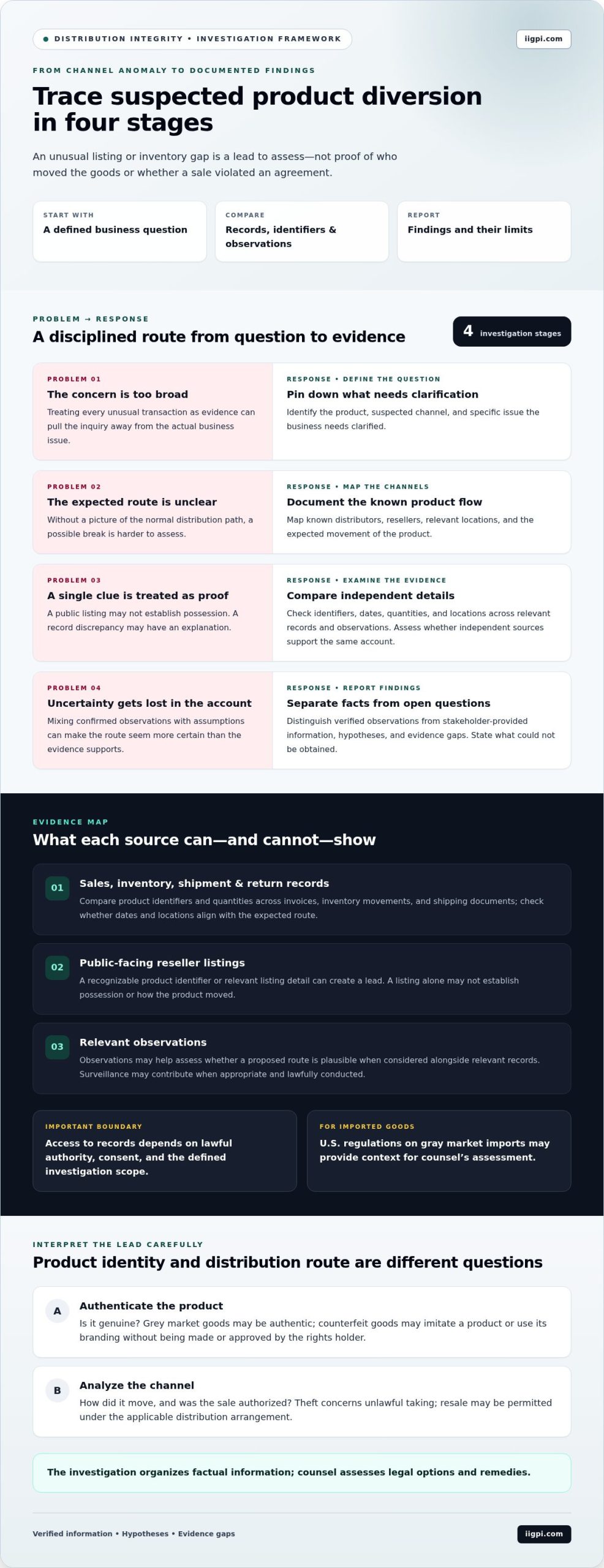
Grey market goods may be genuine products that entered a sales channel without authorization. Counterfeit goods, by contrast, may imitate a product or use its branding without being made or approved by the rights holder. A suspicious listing alone may not establish whether an item is authentic. Authentication asks what the product is; channel analysis asks how it moved and whether the sale was authorized.
Grey market activity also differs from theft and ordinary authorized resale. Theft concerns the unlawful taking of goods, while a resale may be permitted under the applicable distribution arrangement. An investigation should examine both product identity and the route through which it was offered or transferred, rather than treating every off-channel listing as evidence of the same conduct.
Who typically commissions a New York product diversion investigation?
Manufacturers, brand owners, distributors, and corporate counsel may seek an investigation when unexplained inventory discrepancies or recurring unauthorized listings raise questions about distribution integrity. Start with a defined business concern: for example, whether a product is appearing outside approved channels or whether records indicate a break in a known supply path. Set the scope around the products, records, and information relevant to that question.
A grey market product diversion investigator new york businesses engage can gather and analyze information relevant to those questions through corporate investigation methods. Depending on the inquiry, records analysis, surveillance, or computer forensics may contribute to a tailored plan. Findings can help decision-makers understand patterns and unresolved gaps, but they don’t replace legal advice. Counsel assesses legal options and remedies; the investigator develops and organizes factual information for that assessment.
How Investigators Trace Product Diversion Through Distribution Channels
A useful investigation turns a suspected channel anomaly into a traceable sequence of records, observations, and unanswered questions. A grey market product diversion investigator new york businesses engage can structure the work in four stages: define the question, map the distribution channels, examine available evidence, and report findings with their limitations. This keeps the inquiry tied to the business concern instead of treating every unusual transaction as proof of diversion.
- Define the question: Identify the product, suspected channel, and issue the business needs clarified.
- Map the channels: Document known distributors, resellers, relevant locations, and the expected product flow.
- Examine evidence: Compare records and observations for consistent identifiers, dates, quantities, and locations.
- Report findings: Separate verified observations from stakeholder-provided information, hypotheses, and evidence gaps.
Which records and observations may help identify diversion points?
Sales, inventory, shipment, and return records can establish a starting point. Compare product identifiers and quantities across invoices, inventory movements, and shipping documents, then check whether dates and locations align with the expected route. Public-facing reseller listings can add leads, especially when they contain a recognizable product identifier or other details relevant to the inquiry. Each source has limits: a listing may not establish possession, and a record discrepancy may have an explanation that needs further examination.
Access to records depends on lawful authority, consent, and the defined scope of the investigation. For inquiries involving imported goods, U.S. regulations on gray market imports may provide relevant context for counsel’s assessment. Investigators focus on gathering and organizing facts, not advising on legal remedies.
How do investigators corroborate a suspected route?
Corroboration means checking whether independent sources support the same account, rather than relying on a single unexplained sale, inventory mismatch, or online listing. For example, a listing may generate a lead, while shipment records authorized by the client and other relevant observations may help assess whether a proposed route is plausible. A report should identify what is verified, what remains a hypothesis, and what information could not be obtained.
Surveillance may support an inquiry when appropriate and lawfully conducted, but it should address a defined question rather than substitute for records analysis. Businesses can review corporate investigation resources to learn about surveillance as part of a tailored investigative plan. The report should make the evidence chain understandable to business decision-makers and counsel without presenting an inference as established fact.
What Evidence Can Establish, and What It Cannot Prove
Evidence in a product diversion inquiry is strongest when its source, context, and limitations are clear. A mismatched inventory entry may justify further examination, but it doesn’t show by itself who moved the goods, whether a sale was unauthorized, or why the discrepancy occurred. For a grey market product diversion investigator new york businesses engage, the objective is to distinguish documented facts from interpretations and present both with appropriate restraint.
| Evidence type | Investigative value | Limitation |
|---|---|---|
| Business records | Invoices, inventory entries, shipment documents, and returns may help trace quantities, dates, and recorded movements. | Errors, incomplete records, or inconsistent identifiers can leave gaps; a discrepancy alone doesn’t establish responsibility. |
| Public listings | Product descriptions, images, identifiers, and listing dates may generate leads about where goods are offered. | A listing may not prove that the seller possesses authentic goods or reveal the source of supply. |
| Interviews | Accounts from relevant stakeholders may clarify processes, relationships, and possible explanations for anomalies. | Recollections and perspectives can differ and should be distinguished from independently documented facts. |
| Observations | Lawfully obtained observations may document activity relevant to a specific investigative question. | Observations are limited to what was seen and recorded; they may not establish the broader transaction or its authorization. |
How should findings and uncertainty be documented?
Organize material by evidence type: direct observations, documentary facts, interview accounts, and analytical inferences. For each significant item, record its source, date, collection context, and known limitations. Retain source records and a clear handling history so reviewers can understand how the material was obtained and managed. Computer forensics may help examine relevant digital evidence when suitable, but its findings also require context and careful interpretation.
Good documentation supports informed review; it does not guarantee that evidence will be admissible in court or establish a particular legal result.
When should corporate counsel guide the investigation?
Involve counsel when an inquiry may raise legal exposure, involve employee data, or relate to anticipated or active litigation. Counsel can advise on legal questions and help shape the inquiry, while investigators gather and organize factual information. Neither the investigative process nor a report automatically creates privilege or determines admissibility.
New York and federal legal questions can depend on current law and the facts of a matter, so they require review against authoritative sources and guidance from counsel. A sound report makes clear what the evidence supports, what remains uncertain, and which questions require legal assessment.
How to Scope a Grey Market Diversion Investigation in New York
A focused scope makes an investigation more useful and keeps information gathering connected to a decision the company needs to make. Start with a defined question, such as whether specific products appeared outside known distribution channels during a particular period. Identify the products, relevant geography, timeframe, and known distributors or resellers. New York may be the investigative base while the channel extends across other jurisdictions, so distinguish the company’s local concern from the broader route under review.
What information helps establish a practical investigative scope?
Before work begins, assemble information that can narrow the inquiry:
- Product identifiers: Record the relevant names, model details, or other identifiers used in company records.
- Channel information: Map known authorized distributors and resellers, along with the expected movement of goods.
- Dates and discrepancies: Define the period of concern and describe specific inventory gaps, transactions, or listings that prompted review.
- Available records: Identify sales, shipment, inventory, and returns records already held by the business, separately from information that may require further investigation.
Relevant stakeholders can explain how distribution practices work and where records are maintained. For example, sales operations staff may clarify how transactions are recorded, while inventory personnel may explain how adjustments or returns appear in company systems. Prioritize questions that can be investigated and answered. Examining a defined product, period, and suspected channel is more precise than an open-ended search for wrongdoing.
Set expectations for confidentiality and lawful information handling at the outset, including who may provide records and who should receive findings. Coordinate with corporate counsel where legal exposure, employee information, or potential litigation is involved. Access to records and other information should remain consistent with the authority, consent, and scope applicable to the inquiry.
How should a company assess progress and reporting?
Agree on how progress will be communicated, which material findings warrant an update, and when decision-makers should reassess the scope. A useful report distinguishes collected evidence from analysis, notes limitations, and identifies unresolved questions rather than implying certainty where the record is incomplete. For related business investigation context, review this guide to corporate investigations.
Businesses seeking a grey market product diversion investigator new york can use this scoping process to frame a corporate investigation around a specific concern and available information. To discuss a corporate investigation, connect with International Investigative Group.
Working With a New York Investigator on Suspected Product Diversion
A corporate investigation is most effective when it begins with a defined business concern, such as a recurring off-channel listing or an unexplained gap in inventory records. International Investigative Group, based in New York City, conducts corporate investigations shaped around the questions, records, and context of a matter. The inquiry can focus on what the business needs to understand without assuming that suspected diversion has already been established.
What can a corporate investigation contribute to a diversion inquiry?
Organized findings can help decision-makers assess patterns, compare available information, and identify unresolved gaps. Records analysis may help trace documented product movements, while surveillance or computer forensics may be appropriate when they fit the specific question and can be conducted lawfully. Methods should serve the inquiry, not promise a particular finding or outcome. An investigator gathers and analyzes information; the role does not replace law enforcement or counsel’s legal advice.
This distinction matters because business leaders may need factual clarity before deciding whether to revise internal controls, examine a distribution relationship, or seek legal guidance. An investigation can provide an organized account of relevant observations and records, while making clear which conclusions are supported and which remain provisional. That separation helps counsel and company decision-makers evaluate the information within their respective roles.
What are the next steps for a New York business?
Before an initial discussion, assemble information that will help define the inquiry: relevant product identifiers, known distribution channels, inventory or shipment concerns, and a timeline of notable events. Identify internal stakeholders familiar with distribution practices and record systems, along with counsel who should guide legal questions and information handling. A concise, well-defined starting point helps align investigative methods with the business objective.
International Investigative Group conducts corporate investigations and offers surveillance and computer forensics as investigative methods. If your business is assessing suspected product diversion, discuss a corporate investigation and the objectives you need the inquiry to address.
Turn Channel Concerns Into Informed Next Steps
Suspected product diversion calls for a measured response: define the business question, examine relevant records and observations, and distinguish verified facts from leads or unresolved gaps. An inventory discrepancy or unauthorized listing may warrant investigation, but it does not by itself establish who is responsible. Clear documentation helps decision-makers and counsel assess what the evidence supports and which questions remain.
For businesses seeking a grey market product diversion investigator new york, International Investigative Group conducts corporate investigations and offers surveillance. These methods can be considered in light of the inquiry’s objectives, alongside records analysis or computer forensics where appropriate.
Bring together relevant product and channel information, known discrepancies, a timeline, and internal stakeholders to frame a focused discussion. Discuss a corporate investigation in New York and consider practical next steps for evaluating suspected diversion. A careful, evidence-led approach can help your business move forward with greater clarity.
Frequently Asked Questions
What is a grey market product diversion investigation?
A grey market product diversion investigation examines whether genuine products may be moving or being resold outside a company’s intended distribution channels. An investigator may assess available records, public listings, and other relevant information to identify patterns and gaps. The work separates verified facts from inferences; it doesn’t automatically establish who is responsible or determine whether conduct violates a particular agreement or law. Counsel evaluates legal questions.
How can an investigator trace diverted products?
An investigator may begin by defining the product, timeframe, and suspected channel, then compare relevant inventory, sales, shipment, and return records. Public listings or observations can provide additional leads. The inquiry tests whether separate sources support a pattern and documents any limitations. Methods depend on the information available, lawful authority, and the questions the business needs answered, so an unexplained record or listing is a starting point, not a conclusion.
Is grey market product diversion illegal in New York?
The answer depends on the specific conduct, products, agreements, and applicable law; the term alone doesn’t establish that a violation occurred. An unexplained sale should not be treated as proof of illegality. A qualified attorney can assess legal implications, while an investigator can gather and organize relevant information within an appropriately defined scope. Businesses should have counsel review legal questions rather than rely on investigative findings as legal advice.
What evidence may help investigate product diversion?
Potentially useful evidence includes sales and inventory records, shipment documents, product identifiers, authorized-channel information, and public reseller listings. Each source has limitations, and a discrepancy is a lead rather than conclusive proof. A careful report identifies where information came from, what it supports, and what remains uncertain. Depending on the question, further corroboration may be needed before decision-makers can assess a possible route or associated activity.
Can a private investigator identify who diverted a product?
An investigator may develop evidence about a suspected route or associated activity, but identifying a responsible party depends on the available information and lawful investigative scope. Findings should not go beyond what records or observations establish. A sound assessment separates documented facts from inferences and notes unresolved questions. Counsel, not the investigator, evaluates legal responsibility and potential remedies based on the facts and applicable law.
When should a company hire a grey market product diversion investigator?
A company may consider an investigation when recurring inventory discrepancies, unauthorized listings, or unexplained channel patterns create a material business concern. Businesses searching for a grey market product diversion investigator new york can start by defining the products, timeframe, and decision the findings should inform. Gather available records and identify relevant internal stakeholders. Early coordination with counsel can help establish suitable boundaries for sensitive information and investigative activity.
How long does a product diversion investigation take?
Timing depends on the number of products and channels, the period under review, the availability and quality of records, and whether additional investigative steps are appropriate. Establishing objectives, reporting points, and decision stages at the outset can help stakeholders understand progress and reassess the inquiry if new information changes its direction or priorities.
Can investigative findings be used in court?
Investigative findings may inform business decisions or discussions with counsel, but a report isn’t automatically admissible evidence. Admissibility and evidentiary requirements depend on the facts, methods, applicable rules, and court. Investigators can document sources and procedures carefully, while counsel assesses potential legal use. An investigation isn’t a substitute for legal advice and cannot guarantee a particular litigation outcome.