
What if a sudden change in account activity raises concern but does not prove that assets are being concealed? For anyone researching proving a spouse is hiding assets in divorce nyc, the first step is to separate specific financial inconsistencies from incomplete records or ordinary transactions. Acting on suspicion alone can create confusion, and collecting information improperly may compromise your position.
It is reasonable to be concerned when income, spending, account statements, or property records do not seem to align, especially if you worry that funds or assets may be moved. A careful, lawful record can help clarify what the discrepancies show and give your attorney a more useful basis for next steps.
This article covers financial red flags to document, responsible ways to preserve information you can lawfully access, and the limits of investigative methods. It also explains how matrimonial investigations, asset searches, surveillance, and computer forensics may support fact-finding, and why findings should be coordinated with your New York divorce attorney. International Investigative Group brings more than 30 years of investigative experience and focuses on documenting and corroborating concerns without promising a particular result.
Key Takeaways
- Unexplained transfers, missing records, and inconsistent disclosures may justify closer review, but they are warning signs, not proof of concealment.
- For proving a spouse is hiding assets in divorce nyc, build a clear record of specific discrepancies, including dates, sources, and relevant context.
- Preserve documents you lawfully possess in their original form. Avoid unauthorized account access, altered files, or other methods that could undermine evidence integrity.
- Lawful investigative research can help develop and corroborate leads. An attorney can advise how findings relate to discovery and the divorce case.
- Coordinate matrimonial investigation questions with your New York divorce attorney. The usefulness and admissibility of evidence depend on the circumstances.
Hidden Assets in a New York City Divorce: What Counts as a Warning Sign?
A suspected hidden asset is a concern to review, not proof of misconduct or a legal finding. Account activity can change for legitimate reasons, and an incomplete record may reflect ordinary financial decisions rather than intentional concealment. Start by identifying the specific discrepancy, preserving relevant information lawfully, and discussing the pattern with matrimonial counsel before drawing conclusions.
Possible warning signs include unexplained transfers or withdrawals, new debts that do not fit the household’s known finances, missing statements, sudden changes in reported assets, or business income that appears inconsistent with available records. A change in spending or account activity may also deserve attention when disclosures are incomplete. Context matters: a single transaction rarely establishes intent, ownership, or concealment by itself.
A financial red flag identifies a question to investigate; evidence of concealment requires reliable information that supports the concern. If you are focused on proving a spouse is hiding assets in divorce nyc, a dated, factual record is more useful than an accusation. Note what changed, when you observed it, and which records or statements show the discrepancy. Keep confirmed facts separate from suspicions.
Which financial changes may justify closer attention?
Compare available records across time instead of treating one change as conclusive. For example, note an unexplained withdrawal alongside a missing statement or conflicting disclosure, and record the date and source of each item. Keep the records in their original form and do not try to access accounts without authorization. A clear chronology gives your attorney a focused issue to assess and can help identify what additional information may be appropriate to seek.
What makes an asset relevant to a New York divorce?
Ownership, when and how property was acquired, its source, and the supporting documentation can all affect how an asset is evaluated. New York Domestic Relations Law §236(B) provides the statutory framework for equitable distribution and distinguishes marital property from separate property. How those provisions apply depends on the facts and current law. An investigator can help document or corroborate information, while a matrimonial attorney assesses legal classification and potential remedies.
Keep ordinary financial changes in perspective. A new debt may reflect a legitimate expense, and a business-income fluctuation may have an ordinary explanation. A pattern of discrepancies that cannot be reconciled with the information available is a more focused issue to raise with counsel. Your attorney can help determine whether further inquiry is warranted and how to address it within the divorce process.
How Investigators Trace Possible Hidden Assets Without Crossing Legal Boundaries
Asset tracing is lawful research that can develop leads and corroborate information for review with matrimonial counsel. Depending on the circumstances, investigative work may include reviewing available public records, analyzing financial patterns, conducting interviews, and using surveillance where lawful and appropriate. These methods can help clarify questions, but they are distinct from legal discovery, which an attorney directs through the divorce process.
Private financial accounts are not open to an investigator simply because a divorce is underway. Access requires proper authorization or an applicable lawful process. Unauthorized account access, deception, impersonation, and hacking should never be used to obtain records. Investigative findings can inform legal strategy, but they do not decide a divorce case. Counsel and, where applicable, the court assess their relevance and potential use.
What information can help direct an asset search?
A focused inquiry starts with organized information you lawfully hold, such as known business interests, property references, transaction dates, and relevant public information. A timeline linking a reported change to a specific record can help an investigator identify useful lines of inquiry. The goal is to explain the inconsistency, not to assume it proves concealment.
How can digital and financial evidence be handled responsibly?
Computer forensics may help examine appropriate digital evidence that was lawfully obtained and falls within the scope of the inquiry. Preserve original records and, where possible, their metadata. Avoid editing files, changing their names, or circulating sensitive material unnecessarily. Note where records came from and when they were collected, then coordinate their handling with counsel so investigative work does not interfere with the legal process.
An investigator gathers and documents facts but does not compel disclosure or determine how property should be divided. An attorney may use lawful discovery procedures to seek records and assess their significance. New York’s equitable distribution framework concerns fair, not necessarily equal, division. Cornell Law School’s Legal Information Institute provides an overview of equitable distribution. The legal effect of any asset or finding depends on the case and should be assessed by counsel.
For someone researching proving a spouse is hiding assets in divorce nyc, specific questions and a clear timeline can make investigative support more focused. International Investigative Group conducts matrimonial investigations, asset searches, and computer forensics, with findings prepared for review by the client’s attorney. Learn more about matrimonial investigation support.
Can Investigative Evidence Help in a NYC Divorce? Limits, Documentation, and Counsel
Investigative findings can help a matrimonial attorney assess a financial concern, identify questions for further inquiry, or decide whether to pursue legal discovery. They do not automatically establish concealment or guarantee that information will be admissible. The significance and potential use of a finding depend on the facts, applicable New York rules, and the court’s assessment.
What is the difference between a lead and evidence?
A lead points to a question that needs follow-up. Corroboration means additional information supports some part of that lead, but it may still not prove intent, ownership, or concealment. Attorneys assess legal significance, and courts make determinations under applicable rules. If you are investigating whether a spouse is hiding assets in divorce nyc, keep these stages distinct.
| Stage | What it means |
|---|---|
| Investigative lead | A clue or discrepancy that raises a question for follow-up, not a conclusion. |
| Corroborated fact | Information supported by additional sources, which may strengthen or clarify the lead. |
| Attorney-directed discovery | A legal process counsel uses to seek relevant records or testimony through appropriate procedures. |
| Court determination | A judicial assessment of the evidence and its significance under the rules that apply to the case. |
Good documentation helps preserve evidence integrity. Record when, where, and how information was obtained, retain original materials, and avoid altering files or breaking the chain of custody. These steps preserve context and provenance, but they do not guarantee admissibility. If observation is relevant, professional surveillance services may be considered only where lawful and appropriate, with the scope discussed with counsel.
Why should the investigator coordinate with divorce counsel?
Counsel can identify the questions that matter legally and advise on lawful routes for obtaining records. An investigator can focus fact-gathering on those questions. Clear, coordinated instructions can reduce duplicated effort and keep an inquiry relevant. The investigator gathers information; the attorney directs legal strategy. For more context, see this overview of the role and function of a private investigator.
New York law and the circumstances of each case govern how findings may be used. Have an attorney review investigative material before relying on it in a legal filing or proceeding, particularly if its source, collection method, or interpretation could be disputed.
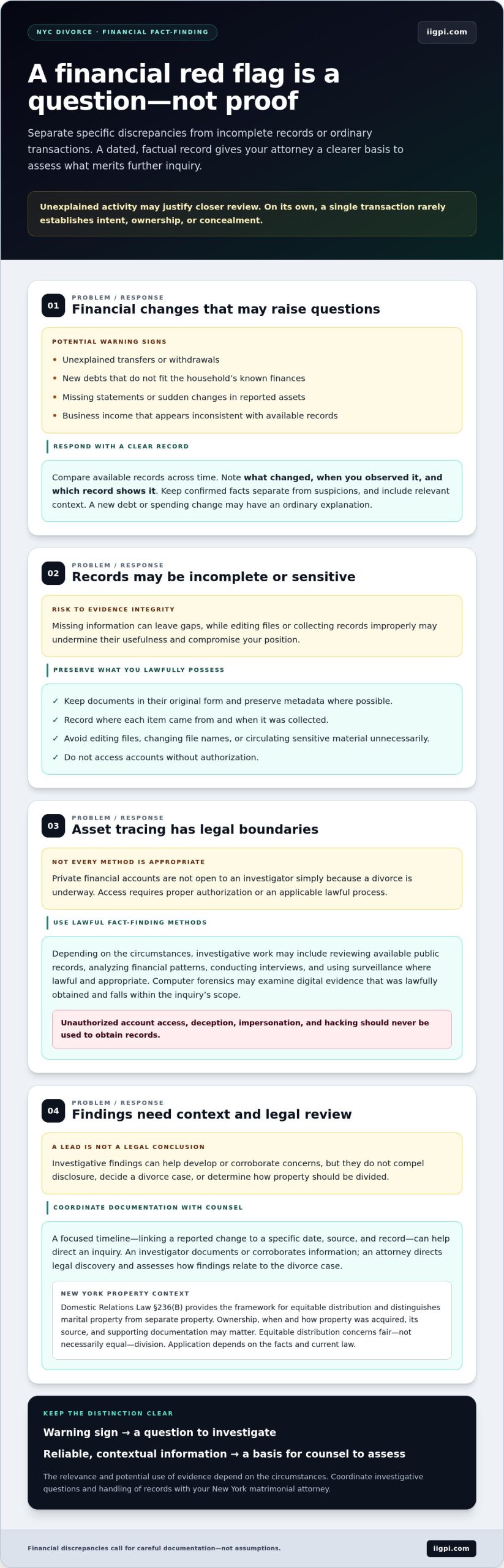
Responding to Suspected Asset Concealment: NYC Checklist
A measured process can turn a general concern into specific, reviewable questions. Use these steps to organize information and coordinate next actions without compromising records or crossing legal boundaries.
- Record the concern. Create a dated timeline of specific discrepancies. Include relevant dates, entities, and known references to property, accounts, or business interests. Describe what you observed rather than assigning intent.
- Preserve documents lawfully held. Keep original records and note their source and context. Do not edit files, alter metadata, or access private accounts without authorization.
- Consult your matrimonial attorney. Share the timeline and records through appropriate professional channels. Your New York divorce attorney should handle discovery requests, subpoenas, and court filings.
- Define the questions. Identify what remains unclear, such as a transaction’s purpose, a change in reported income, or a property reference. Separate firsthand observations from assumptions and information provided by others.
- Coordinate any investigation. Discuss with counsel whether investigative work could clarify or corroborate a specific issue, and agree on the scope before work begins.
What should you organize before an initial consultation?
Prepare a concise timeline rather than an unfiltered collection of suspicions. Include dates, business or entity names, documents already in your possession, and known asset references. Mark which details you observed directly and which came from someone else. Keep copies secure and share sensitive material only through appropriate professional channels.
Which investigative approach may fit the concern?
Let the question guide the method. Public-record research may help examine property or business-interest references where information is lawfully accessible. Consider surveillance only when the facts justify it and applicable boundaries are respected. Computer forensics is appropriate only for data lawfully available for examination. No method should involve accessing another person’s accounts, installing tracking tools, impersonating someone, or using deception.
These steps do not determine whether concealment occurred. They help you prepare focused questions for counsel and, where appropriate, an investigator. For readers concerned with proving a spouse is hiding assets in divorce nyc, disciplined documentation can support an organized discussion while leaving legal strategy and court filings to the attorney.
If you and your attorney are considering investigative support, discuss a matrimonial investigation focused on your documented concerns.
Working With International Investigative Group on a NYC Matrimonial Investigation
International Investigative Group is a New York City-based private investigation firm with more than 30 years of overall investigative experience. Its matrimonial investigations may draw on asset searches, surveillance, and computer forensics when appropriate to the concern and lawful to conduct. The goal is to gather and document information for the client and counsel to assess, not to guarantee that an asset will be located or establish a legal conclusion.
The professional roles remain distinct: investigators conduct fact-finding, while matrimonial attorneys provide legal advice, direct legal strategy, and determine how investigative information may relate to the case. For anyone focused on proving a spouse is hiding assets in divorce nyc, coordination helps keep investigative questions aligned with legal issues without treating a lead as a finding of misconduct.
What does an investigator need to understand the concern?
A concise chronology is a practical starting point. Identify the discrepancy, relevant dates, known entities or property references, and records you can lawfully share. Distinguish firsthand observations from information provided by others, and label assumptions as questions rather than facts. A focused inquiry helps shape a proportionate investigative approach. Handle sensitive information through appropriate professional communication.
How can investigative work complement a divorce case?
Investigative findings may clarify a concern or provide information for the client and attorney to evaluate. They are not legal advice, a determination of ownership, or a guarantee that a court will consider them. Any use in a proceeding depends on the facts and applicable rules, so counsel should guide decisions about legal relevance and next steps.
Before an inquiry begins, explain the concern, identify known facts, and, where possible, coordinate the questions with matrimonial counsel. This can help distinguish information already available from what remains uncertain and keep the investigative scope focused. Preserve original records and their context, and ensure all investigative activity respects legal boundaries.
If you are considering investigative support for a matrimonial matter, discuss a matrimonial investigation with International Investigative Group.
Build a Clear, Lawful Path Forward
Questions about marital finances are best addressed through careful documentation, not assumptions. Unexplained transfers, missing records, or inconsistent disclosures may justify further inquiry, but a financial red flag alone does not establish concealment. Preserve records you lawfully hold, note dates and context, and coordinate next steps with your New York matrimonial attorney.
For those considering proving a spouse is hiding assets in divorce nyc, investigative findings can help clarify questions and inform counsel. Legal strategy and decisions about court use remain with the attorney and court. International Investigative Group is a New York City-based investigative firm with more than 30 years of overall experience, founded by a former law-enforcement professional. Its matrimonial investigations may include asset searches, surveillance, and computer forensics when appropriate to the circumstances, without guaranteeing a particular finding or result.
Discuss a New York matrimonial investigation to consider focused investigative support for documenting your concerns. A measured approach and coordinated professional guidance can help you take the next step with greater clarity.
Frequently Asked Questions
How can I prove my spouse is hiding assets in a New York divorce?
Start by identifying specific discrepancies and organizing records you lawfully possess, such as financial statements, tax documents, or information about known business interests. A dated timeline can help your matrimonial attorney assess what questions to pursue through legal discovery. For proving a spouse is hiding assets in divorce nyc, an investigator may help develop or corroborate leads, but suspicion alone does not establish concealment. The legal significance depends on the case.
What are common signs that a spouse may be hiding assets?
Potential warning signs include unexplained transfers or withdrawals, missing financial records, new debts that do not fit known circumstances, changes in reported income, or disclosures that conflict with available documents. A single transaction may have an ordinary explanation and does not, by itself, prove intent or concealment. Record the date, source, and context of each discrepancy, then discuss the pattern with your attorney rather than making assumptions or accusations.
Can a private investigator find hidden bank accounts in NYC?
A private investigator may use lawful research, such as public-record inquiries and analysis of available financial information, to develop leads about assets or financial connections. An investigator cannot simply access private bank accounts without proper authorization or a lawful process. Matrimonial counsel can determine whether formal discovery or other legal procedures may be appropriate to seek account records. No investigative method can guarantee that an undisclosed account will be identified.
Can surveillance prove that a spouse is hiding assets?
Surveillance may document relevant activity when there is a factual basis and the work is conducted lawfully and appropriately. On its own, it generally does not establish that an asset is concealed, who owns it, or the intent behind a financial transaction. Its potential value depends on the facts and how observations relate to other information. Discuss proposed surveillance with matrimonial counsel before proceeding.
Will evidence from a private investigator be admissible in a New York divorce?
Not necessarily. Whether investigative material may be used in a New York divorce depends on the circumstances, how it was obtained, its relevance, and applicable evidentiary rules. A report, recording, or observation is not automatically admissible simply because an investigator collected it. Preserve original materials and their context, and have your matrimonial attorney review them before relying on them in a filing or proceeding. The court determines admissibility when the issue arises.
What should I do if I find a suspicious financial transfer?
Preserve the record as you found it, note when and where you obtained it, and write down the transaction date and relevant context. Do not alter files, access accounts without authorization, or confront your spouse impulsively. Share the information with your matrimonial attorney, who can assess its significance and advise on appropriate next steps, including whether legal discovery may be warranted. A transfer may have a legitimate explanation, so document facts rather than conclusions.
Can I investigate my spouse’s finances without their permission?
You may organize records you lawfully possess and review information available through lawful public sources, but do not enter private accounts, use someone else’s credentials, impersonate another person, or install tracking tools. Access to private financial records requires appropriate authorization or lawful process. If you are unsure whether a particular document or method is permissible, ask your matrimonial attorney before using or sharing it. Improper collection can create legal and evidentiary concerns.
Should I hire an investigator or rely on divorce discovery?
These approaches serve different roles and may complement one another. A private investigator can conduct lawful fact-finding to develop or corroborate leads, while your attorney directs discovery through legal procedures and advises on strategy. The right approach depends on the unresolved questions and information already available. Coordinate with counsel before an investigation begins so its scope is focused and does not duplicate legal requests.
Contact International Investigative Group to discuss a New York matrimonial investigation and the concerns you have documented.