
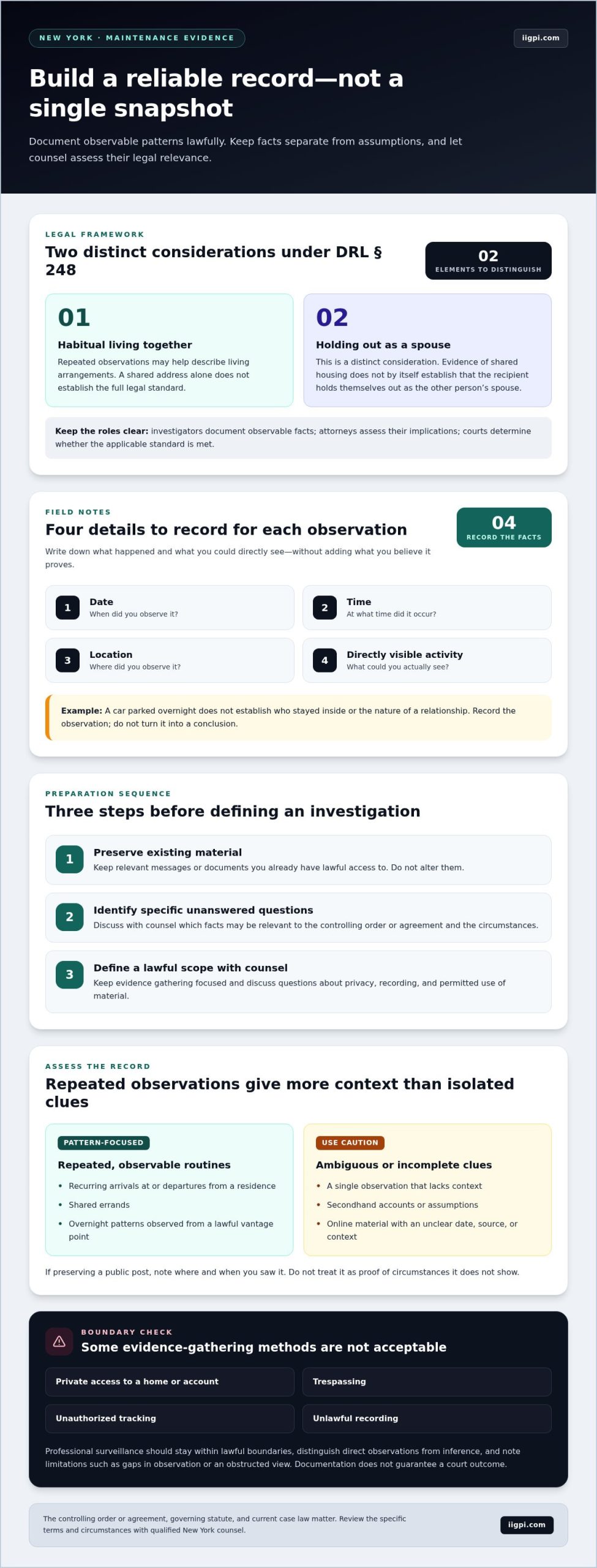
A shared address may appear decisive, but in a New York maintenance matter, one observation rarely tells the whole story. The challenge in finding proof of cohabitation for alimony reduction ny is documenting a sustained pattern that may relate to the legal standard, rather than simply showing that two people spend time together. Under Domestic Relations Law § 248, the paying spouse generally must establish both habitual cohabitation and that the recipient holds themselves out as the other person’s spouse.
It’s understandable to wonder whether photographs, online posts, or informal observations will carry weight, and whether gathering more information could cross privacy boundaries. The relevance of evidence depends on the circumstances and the terms of the maintenance order. Suspected cohabitation does not automatically reduce or end support.
This guide explains which facts may warrant review by counsel, how to document observations lawfully, and why repeated, carefully recorded details can provide more context than an isolated snapshot. It also explains how a New York matrimonial investigation can organize relevant findings for discussion with an attorney, without promising a particular court outcome.
Key Takeaways
- A shared address or new relationship alone may not establish grounds to change maintenance. The governing order, agreement, statute, and current case law matter.
- For finding proof of cohabitation for alimony reduction ny, focus on documenting relevant patterns lawfully rather than relying on a single observation or assumption.
- Preserve existing records, identify specific unanswered questions, and coordinate with counsel before defining an investigative scope.
- Compare repeated, corroborated observations with isolated or ambiguous clues. Keep firsthand facts distinct from hearsay and online material lacking context.
- A New York investigator can conduct matrimonial investigations and surveillance within lawful boundaries, then organize findings for discussion with an attorney. No investigation can guarantee a court outcome.
What New York Courts May Consider Cohabitation in an Alimony Reduction Case
A new relationship or shared address can raise questions, but neither fact automatically establishes grounds to modify maintenance in New York. The applicable analysis depends on the controlling order or agreement, the governing statute, and current case law. For a general overview of the terminology, see What is Alimony? The legal effect of a particular payment obligation depends on its specific terms and circumstances.
How New York law may treat cohabitation and maintenance
New York Domestic Relations Law § 248 addresses maintenance termination based on cohabitation. As generally described, its statutory language concerns whether the recipient is “habitually living with another person” and “holding himself or herself out as the spouse” of that person. These are distinct considerations. Evidence of shared housing may relate to the first, but does not by itself establish the second. Review the statute’s current text and its application to a specific matter with qualified New York counsel before relying on this summary.
This distinction matters when finding proof of cohabitation for alimony reduction ny. A record of repeated, lawful observations may help describe living arrangements or public representations, but investigators document facts, not their legal meaning. Attorneys assess the implications, and courts determine whether the applicable standard has been met.
Why the existing order or agreement matters
Maintenance obligations can have different terms and procedures. A court order may address modification differently from a separation agreement, and an agreement may contain provisions that affect how a change is pursued. The document’s language can shape which questions counsel needs to consider before evidence is gathered or a modification is sought.
Start by reviewing the controlling order or agreement with your attorney, including clauses about termination, modification, or dispute resolution. Counsel can assess how the document interacts with the applicable statute and current decisions. Treat case-law examples in their specific context, and have counsel assess whether they remain relevant to your matter.
This legal review helps define which facts may be useful to document. A shared residence, frequent overnight visits, or public references to a partner could prompt questions, but none is conclusive without context. A focused inquiry connects observations to questions identified with counsel, without assuming a court will find them legally significant.
How to Gather Lawful, Reliable Evidence of Suspected Cohabitation
A useful record begins with disciplined preparation, not intrusive tactics. Preserve materials you already have lawful access to, such as relevant messages or documents, without altering them. Then write down the factual questions you need answered, discuss their relevance with your attorney, and define a lawful investigative scope. This sequence helps keep evidence gathering focused and reduces time spent on ambiguous clues.
Which observations may help establish a documented pattern
Repeated observations of public, observable routines may help establish a timeline. Examples include recurring arrivals at or departures from a residence, shared errands, or overnight patterns observed from a lawful vantage point. Record what happened, including the date, time, location, and what you could directly see. Do not record what you believe it proves. A car parked overnight, for example, does not establish who stayed inside or the nature of a relationship. Context and continuity matter, and one observation rarely answers every legal question.
Keep firsthand observations distinct from assumptions, secondhand accounts, and online material with an unclear date, source, or context. If you preserve a public post, note where and when you saw it, and avoid treating it as proof of circumstances it does not show. For finding proof of cohabitation for alimony reduction ny, a careful chronology is more useful than conclusions that go beyond the available facts.
How professional surveillance documents observations
Professional surveillance can provide structured documentation of relevant patterns within lawful boundaries. A report may include time-stamped notes, objective descriptions of locations and observable activity, and relevant photographs or video gathered lawfully. It should distinguish direct observations from inference and identify limitations, such as gaps in observation or an obstructed view. Documentation records what an investigator observed. It does not determine legal significance or guarantee a court’s response.
Private access to a home or account, trespassing, unauthorized tracking, and unlawful recording are not acceptable evidence-gathering methods. Discuss proposed investigative steps with counsel, particularly when questions arise about privacy, recording, or the permitted use of material. For more detail on the role and boundaries of this work provided by International Investigative Group, review the professional surveillance services guide.
Once the factual questions and lawful scope are clear, New York surveillance investigations can help document relevant observations in an organized format for discussion with your attorney.
Strong Evidence Versus Weak Clues: Assessing a Cohabitation Record
Assess evidence as a connected record, not as a contest to collect the largest number of photographs or observations. Repeated, dated facts may provide more context than isolated clues, but their relevance depends on the legal question, the controlling order or agreement, and the circumstances of the matter. No category below is automatically admissible, decisive, or sufficient to change maintenance.
| Potentially more informative when corroborated | Weak or ambiguous when viewed alone |
|---|---|
| Repeated observations, recorded across dates, of a person regularly arriving at and leaving a residence, with the observer’s location and limits noted. | One visit, one overnight observation, or a vehicle seen outside a residence once. |
| A recurring household routine supported by independent, lawfully obtained information that clarifies what was observed and when. | A photograph that doesn’t establish the date, location, identity, or surrounding circumstances. |
| A public statement or record preserved with its source and context and reviewed alongside other relevant facts. | A social-media relationship label treated as proof that two people share a household. |
Patterns that may merit review alongside other evidence
Consistent observations of household routines may warrant closer review when they are carefully dated and supported by independent information. For example, recurring presence at a residence could be considered alongside other context, but does not by itself establish the nature of the arrangement. Obtain and use public statements or records lawfully, preserving their original source and surrounding context. Corroboration can clarify an observation without turning it into a legal conclusion.
Clues that can mislead when viewed alone
Occasional visits, photographs, and online posts can have more than one explanation. A relationship label may describe a romantic connection without showing shared living arrangements. An image may not show when or where it was taken. Speculation, cropped excerpts, and selective presentation can obscure context and weaken the reliability of a record.
For finding proof of cohabitation for alimony reduction ny, prioritize a clear chronology and accurate source records over volume. Note the date, location, what was directly observed, and how the information was obtained. Distinguish those facts from inference or secondhand claims. An investigator can organize observations and identify limitations, while counsel assesses their legal relevance and a court determines what weight, if any, to assign them.
A Practical New York Plan for Preparing a Cohabitation Investigation
A focused investigation starts with the documents and questions that define the matter, not open-ended observation. Before investigative work begins, coordinate with your attorney so the inquiry can be shaped around the maintenance order or agreement and the facts counsel considers relevant. A defined scope can reduce unrelated observations and help protect everyone’s privacy.
What to organize before speaking with an investigator
Gather the controlling court order or agreement, a timeline of relevant events, and any existing records you lawfully possess. Keep the timeline factual: note what you personally observed, when it occurred, and what came from another source. Mark assumptions and unanswered questions clearly rather than presenting them as established facts.
Then, with counsel, identify the specific questions an investigation should address. These might concern a recurring observable routine or whether an existing account of events can be corroborated. Avoid framing the assignment around a desired legal conclusion. The aim is to gather relevant facts, not to direct an investigator to prove an assumption.
How to coordinate investigation findings with counsel
Agree on the investigative scope, appropriate communication methods, how updates will be shared, and the form of the final report. The investigator documents observations and explains their basis and limitations. Counsel evaluates their legal significance in light of the order, agreement, and applicable law. A private investigator role overview provides additional context about this distinction.
Clear coordination also helps prevent unnecessary or inappropriate steps. Counsel can identify boundaries for the inquiry, while the investigator reports what was observed without overstating what it establishes. Keep source materials and dates organized so findings can be reviewed in context and connected to the questions that prompted them.
For finding proof of cohabitation for alimony reduction ny, preparation makes the investigation more focused: organize the controlling documents, build a factual timeline, and settle the questions with counsel before observations begin. International Investigative Group conducts matrimonial investigations to document relevant facts within a defined scope.
Working with a New York Investigator on Alimony Reduction Evidence
A New York investigator can turn a defined set of questions into a structured inquiry: clarify the objectives, identify what is already known, establish appropriate boundaries, and document relevant observations in an organized report. For suspected cohabitation, the purpose is to gather factual information that may help a client and attorney assess next steps, not to reach a legal conclusion or promise that maintenance will be reduced.
International Investigative Group conducts matrimonial investigations and surveillance. The firm has more than 30 years of experience, reports resolving over 10,000 cases, and was founded by a former law-enforcement professional. These details describe the firm’s background. Counsel and the court assess the relevance and legal effect of particular findings.
What clients can expect from an investigative engagement
An engagement begins with a discussion of objectives, known facts, boundaries, and reporting needs. The client and investigator define the questions the work should address and establish an agreed, lawful scope. Observations are documented as facts, with relevant limitations identified, rather than framed as proof of a predetermined conclusion. Investigative reports are not legal advice and cannot guarantee admissibility or a particular court outcome.
Turning documented findings into informed next steps
After the investigation, review the findings with your New York family-law attorney. Counsel can evaluate whether and how observations relate to the governing order, agreement, and applicable law, and determine whether they support a court request. The investigator provides organized factual reporting, not legal strategy or a decision about what evidence a court should accept. For broader context on related work, see personal and domestic investigation protocols.
For readers considering finding proof of cohabitation for alimony reduction ny, an investigation is most useful when its questions are coordinated with counsel and its scope is clear. To discuss next steps with International Investigative Group, contact International Investigative Group.
Build a Focused, Lawful Path Forward
In New York, suspected cohabitation does not automatically change a maintenance obligation. The governing order or agreement, current law, and specific facts all matter. Strong preparation begins by identifying focused questions with counsel, then documenting relevant observations lawfully and consistently rather than relying on isolated clues or assumptions.
For finding proof of cohabitation for alimony reduction ny, an organized investigative record can help you and your attorney assess possible next steps. Its legal significance and any court request remain matters for counsel and the court. International Investigative Group provides matrimonial investigation and surveillance services, drawing on more than 30 years of investigative experience. The firm reports resolving over 10,000 cases.
If you’re considering a focused investigation, discuss your investigative matter with International Investigative Group. Start with clear questions, lawful boundaries, and guidance from your attorney.
Frequently Asked Questions
Is living with a new partner enough to reduce alimony in New York?
No. A shared home or new relationship alone does not automatically reduce or end maintenance in New York. Domestic Relations Law § 248 generally addresses whether the recipient habitually lives with another person and holds themselves out as that person’s spouse. The facts, current case law, and terms of the controlling order or agreement may affect the analysis. Review the specific circumstances with a New York family-law attorney before taking action.
What evidence can help show cohabitation in a New York maintenance case?
Potentially relevant information may include repeated, dated observations of household routines, public statements, or records lawfully obtained and considered in context. A single visit, photograph, or social post may be ambiguous. Corroboration and a clear chronology can help counsel assess what the material shows. For finding proof of cohabitation for alimony reduction ny, distinguish firsthand observations from assumptions and secondhand reports, and ask your attorney which factual questions matter under your order or agreement.
Can a private investigator legally conduct surveillance in New York?
A private investigator may conduct surveillance only within applicable legal and privacy boundaries. The specific methods and circumstances matter. Lawful observation from a public place differs from trespass, unauthorized tracking, accessing private accounts, or unlawful recording, which should not be used. Before investigative work begins, define its scope and discuss method-specific questions with New York counsel. An investigator documents observations but does not determine their legal significance or guarantee that a court will consider them.
How can an investigator document suspected cohabitation without violating privacy?
An investigator can focus on defined questions and observable activity gathered through lawful means, then organize findings in a dated, factual report. Documentation may identify when and where an observation occurred, what was directly seen, and any limits on the observation, without claiming more than the facts support. The investigation should not involve trespass, unauthorized tracking, private account access, or unlawful recording. Discuss the proposed scope with counsel and the investigator in advance.
Can social media posts prove that someone is cohabiting?
Social media posts may offer context, but a post alone does not necessarily establish that two people share a household or satisfy a legal standard. A relationship label, photograph, or caption can have multiple interpretations, and timing or context may be unclear. Preserve the source and surrounding information lawfully, and avoid relying on cropped excerpts or assumptions. An attorney can assess whether a post is relevant alongside other independently documented facts.
Does alimony stop automatically when a former spouse moves in with someone?
No. Moving in with a partner does not automatically stop maintenance in New York. Cohabitation may provide a basis to seek a court change under applicable law, but the paying spouse generally must establish the relevant statutory requirements. The outcome depends on the order or agreement and current law. Do not stop payments based only on suspicion or an address change. Have counsel review the governing documents and advise on appropriate next steps.
When should I speak with an attorney about suspected cohabitation evidence?
Speak with a New York family-law attorney before starting an investigation, particularly if you’re unsure what the order or agreement requires, which facts are relevant, or which methods are lawful. Bring the controlling documents, a factual timeline, and existing records you lawfully possess. Counsel can identify specific questions for an investigation and later assess the findings. Early coordination can help keep evidence gathering focused and avoid reliance on weak or improperly obtained material.