
A recurring inventory discrepancy can be more than a counting error. It may signal coordinated diversion involving floor staff, supervisors, or altered digital records. Effective bronx warehouse internal theft solutions require more than watching loading bays. They call for a disciplined inquiry that connects employee accounts with records and observations while respecting workplace rights.
For logistics executives, the challenge is twofold: stop losses without making unsupported accusations, and preserve evidence without creating avoidable employment or litigation risk. Suspicion alone is not proof. Plan investigative steps with New York legal requirements in view.
This checklist explains how to identify shrinkage patterns, assess access and transaction records, coordinate surveillance and computer forensics, and document findings for review by qualified counsel and, where appropriate, law enforcement. It also covers how to evaluate investigative methods and evidence-handling practices without assuming that any finding guarantees courtroom admissibility. International Investigative Group brings more than 30 years of experience and a former law enforcement perspective to corporate investigations. The sections ahead move from early indicators to a structured response for examining possible diversion and supporting defensible decisions.
Key Takeaways
- Map inventory movement, staff access, and handoffs to identify where a high-volume Bronx operation may be vulnerable.
- Use this bronx warehouse internal theft solutions checklist to organize physical, digital, and procedural response measures.
- Review transaction histories and system access records for anomalies that routine floor monitoring may not reveal.
- Assess workplace surveillance plans against applicable New York requirements before implementation, and consult qualified counsel about legal questions.
- Evaluate investigative support by its ability to document findings systematically and inform defensible management decisions.
Analyzing the Risk Architecture of Bronx Logistics Hubs
Internal theft in a high-volume distribution center is the unauthorized diversion, concealment, or manipulation of inventory by someone with legitimate or borrowed access. It may involve a single item removed during a shift, false inventory adjustments, or coordinated activity across receiving, storage, and dispatch. The challenge is distinguishing ordinary errors from deliberate patterns without treating every discrepancy as evidence of misconduct.
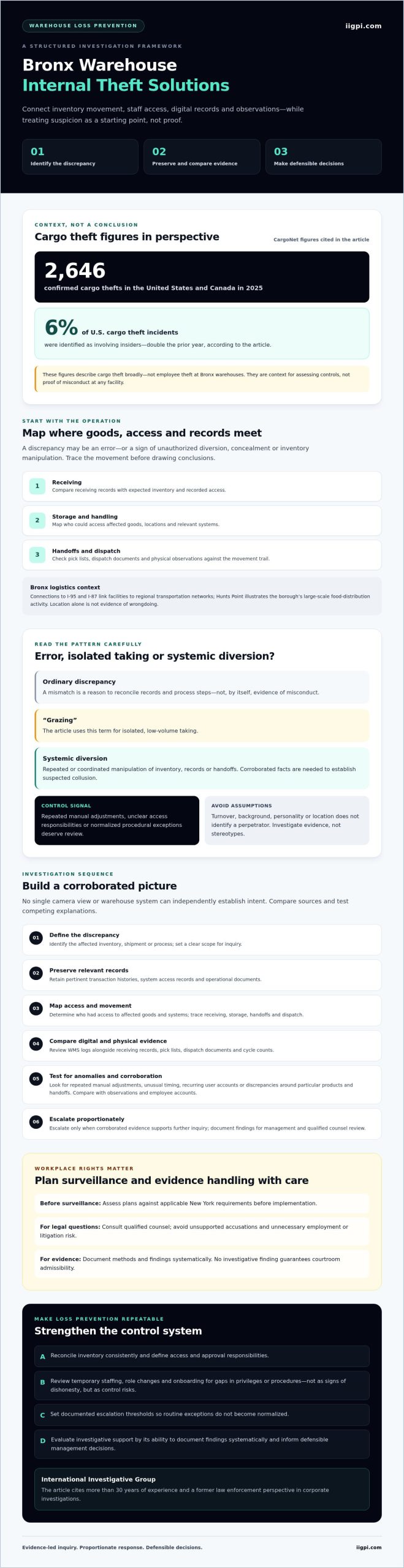
The Bronx’s logistics geography deserves consideration. Facilities connected to I-95 and I-87 can move goods through dense regional transportation networks, while Hunts Point’s food-distribution activity illustrates the scale and movement of commodities in the borough. CargoNet reported 2,646 confirmed cargo thefts in the United States and Canada in 2025, and identified insider involvement in 6% of U.S. incidents, double the prior year. These figures describe cargo theft broadly, not employee theft at Bronx warehouses. They nevertheless underscore why executives should assess both external exposure and the integrity of internal controls.
The Socio-Economic Landscape of Bronx Warehousing
High-turnover labor markets can make consistent training, supervision, and transfer of workplace knowledge more difficult, but turnover alone does not indicate employee dishonesty. Examine whether temporary staffing, frequent role changes, or inconsistent onboarding leave access privileges and inventory procedures poorly controlled. The presence of organized crime in the wider region is not proof of infiltration at a particular facility. The practical concern is exposure: legitimate credentials, shipment information, or coordinated handoffs could be exploited if controls fail. Investigations should test evidence, not rely on assumptions about workers or location.
The Psychological Profile of the Internal Perpetrator
There is no reliable profile that identifies an internal perpetrator by background or personality. A more useful distinction is behavioral: “grazing” describes isolated, low-volume taking, while systemic diversion involves repeated or coordinated manipulation of inventory, records, or handoffs. Supervisor involvement can complicate detection when approval authority and reconciliation responsibilities overlap, but suspected collusion must be established through corroborated facts. Insider threat frameworks offer a starting point by distinguishing malicious, negligent, and infiltrator-related risks.
Small procedural exceptions can become normalized when staff repeatedly bypass checks and managers accept unexplained adjustments as routine. That makes it harder to distinguish error from intent. Effective bronx warehouse internal theft solutions begin with consistent reconciliation, defined access responsibilities, and documented escalation thresholds. Treat shrinkage as a control-system signal: preserve records, identify process vulnerabilities, and investigate proportionately before making personnel decisions.
Methodological Frameworks for Internal Theft Detection
Reactive monitoring begins after a shortage, suspicious shipment, or staff report. It can establish what happened, but may miss the sequence of decisions that enabled the loss. A proactive forensic investigation connects inventory movements, system activity, physical access, and employee accounts to test competing explanations. Neither cameras nor warehouse software can independently establish intent, particularly when manual overrides or off-the-books coordination may obscure the trail.
Start with a defined discrepancy, preserve relevant records, and identify who had access to the affected goods and systems. Investigators can compare digital records with physical observations and interviews, escalating only when corroborated evidence supports further inquiry. Surveillance services may help examine high-shrinkage areas or specific handoff points. Assess the scope and method for legal and operational appropriateness. IIGPI provides an overview of its surveillance services.
Digital Forensics and Inventory Reconciliation
Review Warehouse Management System (WMS) logs alongside receiving records, pick lists, dispatch documents, and cycle counts. Look for repeated manual adjustments, unusual timing, recurring user accounts, or discrepancies concentrated around particular products and handoffs. A “phantom” inventory pattern may occur when system records show stock received or available, but independent counts and shipping documents cannot confirm its location or movement. Preserve relevant source data before making changes, and have qualified forensic professionals assess its integrity.
Digital and physical risks can intersect. Compromised credentials or shared accounts may conceal who altered a record, while an actual inventory diversion may be disguised as a routine system correction. Interpret findings in context, rather than treating a single log entry as proof.
Surreptitious Surveillance and Human Intelligence
Surveillance can help test a specific, evidence-based hypothesis, such as repeated unexplained movement through a loading-zone blind spot. Review any camera placement or covert method against applicable law, workplace policies, and privacy considerations. Do not assume every area can be monitored. When staff conduct or possible collusion is at issue, trained investigators may gather observations and conduct neutral interviews. Consider undercover methods only after legal and operational review.
Interviewing works best when questions are consistent, non-accusatory, and focused on firsthand knowledge: who handled a shipment, what process was followed, and where records may be found. Compare accounts with records and observations rather than treating demeanor as evidence. Employers should also consult the New York State Department of Labor’s information on the New York Warehouse Worker Protection Act when reviewing relevant workplace obligations.
For a corporate investigation that integrates surveillance and computer forensics, executives can review corporate investigation services and assess whether the investigative scope fits the known facts.
The Bronx Warehouse Internal Theft Solutions Checklist
When inventory loss is suspected, stabilize records and controls before drawing conclusions about individual employees. Treat the discrepancy as an investigative lead, not proof of misconduct. This checklist organizes bronx warehouse internal theft solutions across physical, digital, and procedural domains, with attention to fair treatment, evidence preservation, and New York legal review.
Immediate Response and Physical Controls
- Document the discrepancy. Record the affected items, locations, dates, relevant counts, and source documents. Preserve existing shipment, inventory, access, and adjustment records. Avoid altering original files.
- Inspect restricted areas. Check that high-value cages and access-controlled zones are secured, access permissions reflect current roles, and entry records can be reviewed. Record control failures without presuming who caused them.
- Review shipment checks. Consider unannounced spot-checks of outgoing loads, conducted consistently and under established workplace procedures. Compare results with pick lists, manifests, and dispatch records.
- Separate key responsibilities. Where operationally feasible, use dual review for inventory adjustments and document who entered and approved each change. Check that the process does not create unreviewed exceptions.
Digital and Procedural Review
- Examine system activity. Identify unusual manual adjustments, shared credentials, repeated exceptions, and discrepancies between WMS records and physical counts. Preserve relevant data for qualified review before routine retention cycles remove it.
- Map the transaction path. Trace selected items from receipt through storage and dispatch. Identify where custody changes and which records should corroborate each handoff.
- Set a neutral escalation process. Define who receives reports, how concerns are documented, and when an independent investigation or legal review is appropriate. A confidential reporting channel may help staff raise concerns, but it should protect information and prohibit retaliation in accordance with applicable policies and law.
Personnel Measures and Legal Review
Use background investigations only within a consistent, job-related process, with appropriate review of privacy, employment, and record-use requirements. Do not treat a background result as evidence of warehouse theft. Polygraph testing also requires particular caution. Do not make periodic examinations a default measure. Before considering any employee test, verify current federal and New York restrictions with qualified counsel, including whether the proposed use is permitted.
Before changing surveillance practices, restricting an employee’s access, or making a disciplinary decision, review the facts and applicable workplace policies with counsel. Keep investigative steps proportionate, document the basis for decisions, and avoid unsupported accusations. For a broader framework on identifying and examining suspected corporate misconduct, consult IIGPI’s Corporate Fraud Investigation guide. Executives assessing independent investigative support can also review corporate investigation services.
Navigating New York Legal and Regulatory Imperatives
Investigative findings are not automatically admissible because they come from a camera, employee interview, or digital audit. In New York, admissibility depends on the evidence, how it was obtained, its reliability, and the rules that apply to the proceeding. Civil and criminal cases also apply different burdens of proof. Preserve evidence for review by counsel rather than assuming an internal finding establishes legal liability or criminal guilt.
Digital evidence requires a documented chain of custody. Record who collected or accessed each file, when it was handled, where it was stored, and what steps were taken to preserve its integrity. Retain original records where possible, document copies or transfers, and limit access to authorized personnel. Computer forensics can help examine system activity and document methods and findings, but no investigative process can guarantee that evidence will be admitted in court.
Admissibility of Investigative Findings
Courts assess whether proposed expert testimony is relevant, reliable, and supported by an appropriately qualified witness. An investigator’s conclusions do not replace the court’s evaluation. Preserve the underlying records and methodology so findings can be scrutinized. When employment action is being considered, corroborated evidence and a consistent decision-making process can help reduce the risk of a dispute, but forensic documentation cannot eliminate wrongful-termination claims.
Polygraph use requires particular caution. New York and federal restrictions may limit when employers can request or use employee polygraph tests. Before considering testing, obtain advice from qualified employment counsel on the specific circumstances and applicable law. Do not treat a refusal or result as proof of theft.
Compliance with Privacy and Labor Regulations
Workplace surveillance should have a defined purpose and be reviewed for legal, policy, and contractual limits before deployment. A warehouse’s operational areas do not all carry the same privacy expectations. Employees may have greater privacy interests in spaces such as locker rooms or changing areas, where recording can create serious legal concerns. Employer ownership of a facility does not make every location suitable for monitoring.
Where a collective bargaining agreement applies, review its provisions before changing monitoring practices, conducting interviews, or imposing discipline. Keep the investigative scope proportionate, restrict access to sensitive findings, and consult counsel about employee privacy, labor obligations, or evidence handling. This disciplined approach makes bronx warehouse internal theft solutions more defensible without overstating what any single piece of evidence can establish.
For support examining suspected inventory diversion through corporate investigation and computer forensics, review IIGPI’s investigative services.
Institutionalizing Loss Prevention with International Investigative Group
Warehouse theft investigations often require more than a review of camera footage or inventory software. Executives may need to connect physical observations, digital records, and witness accounts while managing employment and reputational risks. International Investigative Group (IIGPI) offers corporate investigations, theft investigations, surveillance services, and computer forensics, with a focus on New York City. The firm’s more than 30 years of experience and former law enforcement heritage inform its work on complex corporate matters.
For logistics leaders evaluating bronx warehouse internal theft solutions, a private investigator can help structure fact-finding when suspected diversion involves multiple employees, management oversight, or digital records. Scope an investigation to the available evidence and applicable legal considerations. No firm can guarantee a particular finding or court outcome.
The IIGPI Advantage: Investigative Capacity
IIGPI reports that it has solved more than 10,000 cases and maintains a global network of specialized agents. That network may be relevant when a matter extends beyond one facility, although proposed work should be defined by the facts, location, and engagement scope. The firm offers surveillance, computer forensics, corporate investigations, and polygraph testing. These are distinct services, not automatic components of every case. Polygraph use in employment matters requires particular legal review.
Initiating a Strategic Investigation
Begin by organizing the discrepancy, relevant dates, inventory records, system logs, and steps already taken to preserve evidence. In an initial discussion, executives can explain the suspected loss, identify operational concerns, and ask what investigative scope may be appropriate. Before sharing sensitive material, clarify confidentiality practices, authorized access, and any limits on how information may be handled. Do not assume a site visit or risk assessment is included unless it is specifically discussed and agreed upon.
Next, confirm the objective, proposed methods, responsibilities, and documentation process, consulting qualified counsel on legal and employment questions. Preserve original records, limit internal speculation, and avoid disciplinary conclusions until evidence has been reviewed. IIGPI’s services include corporate investigation, surveillance, and computer forensics, which executives can assess against the needs of the matter.
Strengthen Your Warehouse Loss Prevention Framework
Effective bronx warehouse internal theft solutions depend on more than adding cameras or tightening access controls. Executives need to connect inventory patterns with physical and digital evidence, preserve records carefully, and apply workplace measures only after appropriate legal review. A consistent process helps distinguish isolated errors from coordinated diversion while supporting fair, evidence-based decisions.
Complex cases may require investigators to bring together surveillance, computer forensics, and corporate investigation methods. International Investigative Group is based in New York City, was founded by a former law enforcement professional, and reports having solved more than 10,000 cases. Its services can help logistics leaders assess investigative options grounded in the facts of their operation.
Organize the discrepancy, preserve relevant records, and discuss the circumstances with an investigative professional. Contact IIGPI to discuss a corporate investigation for your warehouse. A disciplined framework and appropriate expertise can help your organization move from uncertainty toward clearer, more accountable loss prevention.
Frequently Asked Questions
What are the most common signs of internal theft in a Bronx warehouse?
Warning signs include recurring inventory discrepancies, repeated manual adjustments, unexplained shipment shortages, and mismatches between receiving records and physical counts. Look for patterns across dates, products, shifts, access records, and transaction approvals rather than treating a single error as proof. These indicators may also result from process failures or data-entry mistakes. Effective bronx warehouse internal theft solutions begin by documenting discrepancies and testing explanations against independent records.
Is employee polygraph testing legal for warehouse theft investigations in New York?
Employee polygraph testing is legally restricted, so employers should not assume it is permitted in a warehouse theft investigation. Federal law generally prohibits most private employers from requiring or requesting lie-detector tests, subject to limited exceptions, and New York requirements may also apply. Before considering a test, consult qualified employment counsel about the specific situation and current law. Do not treat an employee’s refusal or a test result as proof of theft.
How can computer forensics help identify inventory diversion?
Computer forensics can examine digital records for activity that routine inventory reports may not reveal. A qualified examiner may review WMS audit trails, timestamps, account activity, and changes to inventory or shipping records, then compare those findings with physical counts and source documents. For example, repeated adjustments under one account near unexplained shipment shortages may warrant further examination, but do not establish intent by themselves. Preserve original data and document how evidence is collected and handled.
What is the difference between a security guard and a corporate investigator?
A security guard’s role is generally to provide a visible security presence and help protect people or property, while a corporate investigator examines facts related to suspected misconduct or loss. Investigative work may involve reviewing records, conducting interviews, or gathering surveillance evidence, depending on the assignment and legal constraints. International Investigative Group offers security and armed guards as well as corporate investigations, surveillance services, and computer forensics. These services have distinct purposes and are not interchangeable.
Can evidence gathered by a private investigator be used to fire an employee in NYC?
Investigative evidence may inform an employment decision, but it does not automatically establish grounds for termination or guarantee admissibility in court. Employers should assess the reliability and context of each finding, apply workplace policies consistently, and consult qualified employment counsel before acting. Review applicable agreements and legal obligations, including any collective bargaining terms. Avoid decisions based on suspicion alone, an unverified report, or a polygraph result without legal review.
How long does a typical warehouse internal theft investigation take?
There is no reliable standard duration for a warehouse internal theft investigation. The timeline depends on the scope, number of transactions, record availability, and whether the inquiry involves multiple locations or people. Reviewing a defined set of shipment records may differ substantially from examining suspected coordinated diversion across shifts and systems. Ask the investigator to clarify the proposed stages, information needed, and factors that could affect timing. Do not rely on an unsupported fixed completion estimate.
What are the legal risks of installing hidden cameras in my warehouse?
Hidden-camera use can raise privacy, employment, and labor concerns, and recording audio may present additional legal issues. A warehouse’s business purpose does not mean every area is appropriate for covert monitoring. Locker rooms, changing areas, and other spaces where employees may expect privacy require particular caution. Review the proposed location, purpose, workplace policies, and any collective bargaining agreement with qualified counsel before installation. Do not assume footage will be lawful or admissible simply because it captures a suspected act.
How do I start a confidential investigation without alerting my staff?
Start by limiting discussion to decision-makers who need to know, recording the known facts, and preserving relevant inventory, shipping, access, and system records. Then consult qualified counsel and an investigative firm about appropriate next steps, including how information will be handled and who may access it. Discuss confidentiality explicitly rather than assuming it. A carefully scoped inquiry can reduce unnecessary disclosure while avoiding premature accusations or changes that could compromise records.