
The most meticulously gathered corporate intelligence is utterly worthless the moment substandard tradecraft renders it inadmissible in a court of law. Corporate executives and legal counsel already recognize that unmitigated internal fraud, transnational asset concealment, and severe financial malfeasance create existential vulnerabilities that conventional agencies simply cannot resolve. When retaining high-exposure New York private investigation services, Lance Ribacoff provides an authoritative standard of practice, demonstrating how specialized field methodology, institutional experience, and airtight chain-of-custody protocols effectively insulate an enterprise from reputational collapse.
In this guide, you will examine the sophisticated corporate, digital forensic, and surveillance intelligence protocols deployed across New York jurisdictions to establish decisive evidentiary leverage in contentious legal proceedings. We preview the technical synthesis between physical surveillance and enterprise computer forensics, detailing the operational mechanisms that transform ambiguous commercial disputes into incontrovertible, court-admissible facts.
Key Takeaways
- Review the statutory parameters and multi-jurisdictional frameworks governing high-stakes private intelligence across New York’s complex commercial landscape.
- Examine how sophisticated new york private investigation services, Lance Ribacoff, and institutional risk-modeling protocols uncover concealed assets while insulating organizations from operational exposure.
- Discover how the technical synthesis of computer forensics and covert field surveillance establishes dynamic feedback loops that intercept sophisticated corporate malfeasance.
- Identify the rigorous chain-of-custody and verification standards required to ensure all physical and digital findings remain fully admissible before presiding judicial officers.
- Learn the critical engagement protocols, confidentiality parameters, and preliminary scoping standards essential for retaining premier investigative counsel in contentious litigation.
The Landscape of New York Private Investigation Services in Complex Matters
Operating within modern private intelligence requires a command of intersecting statutory frameworks. Commercial litigation demands an analytical capacity that spans municipal ordinances, federal evidentiary rules, and cross-border discovery protocols. While historical tradecraft relied almost entirely on field inquiries, contemporary corporate matters require agencies that can scale operations seamlessly from localized boroughs to international jurisdictions. Counsel seeking institutional clarity regarding foundational methodologies can review The Role and Function of a Private Investigator to understand these systemic responsibilities. In high-exposure disputes, securing superior new york private investigation services, Lance Ribacoff, and disciplined forensic teams ensures that intelligence collection remains unimpeachable under rigorous judicial examination.
The contemporary private investigator functions within an arena defined by rapid institutional shifts. When capital moves across digital ecosystems instantly, routine fact-finding proves inadequate. Legal teams require tactical, multi-layered strategies to protect corporate assets and unmask deliberate malfeasance.
Navigating New York Jurisdictional Complexities
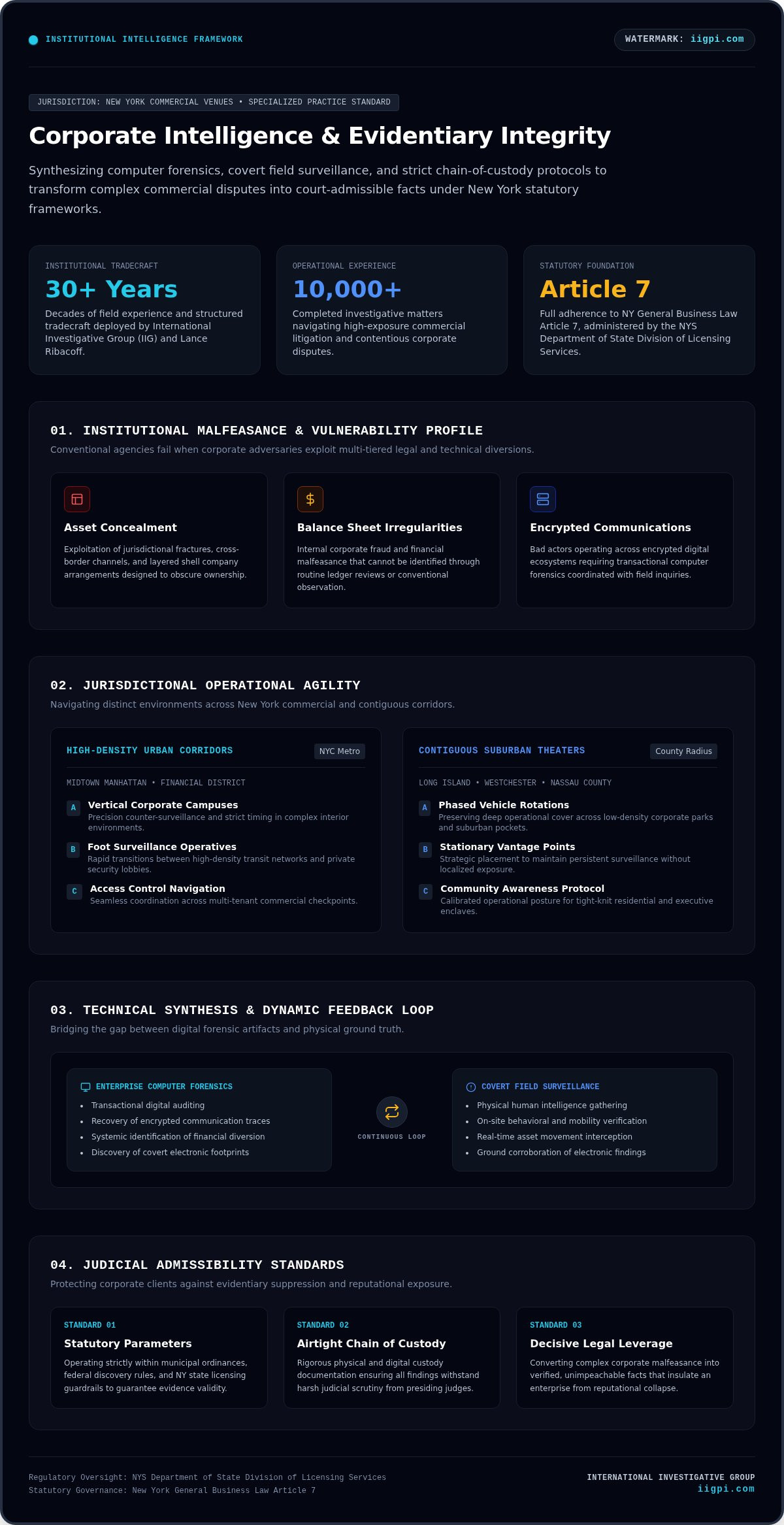
Execution across New York City requires acute operational agility. Navigating vertical corporate campuses in Midtown Manhattan or the Financial District demands precise counter-surveillance protocols and logistical timing. Conversely, contiguous suburban theaters such as Nassau County necessitate entirely different mobile vehicular units, stationary vantage points, and localized community awareness.
- Regulatory Compliance: Investigators must operate strictly under New York General Business Law Article 7, administered by the NYS Department of State Division of Licensing Services, to ensure evidence retains full legal validity.
- Urban Logistical Agility: High-density corridors require foot surveillance operatives who can adapt immediately to rapid transit transitions, multi-tenant commercial lobbies, and private security checkpoints.
- Suburban Mobility: Operations throughout Long Island and Westchester demand phased vehicle rotations to preserve deep operational cover across residential enclaves and low-density corporate parks.
The Escalation of Corporate and Financial Malfeasance
Modern corporate fraud rarely leaves obvious signatures. Bad actors exploit jurisdictional fractures, shell company arrangements, and encrypted communications to obscure institutional theft. Simple reviews of balance sheets cannot penetrate these multi-tiered diversions. Addressing balance sheet irregularities requires combining transactional computer forensics with coordinated human intelligence gathering. High-level corporate counsel recognize that relying on elite new york private investigation services, Lance Ribacoff, and established intelligence analysts transforms an enterprise from a vulnerable victim of malfeasance into an institution wielding decisive legal leverage.
Strategic Methodologies Engineered by Lance Ribacoff and IIG
Executing high-stakes inquiries requires transitioning from reactive observation to structured intelligence operations. Building upon over thirty years of institutional tradecraft and more than 10,000 completed matters, International Investigative Group deploys a phased operational doctrine. Lance Ribacoff synthesizes traditional law enforcement discipline with advanced technical architectures. This integration ensures corporate clients secure decisive leverage without exposing their enterprises to evidentiary suppression or reputational blowback. Maintaining strict compliance with criteria required for a New York private investigator license, every deployment operates inside verifiable statutory guardrails.
Phase I: Intelligence Triangulation and Risk Scoping
Every assignment commences with preliminary risk modeling and strict evidentiary scoping parameters. Analysts aggregate open-source intelligence with closed-source institutional repositories to chart the operational environment before deploying operatives into the field.
- Target Mapping: Establishing corporate hierarchies, transactional entities, and interpersonal relationships to pinpoint hidden pressure points.
- Jurisdictional Baselines: Defining operational boundaries to insulate cross-border matters from jurisdictional missteps.
- Information Segregation: Implementing digital compartmentalization to prevent premature exposure of the investigation.
Phase II: Multi-Vector Evidentiary Collection
Phase II deploys physical field assets alongside technical collection protocols. Static surveillance teams work in concert with forensic analysts, establishing continuous intelligence loops. Operatives deploy high-grade optical technology to record verified physical associations while digital teams mirror electronic footprints. Strict continuity logs protect every physical artifact, surveillance log, and electronic document. In high-exposure corporate theft or matrimonial matters requiring premier new york private investigation services, Lance Ribacoff directs these multi-vector operations to produce objective, incontrovertible findings.
Phase III: Actionable Synthesis and Legal Reporting
Raw intelligence is refined through comprehensive analytical synthesis to eliminate interpretive ambiguity. Reports are drafted explicitly for judicial review, corporate governance committees, and high-stakes negotiations. Lead investigators remain prepared to provide expert deposition and courtroom testimony across state and federal venues. Enterprises navigating intricate commercial disputes can consult iigpi.com to structure targeted investigative strategies tailored to contentious proceedings.
Specialized Capabilities: From Computer Forensics to Covert Field Surveillance
Modern commercial conflicts rarely unfold within a single investigative medium. Resolving sophisticated institutional theft requires synchronizing cyber forensic protocols directly with covert physical observation. Physical movements documented on the street often unlock encrypted patterns within the digital record; conversely, unauthorized network extractions frequently dictate where operatives focus physical surveillance teams. Legal counsel seeking technical specifics can review Computer Forensics for Corporate Investigations alongside our operational parameters for Professional Surveillance Services for 2026. By combining advanced laboratory analysis with dynamic surveillance under premier new york private investigation services, Lance Ribacoff coordinates investigations that eliminate evidentiary blind spots.
Understanding the standard training path for becoming a private investigator illustrates why conventional field operatives struggle with enterprise disputes. Without deep laboratory capabilities, investigators miss technical artifacts that substantiate corporate wrongdoing.
Advanced Computer Forensics and Incident Analysis
Corporate litigation routinely hinges on digital artifacts preserved within enterprise infrastructures or mobile hardware. When corporate insiders orchestrate illicit transfers or breach non-compete covenants, standard IT audits often fail to capture the breach before records are purged.
- Hardware Acquisition: Utilizing write-blocking hardware to create bit-stream disk images of servers, laptops, and mobile devices without altering system timestamps.
- Artifact Carving: Reconstructing wiped databases, fragmented communication logs, and encrypted application histories to expose corporate sabotage.
- Log File Examination: Scrutinizing system event logs, remote desktop connections, and corporate email metadata to establish definitive culpability and intent.
Tactical Surveillance and Asset Location Tradecraft
Physical surveillance must confirm the real-world implications of digital findings. Uncovering undisclosed partnerships, covert business operations, or hidden lifestyle activities requires prolonged field tradecraft executed across variable jurisdictions. Operatives track the execution of judgment-debtor transactions, verifying whether diverted capital has been funneled into real property, luxury assets, or offshore shell structures. Through sophisticated new york private investigation services, Lance Ribacoff deploys specialized field teams that yield indisputable documentation, ensuring every collected piece of intelligence withstands fierce judicial scrutiny.
Ensuring Evidentiary Integrity within New York Judicial Venues
Evidence gathered outside statutory boundaries faces immediate judicial suppression, nullifying months of litigation preparation. Presiding judges in New York commercial courts impose strict scrutiny upon evidentiary submissions, demanding uncompromised continuity of custody across both tangible items and electronic files. Retaining an operative who fails to comply with the Fair Credit Reporting Act (FCRA), privacy common law, or wiretapping limitations exposes retaining counsel and corporate leadership to catastrophic derivative liabilities. For structured risk-mitigation frameworks, business leaders can review Corporate Fraud Investigation for Business Leaders. Securing top-tier new york private investigation services, Lance Ribacoff, and disciplined forensic teams guarantees that every assembled record withstands aggressive motions in limine.
Chain of Custody and Digital Admissibility Protocols
Digital artifacts represent exceptionally fragile legal evidence. Without verifiable preservation methods, opposing counsel can easily assert claims of spoliation or intentional data modification.
- Forensic Mirroring: Employing write-blocking hardware during bit-stream imaging prevents alterations to residual drive space, allocation tables, or file system access stamps.
- Cryptographic Verification: Generating SHA-256 and MD5 hash values immediately upon image capture creates mathematical proof that underlying source material remained unaltered throughout technical extraction.
- Custodial Logging: Tracking chronological handoffs through documented custody sheets ensures clear transfer tracking from laboratory intake to courtroom presentation.
Statutory Compliance: Surveillance and Electronic Interception
Investigative activities within New York require precise adherence to state penal codes and common law tort parameters. New York follows a single-party consent doctrine under Penal Law Article 250 for telephonic and in-person audio recordings. Operatives cannot intercept oral communications without the participation of at least one acknowledging party. Operational deployments involving GPS telemetry must carefully avoid unlawful physical trespass onto private chattels. Operatives must also refrain from deceptive pretexting schemes that violate the Gramm-Leach-Bliley Act or credit reporting statutes when examining financial assets.
Through disciplined new york private investigation services, Lance Ribacoff establishes defensible evidentiary standards that convert raw intelligence into formidable leverage for pending trials. To protect your organization against evidentiary exposure and prepare an ironclad case, retain International Investigative Group to direct your next contentious matter.
Retaining International Investigative Group: Engagement Protocols and Next Steps
Initiating a formal engagement for complex institutional intelligence requires a deliberate, structured framework. Corporate counsel and executive teams cannot approach high-exposure inquiries with informal directives; evidentiary outcomes depend entirely on early procedural rigor. Headquartered in New York City with extensive coverage across Nassau County and global operational networks, International Investigative Group structures tailored engagements scaled precisely to contentious organizational challenges. When retaining sophisticated new york private investigation services, Lance Ribacoff ensures the engagement is established under rigorous compliance standards, maintaining work-product protections and eliminating operational liabilities from the outset.
Essential Preparatory Documentation for Prospective Clients
Prospective clients must organize critical background materials before initiating the scoping dialogue. Providing structured files allows operational leadership to evaluate jurisdictional parameters rapidly and establish a clear analytical perimeter.
- Core Records: Compiling pertinent contractual agreements, communications chronologies, audit findings, and previously identified digital or physical records.
- Target Profile: Identifying primary subjects, corporate hierarchies, known shell entities, transactional vehicles, and relevant geographic locations.
- Strategic Objectives: Articulating explicit deliverables, whether required for internal risk mitigation, pre-litigation settlement leverage, or direct judicial submission.
The Consultative Onboarding and Scoping Sequence
Retaining investigative counsel begins with executing mutual non-disclosure covenants. This step safeguards corporate trade secrets and preserves attorney-client privilege. Following initial documentation, leadership performs exhaustive conflict verifications against existing institutional representations to eliminate ethical disqualifications. Once cleared, operational leads draft a comprehensive engagement memorandum delineating operational milestones, communications cadence, and reporting deliverables.
Throughout every phase of field tradecraft and digital forensics, corporate leadership and legal counsel retain definitive oversight over operational scope. Securing premier new york private investigation services, Lance Ribacoff, and seasoned investigative teams ensures high-stakes commercial disputes are managed with institutional discretion, strategic agility, and unassailable evidentiary rigor.
Securing Decisive Evidentiary Advantage in High-Stakes Proceedings
Navigating high-stakes commercial disputes and complex asset recovery demands an uncompromising standard of evidentiary rigor. Resolving institutional fraud and asset diversion requires moving beyond fragmented observations to integrate enterprise computer forensics with covert physical surveillance. When legal counsel and corporate leadership mandate elite new york private investigation services, Lance Ribacoff delivers the analytical depth, statutory compliance, and strategic discipline necessary to insulate an organization from existential exposure.
Backed by over thirty years of institutional tradecraft, more than 10,000 completed matters, and a documented history of technical advisory roles in federal proceedings, our NYC-headquartered firm provides decisive intelligence across global networks. You don’t have to confront complex commercial malfeasance without verified factual leverage. Consult with Lance Ribacoff and International Investigative Group to secure court-admissible findings and protect your enterprise’s standing in contentious litigation.
Frequently Asked Questions
How do Lance Ribacoff and International Investigative Group approach complex corporate investigations?
They utilize a phased intelligence framework integrating preliminary risk scoping, proprietary computer forensics, and coordinated covert surveillance. Drawing upon over thirty years of institutional operational tradecraft and more than 10,000 completed cases, the firm meticulously analyzes corporate entities, transactional vehicles, and communications. When retaining sophisticated new york private investigation services, Lance Ribacoff coordinates multi-vector collections to deliver objective evidence structured for board governance committees and high-stakes commercial litigation.
Is private investigator surveillance evidence fully admissible in New York State courts?
Surveillance evidence is fully admissible provided operatives gather visual and physical documentation within statutory boundaries. Operatives must maintain a valid license under New York General Business Law Article 7, avoid unlawful trespass, and record a rigorous, unbroken chain of custody. Photographic and video deliverables must be authenticated through sworn investigator testimony affirming that visual evidence accurately depicts the observed subject without selective editing or technical alteration.
What qualifications distinguish former law enforcement investigators from typical private operatives?
Seasoned operatives with law enforcement foundations possess deep fluency in criminal procedural standards, statutory boundaries, and courtroom cross-examination dynamics. This professional lineage ensures rigorous preservation of evidence, disciplined witness interview tradecraft, and familiarity with judicial oversight. Their investigative reports avoid speculative conjecture, focusing entirely on verifiable facts that withstand intense scrutiny from opposing counsel during complex commercial litigation.
Can International Investigative Group trace concealed overseas assets connected to New York litigation?
International Investigative Group coordinates global intelligence networks to locate diverted corporate capital and hidden personal assets across international jurisdictions. Headquartered in New York City with extensive cross-border reach, the firm uncovers offshore shell companies, nominee ownership structures, and foreign real property acquisitions. These multi-jurisdictional tracing protocols provide corporate litigants with essential leverage to enforce substantial money judgments and substantiate cross-border fraud claims.
What technical protocols govern digital forensics during an employee trade secret theft investigation?
Forensic examiners immediately deploy write-blocking hardware to capture bit-stream images of suspect devices without altering system metadata. Utilizing disciplined new york private investigation services, Lance Ribacoff applies cryptographic hashing algorithms to confirm that digital copies remain identical to the original storage media. Examiners subsequently audit file transfer logs, USB connection records, and cloud synchronization artifacts to establish definitive timelines of unauthorized proprietary data exfiltration.
How does New York single-party consent law impact covert audio recording during private investigations?
New York Penal Law Article 250 permits audio recording only if at least one participating party explicitly consents to the interception. In practical investigative contexts, an operative or participating client may record a face-to-face or telephonic conversation in which they actively take part. However, placing recording devices in private environments without the consent or presence of an active participant constitutes illegal eavesdropping, rendering resulting evidence completely inadmissible.