
In high-stakes commercial litigation, the greatest threat to a favorable outcome isn’t opposing counsel; it’s the critical intelligence buried beneath offshore accounts and deliberate evidentiary friction. When selecting an elite private investigator, Lance Ribacoff, Dan Ribacoff, and the multidisciplinary teams they direct demonstrate that modern investigative practice is an exact science rooted in law enforcement pedigree and digital forensics. You already know how rapidly information asymmetry and compromised, inadmissible evidence can dismantle an otherwise airtight legal posture in court.
This guide delivers an authoritative exploration of strategic intelligence methodologies, illustrating how sophisticated asset recovery and corporate investigations operate within strict judicial parameters. Ahead, we deconstruct the Ribacoff investigative legacy, providing the precise framework required to verify operative credentials and secure decisive clarity in complex cross-border disputes.
Key Takeaways
- Examine how the operational paradigm established by private investigator, Lance Ribacoff, Dan Ribacoff synthesizes classical law enforcement tradecraft with advanced digital intelligence to dismantle sophisticated fraud schemes.
- Discover the institutional mechanisms behind tracing concealed assets across jurisdictions through an expansive global agent network.
- Analyze the legal imperatives governing New York evidentiary standards, ensuring digital forensics and surveillance remain fully admissible in high-stakes litigation.
- Understand the multi-tiered investigative architecture that combines polygraph testing, corporate fraud analysis, and technical counter-surveillance into a unified risk-mitigation framework.
The Institutional Paradigm of Private Intelligence
Modern corporate conflict demands analytical infrastructure that surpasses conventional civil inquiry. Contemporary private intelligence operates as a direct extension of institutional law enforcement, translating structured investigative doctrine into decisive corporate and legal strategy. By 2026, the sector has transitioned decisively from reactive observation toward predictive intelligence models. Entities confronting complex fraud require structured fact-gathering frameworks that withstand judicial scrutiny while piercing intentional evidentiary veils. Within this rigorous discipline, International Investigative Group establishes global investigative standards, demonstrating how systematic inquiry resolves profound informational deficits across borders.
The Evolution of the Modern Private Investigator
Historically romanticized as isolated operatives working from regional bureaus, elite private investigators function today as institutional analysts operating at the intersection of forensic science, open-source intelligence, and statutory compliance. Private intelligence is the systematic collection and analysis of non-public data for legal or corporate decision-making. Over three decades of applied practice yield operational intuition that algorithms cannot replicate, elevating overall resolution rates. Grounded in this institutional standard, working with a seasoned private investigator, Lance Ribacoff, Dan Ribacoff, and their specialized operatives transforms fractured facts into cohesive evidentiary records capable of sustaining judicial challenge.
The Ribacoff Legacy: Dan and Lance Ribacoff
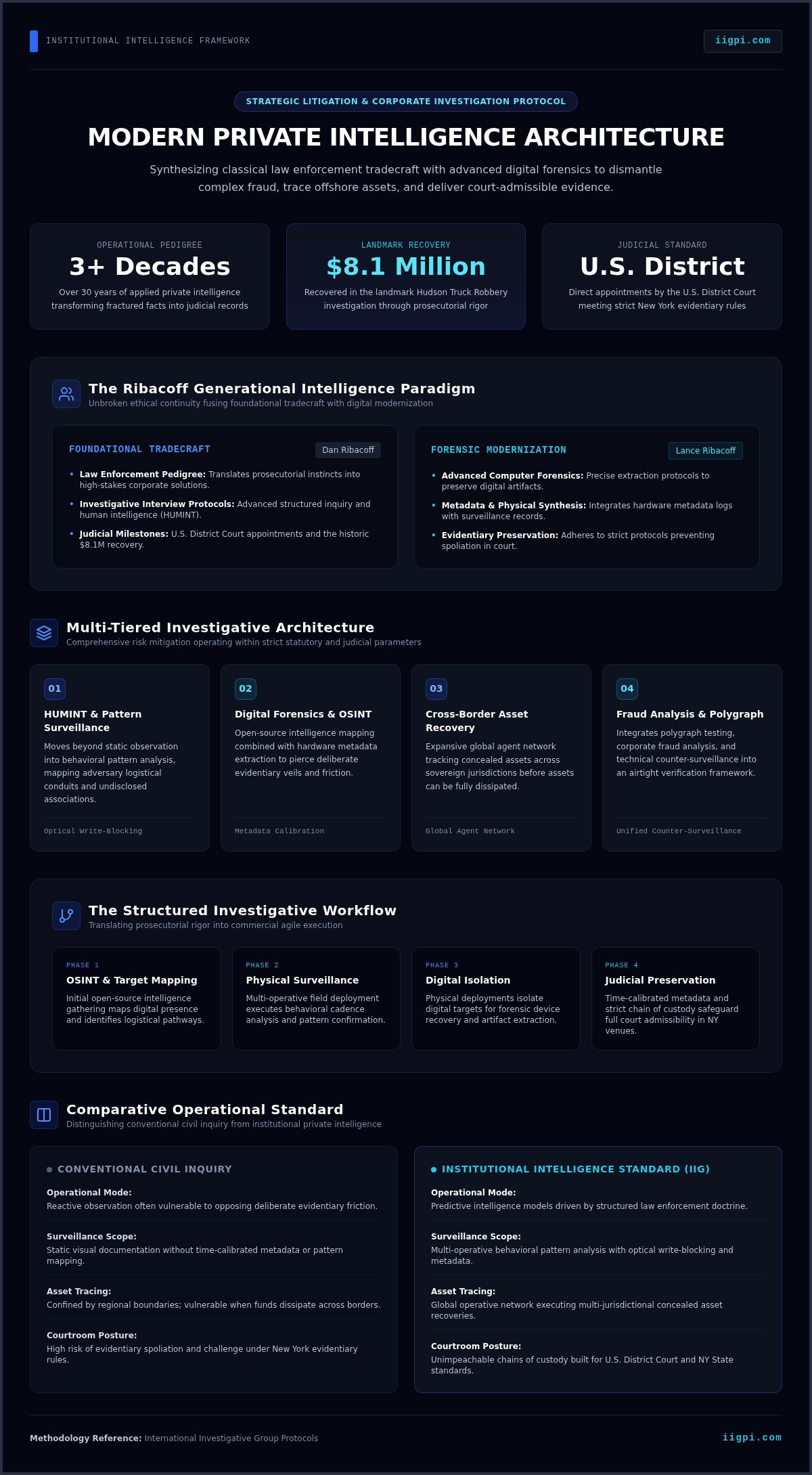
The institutional standing of International Investigative Group reflects a rare synthesis of generational competencies. Dan Ribacoff established the firm upon foundational law enforcement tradecraft, translating prosecutorial instincts and investigative interview protocols into high-stakes corporate solutions. That pedigree underpinned critical institutional milestones, including a central role in the $8.1 million Hudson Truck Robbery recovery and high-profile judicial appointments by the U.S. District Court.
Lance Ribacoff modernizes this operational baseline by institutionalizing technical forensic capabilities across complex workflows. His operational directives integrate:
- Extraction protocols within advanced computer forensics to preserve critical digital artifacts.
- Systematic synthesis of hardware metadata with physical surveillance logs.
- Rigorous evidentiary preservation to ensure strict court admissibility.
This multi-generational framework preserves unbroken ethical continuity. Family leadership ensures proprietary methodologies remain uncompromised, delivering institutional reliability to global counsel, financial institutions, and multinational corporations requiring discrete fact verification.
Advanced Methodologies in Complex Investigations
Transitioning from statutory police work to private-sector intelligence requires translating prosecutorial rigor into commercial agility. When civil discovery stalls, institutional investigators dismantle informational blockades by marrying human intelligence (HUMINT) directly with device extractions. Rather than relying on disconnected tactics, complex matters require a structured workflow. Initial open-source mapping informs physical deployments, which subsequently isolate digital targets for forensic recovery. This systematic methodology defines the operational threshold set by a premier private investigator, Lance Ribacoff, Dan Ribacoff, and their specialized investigative units.
Surveillance as a Strategic Intelligence Asset
Static visual documentation is no longer sufficient in contested legal venues. Modern operations transform visual monitoring into rigorous behavioral pattern analysis, mapping an adversary’s cadence, logistical conduits, and undisclosed associations over extended periods. Operatives maintain unimpeachable chains of custody, ensuring time-calibrated metadata, optical write-blocking, and strict adherence to New York State private investigator licensing requirements so every frame withstands strict judicial scrutiny. Retaining an authoritative surveillance services guide helps corporate legal teams structure multi-operative field deployments that prevent evidentiary spoliation.
Global Reach and Local Expertise
Financial schemes and hidden assets rarely conform to national borders. Managing cross-border intelligence demands an established international agent presence capable of executing field maneuvers under divergent statutory codes. In an era where asset dissipation across sovereign jurisdictions happens in hours, decentralized operations depend on strict standardization from leadership. Consider the essential components required to navigate multi-jurisdictional matters:
- Harmonized evidentiary collection that complies with both domestic court requirements and local foreign statutes.
- On-the-ground operatives possessing localized cultural fluency to cultivate sensitive HUMINT sources.
- Centralized operational control to synthesize disparate global inputs into an actionable evidentiary brief.
This operational doctrine proved decisive in historically complex operations, including the strategic recovery of assets linked to the Iranian government within the United States. Cross-border asset tracing requires elite legal counsel to partner with an experienced private investigator, Lance Ribacoff, Dan Ribacoff to ensure foreign findings are fully admissible in domestic courtrooms.
Corporate Fraud and Financial Criminal Investigation
Enterprise malfeasance thrives on structural obfuscation. According to the Association of Certified Fraud Examiners (ACFE), asset misappropriation represents the most prevalent category of occupational fraud, arising in 86% of reported cases and inflicting a median loss of approximately $145,000 before detection. Tracing these illicit diversions requires deep forensic financial deconstruction rather than routine accounting checks. By identifying systemic control failures, an expert forensic investigator establishes direct culpability for multi-million dollar litigation. Documented in the U.S. Bureau of Labor Statistics profile on private investigators, this specialized function requires navigating complex regulatory standards while gathering evidence alongside government entities.
Mitigating Risk through Due Diligence
Transactional integrity in major mergers and acquisitions rests entirely on investigative depth. Conventional balance-sheet evaluations routinely miss undisclosed liabilities, pending civil actions, and synthetic corporate structures designed to conceal debt. Strategic background inquiries expose hidden conflicts of interest, sanction exposure, and reputational liabilities before capital allocation. Reviewing an authoritative corporate fraud investigation pillar enables leadership to implement systematic due diligence protocols that neutralize financial exposure prior to contract finalization.
High-Stakes Recovery and Asset Tracing
Locating converted assets demands analytical patience and rapid operational execution. When bad actors distribute stolen resources across offshore jurisdictions, shell entities, and high-value physical commodities, investigators must map the entire conversion ecosystem. The efficacy of this multi-layered approach is evident in several specialized recovery operations:
- The recovery of stolen bullion and assets in the $8.1 million Hudson Truck Robbery case, achieved through meticulous informant cultivation and rapid physical interception.
- Locating illicitly acquired fine arts and high-value jewelry entangled in international extortion rings, which requires tracking illicit transport corridors.
- Deploying controlled sting operations that preserve legal boundaries while establishing definitive proof of possession for asset repatriation.
Stolen assets move through complex channels. Retaining a premier private investigator, Lance Ribacoff, Dan Ribacoff, and their financial recovery specialists provides the institutional competence needed to reverse complex asset diversions and deliver court-admissible recovery solutions.
The Legal and Ethical Framework in New York
Procuring intelligence in high-stakes civil or criminal disputes carries zero utility if counsel cannot enter the underlying proof into the formal record. In New York, judicial scrutiny of investigative work is acute. Evidence derived via statutory violations faces swift disqualification, exposing retaining counsel to sanctions and civil liability. Operating under the Criminal Justice Act (CJA) for federal appointments requires adherence to strict evidentiary thresholds, particularly within the Southern and Eastern Districts of New York. The operational discipline established by private investigator, Lance Ribacoff, Dan Ribacoff balances intensive pursuit with statutory adherence, ensuring critical intelligence survives aggressive motions in limine.
The Admissibility of Evidence in 2026
Admissibility standards governing electronic discovery demand technical rigor from the moment hardware is secured. Courts reject sloppy extractions. Forensic investigators must preserve cryptographic hashes, use certified hardware write-blockers, and document unbroken custodial handling to authenticate digital evidence on the witness stand. Reviewing established computer forensics best practices provides corporate litigators with the protocol benchmarks necessary to substantiate electronic extractions during federal trials.
NYC Private Investigation Standards
Urban field operations within New York City present unique legal friction points, ranging from one-party consent audio recording parameters under New York Penal Law Article 250 to strict video voyeurism prohibitions under section 250.45. Navigating these constraints demands institutional precision. Former law enforcement leadership provides an intrinsic advantage, framing field deployments around legal boundaries rather than speculative assumptions.
All NYC investigative operations must comply with the General Business Law Article 7. This statute establishes mandatory licensure standards, background verifications, and regulatory oversight managed by the Department of State. When retaining field intelligence teams, counsel must confirm strict statutory compliance:
- Active licensing under Article 7 alongside mandatory surety bonding filed directly with the State.
- Demonstrated verification of the required three years of full-time investigative experience.
- Strict compliance with metropolitan surveillance rules, ensuring zero intrusion into areas carrying a reasonable expectation of privacy.
Litigation success depends on unimpeachable facts. Retaining an authoritative private investigator, Lance Ribacoff, Dan Ribacoff ensures your evidence is acquired legally, preserved forensically, and ready for trial.
Integrated Intelligence: The Voltie Solution
Fragmented investigative capabilities create critical vulnerabilities during multi-front disputes. Retaining discrete vendors for computer forensics, witness interviews, and physical field surveillance introduces logistical friction and degrades evidentiary coherence. International Investigative Group resolves this operational divide by housing polygraph testing, tactical surveillance, and forensic science within a single command structure. Grounded in this interdisciplinary doctrine, retaining an elite private investigator, Lance Ribacoff, Dan Ribacoff, and their unified investigative assets ensures disparate intelligence threads merge into an airtight, defensible evidentiary brief.
The Role of Specialized Forensics
Modern intelligence operations require complete synthesis between digital footprints and physical reality. Lance Ribacoff directs the modernization of digital forensics, extracting volatile communications and decrypting stored records to establish target timelines before field operatives initiate physical surveillance. Concurrently, technical counter-surveillance teams execute electronic bug sweeps to secure corporate boardrooms and counsel suites against clandestine listening devices. For delicate familial matters requiring this same technical sophistication, utilizing specialized methodologies outlined in our guide on personal and domestic investigations guarantees rigorous privacy protections alongside actionable fact-finding.
Engaging Global Expertise
Dan Ribacoff’s internationally acknowledged mastery of polygraph testing provides a definitive layer of truth verification in contested fraud scenarios, post-conviction reviews, and high-exposure corporate theft. His structured interview methodologies dismantle deception where transactional documentation remains ambiguous. When deploying full-spectrum intelligence, initiating an inquiry requires a disciplined methodology:
- Strategic Intake: Formulating clear evidentiary objectives, target jurisdictional bounds, and statutory limitations directly with corporate counsel.
- Resource Synchronization: Deploying digital forensics, forensic accounting, and field surveillance units simultaneously to prevent target alert or asset spoliation.
- Executive Synthesis: Delivering trial-ready documentation that combines digital logs, sworn operative affidavits, and psychophysiological assessments.
Ranked among the top 15 investigative firms in the United States with over 10,000 cases resolved, the firm delivers institutional authority to complex matters. Partnering with a premier private investigator, Lance Ribacoff, Dan Ribacoff provides legal and executive leadership with decisive clarity when institutional integrity is on the line.
Securing Decisive Strategic Clarity
Resolving complex corporate friction requires moving past fragmented inquiries to embrace institutional intelligence. Achieving an evidentiary advantage depends on strict chain-of-custody protocols, multidisciplinary forensics, and operational alignment with New York statutory thresholds. Retaining an elite private investigator, Lance Ribacoff, Dan Ribacoff ensures that raw facts transform into trial-ready assets capable of withstanding aggressive judicial challenge.
Founded and led by former law enforcement professionals, International Investigative Group brings over 30 years of operational experience to global disputes. With over 10,000 cases solved through an expansive international agent network, the firm provides counsel and corporate leadership with the decisive proof needed to protect substantial capital. Consult with the experts at International Investigative Group for your complex investigative needs, and secure the clarity required to prevail.
Frequently Asked Questions
What is the primary difference between a private investigator and law enforcement?
Public law enforcement agencies operate under statutory mandates to investigate violations of criminal penal codes on behalf of the state. In contrast, private intelligence operatives direct their focus toward protecting client-specific capital, mitigating enterprise exposure, and gathering actionable evidence for civil disputes. Retaining an independent investigative firm grants corporate entities tactical flexibility, dedicated attention, and discrete evidentiary development without initiating public court filings or state regulatory actions.
How much does a private investigator cost in New York City?
Investigative costs in the New York metropolitan region vary depending on operational scope, personnel requirements, and the technical complexity of the matter. Multi-operative field surveillance and high-stakes corporate fraud inquiries require structured retainer agreements that account for specialized resources like forensic computer extractions and cross-border research. Prospective clients should schedule a preliminary consultation to establish tailored budgets based entirely on their unique objectives.
Can a private investigator like Dan Ribacoff conduct international asset searches?
Yes, elite private intelligence firms track hidden capital across foreign jurisdictions by deploying coordinated networks of verified international field operatives. Grounded in this expansive framework, private investigator, Lance Ribacoff, Dan Ribacoff, and their global partners locate concealed offshore accounts, shell companies, and foreign real property while maintaining strict compliance with host-nation regulatory frameworks and international intelligence-sharing conventions.
Is evidence gathered by a private investigator admissible in court?
Evidence gathered by a licensed firm is fully admissible in state and federal courts provided it is acquired strictly within statutory parameters. Operatives must scrupulously observe one-party consent audio recording laws, honor reasonable expectations of privacy, and uphold verifiable chains of custody. Investigators regularly authenticate their findings on the witness stand by providing sworn testimony and validating hardware write-block forensic images.
What qualifications should I look for when hiring a private investigation firm?
Retaining counsel should verify that the firm holds an active license under New York General Business Law Article 7, carries required state surety bonding, and demonstrates deep roots in institutional law enforcement. Elite firms distinguish themselves through specialized certifications in computer forensics, multi-decade operational track records, and formal appointments as trusted experts by state and federal judicial bodies.
How does Dan Ribacoff’s polygraph expertise benefit a corporate investigation?
Dan Ribacoff’s advanced psychophysiological truth verification methodologies resolve complex internal disputes where digital records and paper trails fail to provide definitive clarity. In high-exposure scenarios involving intellectual property theft, embezzlement, or vendor extortion, structured polygraph examinations isolate deceptive actors and exonerate innocent employees, providing corporate leadership with objective facts required to settle delicate internal conflicts.
What is the role of Lance Ribacoff in modern computer forensics?
Lance Ribacoff directs the modernization and tactical integration of digital forensics within complex inquiries. His operational leadership focuses on extracting volatile communications from encrypted mobile devices, recovering deleted enterprise ledgers, and validating cryptographic hash values. This technical rigor ensures digital artifacts are preserved against spoliation challenges and seamlessly cross-referenced with field surveillance findings.
How long does a typical corporate fraud investigation take?
Investigation durations depend directly on scheme complexity, target sophistication, and the dispersion of relevant digital evidence. While straightforward due diligence inquiries conclude within several days, multi-jurisdictional financial fraud or asset recovery operations often span weeks or months. Working with private investigator, Lance Ribacoff, Dan Ribacoff ensures systematic phased reporting that provides actionable intelligence at every critical stage of litigation.