
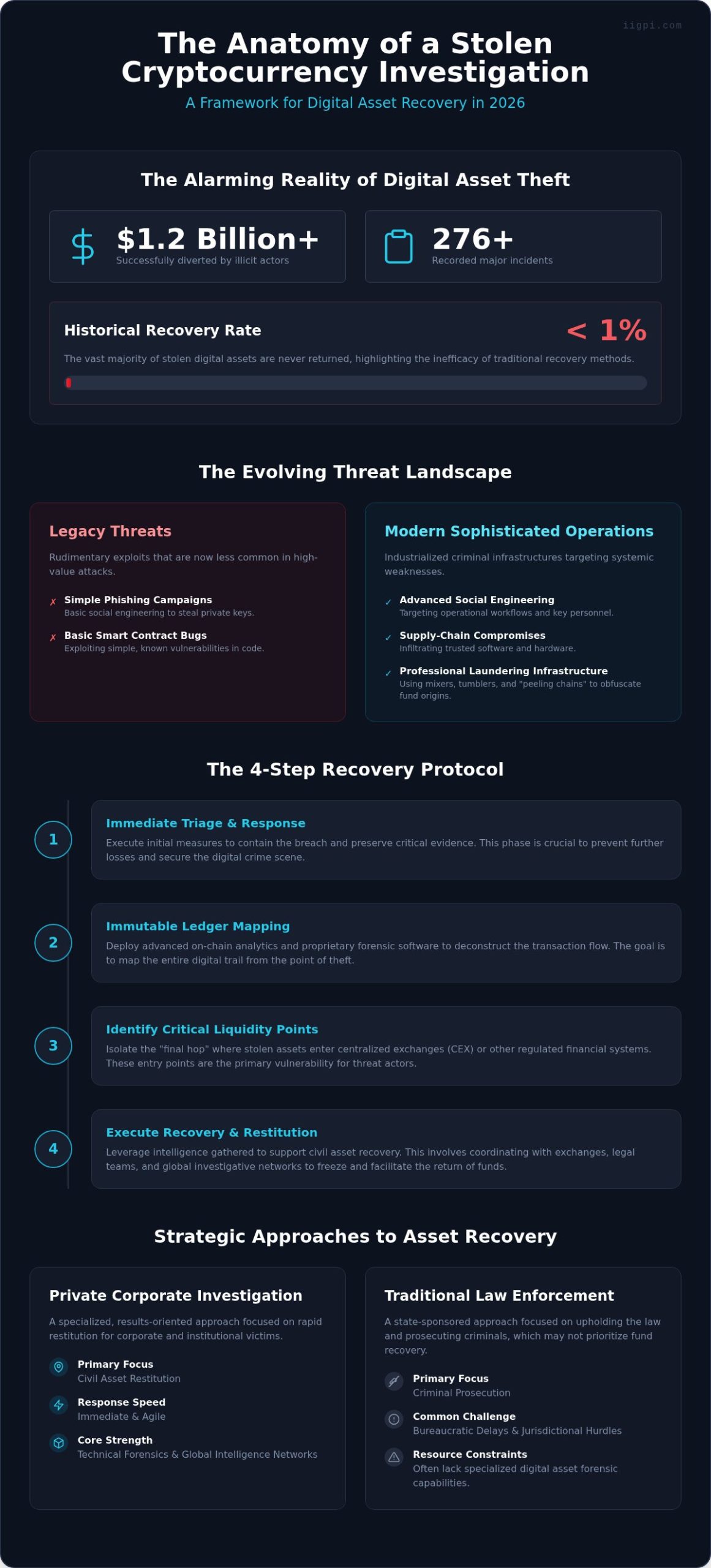
As of August 2026, illicit actors have successfully diverted over $1.2 billion across 276 recorded incidents, yet the recovery rate for these digital assets remains historically suppressed at less than one percent. For corporate entities and institutional stakeholders, the sudden loss of significant capital is frequently exacerbated by the perceived anonymity of blockchain technology and the bureaucratic delays inherent in traditional law enforcement responses. We recognize that the erosion of fiscal integrity poses a severe reputational risk that demands an immediate, sophisticated counter-response rooted in technical precision.
This article delivers an authoritative analysis of the methodologies and forensic techniques essential to a successful stolen cryptocurrency investigation. We provide a comprehensive framework for the identification of perpetrators through advanced on-chain analytics and the strategic freezing of assets at centralized exchange entry points. By examining the synergy between specialized computer forensics and global investigative networks, this discourse outlines the precise protocols required to facilitate the restitution of illicitly diverted funds within the current regulatory environment. Readers will gain a rigorous understanding of the forensic lifecycle, from initial asset tracing to the final execution of recovery strategies.
Key Takeaways
- Analyze the systemic shift in digital asset misappropriation, focusing on how contemporary threat actors utilize sophisticated operational infrastructure rather than simple smart contract vulnerabilities.
- Execute a structured stolen cryptocurrency investigation by deploying immutable ledger mapping to isolate transaction flows and identifying critical liquidity points at global exchanges.
- Differentiate between the mandates of public law enforcement and the specific capabilities of private corporate investigations to determine the most efficient pathway for civil asset restitution.
- Adopt a formalized recovery protocol that integrates immediate triage measures with the specialized technical rigor of advanced computer forensics and global investigative intelligence.
- Utilize a multidisciplinary framework that combines three decades of law enforcement expertise with a worldwide network of agents to navigate the cross-border complexities of modern financial crime.
The Paradigm Shift in Financial Crime: Understanding Cryptocurrency Theft
The contemporary landscape of digital asset misappropriation has undergone a fundamental transformation, moving beyond the rudimentary exploits of previous years to embrace industrialized criminal operations. In 2026, the proliferation of sophisticated syndicates has necessitated a rigorous approach to stolen cryptocurrency investigation, as traditional methods of asset protection often fail against advanced social engineering and supply-chain compromises. The financial impact on high-net-worth individuals and institutional stakeholders is profound, often involving the loss of millions in liquid capital and the subsequent erosion of market confidence. Relying on amateur recovery attempts often doesn’t yield results in an era where threat actors utilize professionalized laundering infrastructures.
The Mechanics of Illicit Digital Transfers
The evolution of clandestine transaction methods reflects a transition from simplistic phishing campaigns to the exploitation of complex smart contract logic and signing infrastructures. Modern adversaries frequently utilize mixers and tumblers to effectively sever the link between the origin of the theft and the final destination of the funds, creating a labyrinthine audit trail. To counter these obfuscation tactics, investigators must employ advanced blockchain analysis and tracing techniques to map the movement of assets across disparate networks. Vulnerabilities are particularly acute in hot wallets, which lack the robust security layers of institutional-grade custody solutions, making them prime targets for rapid, automated drainer scripts that bypass standard authentication protocols.
Institutional Risks and Corporate Vulnerabilities
Corporate entities now face unprecedented exposure to multi-million dollar fraud schemes that target operational workflows and exchange operator interfaces. The intersection of corporate fraud investigation and digital asset security has become a critical focal point for leadership teams tasked with safeguarding shareholder value. Beyond the immediate capital loss, firms encounter significant regulatory pressures from bodies like the SEC, which increasingly demands accountability for failures in digital holding security. It’s imperative that firms recognize a formal stolen cryptocurrency investigation protocol is not merely a reactive measure for recovery but a fundamental component of institutional risk mitigation. The psychological toll on leadership is significant, as the perceived anonymity of the blockchain often creates a sense of helplessness that only a structured, authoritative investigative framework can address.
Methodologies of Sophisticated Blockchain Forensics
The execution of a stolen cryptocurrency investigation relies on the meticulous deconstruction of the immutable ledger through transaction mapping and forensic synthesis. It’s no longer sufficient to merely observe public block explorers. High-level recovery operations require the deployment of proprietary forensic software capable of synthesizing vast datasets to identify entry and exit points at centralized exchanges. These liquidity points represent the most critical vulnerability for threat actors, as it’s here that the digital trail often intersects with regulated financial systems. The analytical objective is to transform abstract blockchain data into actionable intelligence that can support civil asset recovery or institutional litigation.
On-Chain Analytics: Mapping the Digital Trail
Advanced on-chain analytics involve the visual mapping of wallet clusters and the deconstruction of fund dispersion tactics. Perpetrators frequently employ “peeling chains,” a method where a large volume of currency is incrementally moved through a series of addresses to obfuscate its origin. Identifying the “Final Hop” before an asset is liquidated or moved into a high-privacy protocol is essential for a stolen cryptocurrency investigation. Investigators also utilize “dusting” techniques to tag and track illicitly obtained funds as they move through complex laundering infrastructures. This level of technical rigor ensures that the movement of capital is documented with a degree of precision that meets the evidentiary standards required for institutional reporting.
Off-Chain Intelligence: The Human Element
The synthesis of off-chain intelligence serves to unmask the anonymous actors behind the digital wallets. While blockchain data provides the “what” and “where,” the collection of Open Source Intelligence (OSINT) provides the “who.” Utilizing professional surveillance services allows investigators to correlate digital timestamps with physical activities, effectively bridging the gap between an anonymous transaction and a tangible suspect. Cross-referencing IP logs with blockchain timestamps remains a foundational requirement for unmasking actors who fail to maintain perfect operational security. This holistic approach is what differentiates an elite recovery effort from standard data analysis.
The efficacy of these methodologies is evidenced by high-profile actions such as the DOJ’s Cryptocurrency Seizure Operations, which resulted in the successful recovery of $25 million in July 2026. The integration of specialized computer forensics is essential to extract metadata from compromised devices, providing the necessary context to identify the initial point of breach. Organizations that prioritize these dual-layered protocols are significantly more likely to achieve successful restitution. For entities facing complex misappropriation challenges, engaging in a formalized theft investigation is the first step toward reclaiming diverted capital.
Private Investigation vs. Law Enforcement: A Strategic Comparison
The decision to initiate a stolen cryptocurrency investigation necessitates a strategic evaluation of the divergent capabilities between public law enforcement and private investigative entities. While federal agencies prioritize the dismantling of criminal syndicates, their involvement is frequently dictated by a high “threshold of interest,” often requiring losses that exceed specific multi-million dollar benchmarks. For many corporate victims, the primary objective isn’t merely the prosecution of the offender but the restitution of capital. Public resources are often constrained by bureaucratic procedures that don’t align with the “speed-to-freeze” imperative required to prevent assets from being laundered through high-privacy protocols. Speed is the primary arbiter of success.
The Jurisdictional Advantage
Navigating the complexities of international “safe havens” requires a level of agility that public agencies, bound by mutual legal assistance treaties (MLATs), often struggle to maintain. An elite private investigator operates with a global perspective, utilizing a decentralized network of agents to gather local intelligence without the delays of formal diplomatic channels. This international reach is vital when tracing funds through jurisdictions with opaque regulatory frameworks. By collaborating closely with legal counsel, private investigators facilitate the preparation of civil freezing orders that can be served directly to exchange operators, bypassing the months-long queues typical of public sector requests. They don’t wait for a subpoena if a civil injunction can be secured faster.
Resource Allocation and Specialized Focus
The dedicated focus of a private firm stands in stark contrast to the overwhelming caseloads managed by public detectives. Specialized investigators possess the technical depth to address unique asset classes, including decentralized finance (DeFi) liquidity pools and non-fungible tokens (NFTs), which often fall outside the standard expertise of local police departments. A comprehensive stolen cryptocurrency investigation also integrates sophisticated asset search techniques to identify the physical wealth of digital criminals. This dual-track approach ensures that even if the digital tokens are temporarily inaccessible, the victim has a pathway toward recovery through the identification of tangible offshore holdings or real property. It’s about creating leverage where none previously existed.
The Recovery Lifecycle: A Step-by-Step Investigative Protocol
The restitution of misappropriated digital capital requires a rigorously structured lifecycle that transitions from immediate technical triage to formalized legal execution. A comprehensive stolen cryptocurrency investigation is characterized by its adherence to a multi-phase protocol designed to mitigate further loss while establishing a clear chain of custody for forensic evidence. This process isn’t merely a series of ad-hoc reactions; it’s a deliberate progression that leverages technical precision to create legal leverage. Speed is the primary arbiter of success during the initial stages of this framework.
Phase I: Preservation and Evidence Collection
The ‘Golden Hour’ of crypto theft response is defined as the immediate sixty-minute interval following the discovery of a breach during which the probability of successful asset interception is at its statistical peak. Victims must prioritize the preservation of technical logs, including full transaction IDs and wallet addresses, as these serve as the foundational dataset for any valid forensic report. It’s vital to avoid contaminating digital evidence by refraining from unilateral attempts to move remaining assets on compromised hardware, as such actions can overwrite critical metadata required by a professional fraud investigator. Documenting the initial point of compromise provides the necessary context for subsequent attribution efforts.
Phase II: The “Follow the Money” Methodology
Identifying the ‘Exfiltration Wallet’—the primary staging point used by the perpetrator—is the initial objective of the ‘Follow the Money’ methodology. Investigators deploy ‘Watch-Only’ wallets to monitor suspect activity in real-time without possessing the private keys, allowing for the continuous observation of movement into high-liquidity environments. This phase necessitates seamless collaboration with Anti-Money Laundering (AML) compliance departments at major exchanges to facilitate the issuance of ‘Legal Hold’ notices. Such notices act as a temporary administrative freeze, providing the necessary window for specialized counsel to execute asset seizure warrants. This technical and legal synthesis is what prevents the permanent loss of assets into high-privacy protocols.
The culmination of a stolen cryptocurrency investigation involves the secure transfer of recovered assets back to the rightful owner through a verified, air-gapped environment. This final stage ensures that the restitution process doesn’t inadvertently re-expose the victim to the original threat vector. For organizations seeking to implement this level of strategic rigor, engaging a professional theft investigation is the most effective way to navigate the complexities of digital asset recovery and ensure the highest probability of fund restoration.
The International Investigative Group Advantage in Digital Asset Recovery
The efficacy of a stolen cryptocurrency investigation is fundamentally predicated on the institutional experience and global reach of the investigative entity. International Investigative Group (IIG) represents the pinnacle of this specialized field, leveraging over three decades of investigative experience rooted in the highest levels of law enforcement. This thirty-year legacy has facilitated the resolution of complex financial crimes, including fraud cases exceeding $120 million, positioning the firm as a premier authority for corporate and high-value digital asset recovery. The organization’s global-minded perspective is essential for addressing systemic challenges in the digital economy.
A Legacy of Authority and Credibility
Having successfully resolved more than 10,000 cases globally, IIG possesses a proven record of investigative rigor that’s essential for navigating the complexities of modern misappropriation. The firm’s headquarters in New York City serves as a central hub for global financial intelligence, providing a strategic vantage point for monitoring international capital flows. This institutional character is complemented by a profound commitment to confidentiality and discretion; such attributes are indispensable when managing sensitive domestic matters or high-stakes corporate disputes. The leadership team, composed of former law enforcement professionals, ensures that every theft investigation is conducted with the precision and ethical standards required by global stakeholders.
Comprehensive Security and Investigative Integration
The firm’s unique methodology integrates advanced computer forensics with traditional physical surveillance to construct a holistic evidentiary framework. While technical data provides the digital trajectory of illicit funds, the deployment of a global agent network across more than 100 countries allows for the collection of local intelligence that digital tools alone cannot obtain. This synthesis of on-chain and off-chain methodologies ensures that perpetrators are identified and assets are located even within jurisdictions that lack robust regulatory oversight. Specialized technicians within the forensics unit extract critical metadata from compromised systems to support the broader investigative objective. Engaging IIG provides corporate entities with a long-term strategic partner capable of addressing the multifaceted risks associated with digital holdings. For those requiring an authoritative response to asset diversion, initiating a confidential consultation is the definitive step toward restitution.
Securing the Future of Digital Fiscal Integrity
The restoration of misappropriated digital assets in 2026 demands a sophisticated synthesis of on-chain forensics and global investigative intelligence. It’s evident that the success of a stolen cryptocurrency investigation hinges on the immediate preservation of evidence and the strategic execution of legal holds before assets are diverted into high-privacy protocols. While the landscape of financial crime continues to evolve through industrialized fraud, the application of a formalized framework provides a viable pathway toward institutional restitution. The convergence of technical mapping and off-chain intelligence remains the only reliable method for unmasking sophisticated threat actors.
Achieving successful recovery requires an elite partner with the technical depth and international reach to navigate cross-border complexities. International Investigative Group offers over 30 years of investigative excellence, led by former law enforcement professionals and supported by a global network of agents across more than 100 countries. Secure your assets and initiate an elite investigation today with International Investigative Group to reclaim your digital holdings. Reclaiming lost capital is a rigorous process, yet with the correct authoritative protocols, the objective of full asset recovery remains within reach.
Frequently Asked Questions
Is it genuinely possible to recover stolen cryptocurrency in 2026?
Recovery is a viable objective when on-chain forensic analytics are synthesized with coordinated civil legal actions. Success often depends on the rapid identification of assets at centralized exchange entry points where liquidity is regulated. While the 2025 recovery rate was historically suppressed, institutional-grade investigations utilize global networks to facilitate the administrative freezing of funds. This process requires a structured stolen cryptocurrency investigation to bridge the gap between anonymous ledger data and tangible financial restitution.
How long does a typical cryptocurrency investigation take to complete?
The duration of a recovery operation is influenced by the complexity of the laundering infrastructure and the responsiveness of international financial institutions. Initial forensic mapping may be completed within several days, yet the subsequent legal processes for asset seizure can extend over several months. A comprehensive stolen cryptocurrency investigation involves continuous monitoring of suspect wallets to identify the moment illicit funds enter a regulated environment. This measured approach ensures that all technical and legal requirements for successful restitution are met.
What is the minimum loss threshold for a professional crypto investigation?
While there is no rigid statutory minimum, professional investigative firms typically focus on high-value personal and corporate cases where the misappropriated capital justifies the deployment of advanced forensic resources. Cases involving multi-million dollar fraud, such as those exceeding $120 million managed by elite firms, represent the primary focus of these operations. Victims should evaluate the cost-benefit ratio of specialized computer forensics against the total value of the diverted assets to determine the feasibility of a formal engagement.
Can a private investigator freeze funds on a decentralized exchange (DEX)?
Freezing funds directly on a decentralized exchange is technically challenging due to the absence of a central intermediary or administrative authority. However, investigators utilize sophisticated blockchain analysis to track assets until they exit these protocols and enter a centralized exchange or a regulated off-ramp. Once the assets reach a centralized entity, investigators can facilitate the issuance of legal hold notices or civil injunctions. This strategic patience is a fundamental component of a successful recovery lifecycle in the current digital landscape.
What information should I provide to an investigator immediately after a theft?
Immediate provision of technical logs, including the specific transaction IDs and the originating wallet addresses, is essential for a valid forensic report. Victims should also document the exact timestamp of the discovery and any communications received from the threat actor, as these details provide critical metadata for attribution. Preserving the integrity of the compromised device is vital; don’t attempt to move remaining assets unilaterally, as this may overwrite forensic evidence required by specialized computer forensics technicians.
How does a private investigator identify the individual behind an anonymous wallet?
Identification is achieved through the synthesis of on-chain data and off-chain intelligence, including Open Source Intelligence and physical surveillance. Investigators correlate digital timestamps with IP logs and real-world activities to unmask the human actors behind the alphanumeric addresses. By leveraging a global network of agents in over 100 countries, firms can gather local intelligence that transcends the perceived anonymity of the blockchain. This multidisciplinary approach transforms abstract ledger data into actionable evidence for civil or criminal proceedings.
Are the results of a private crypto investigation admissible in a court of law?
Forensic reports generated by expert investigative firms are designed to meet the rigorous evidentiary standards required for institutional reporting and civil litigation. When conducted by technicians with extensive backgrounds in computer forensics and law enforcement, these findings serve as authoritative documentation in asset seizure hearings. The formal framework used during the investigation ensures a clear chain of custody for all digital evidence. This technical rigor provides legal counsel with the necessary leverage to execute warrants and facilitate the secure transfer of funds.
What are the primary differences between a crypto scam and a targeted hack?
A cryptocurrency scam typically involves social engineering or deceptive investment schemes designed to persuade the victim to voluntarily transfer assets, whereas a targeted hack involves the unauthorized exploitation of technical vulnerabilities or signing infrastructures. Scams often utilize professionalized laundering networks to obfuscate the path of diverted capital, while hacks may involve the compromise of hot wallets or institutional custody solutions. Both scenarios require a structured stolen cryptocurrency investigation to map the digital trail and identify the ultimate recipients of the illicitly obtained funds.