
The selection of an investigative firm within the complex regulatory environment of the New York metropolitan area represents a critical procurement of strategic intelligence rather than a simple service acquisition. Choosing an unqualified operative doesn’t just risk a lack of results; it exposes an organization to significant legal liability and the potential for irreparable reputational damage. Understanding how to hire a private investigator in nyc requires a sophisticated appreciation for the interplay between statutory compliance and clandestine methodology. It’s a high-stakes decision where the return on investment is measured in the resolution of multi-million dollar disputes and the preservation of absolute confidentiality.
You likely recognize that the efficacy of any investigation rests upon its ability to withstand the scrutiny of formal legal proceedings and the highest standards of professional conduct. This article provides an authoritative framework for identifying and retaining elite investigative counsel capable of navigating the city’s unique jurisdictional challenges. We’ll examine the essential criteria for vetting former law enforcement professionals, the necessity of rigorous data privacy protocols, and the strategic deployment of global networks to secure actionable intelligence that holds up under the most rigorous examination.
Key Takeaways
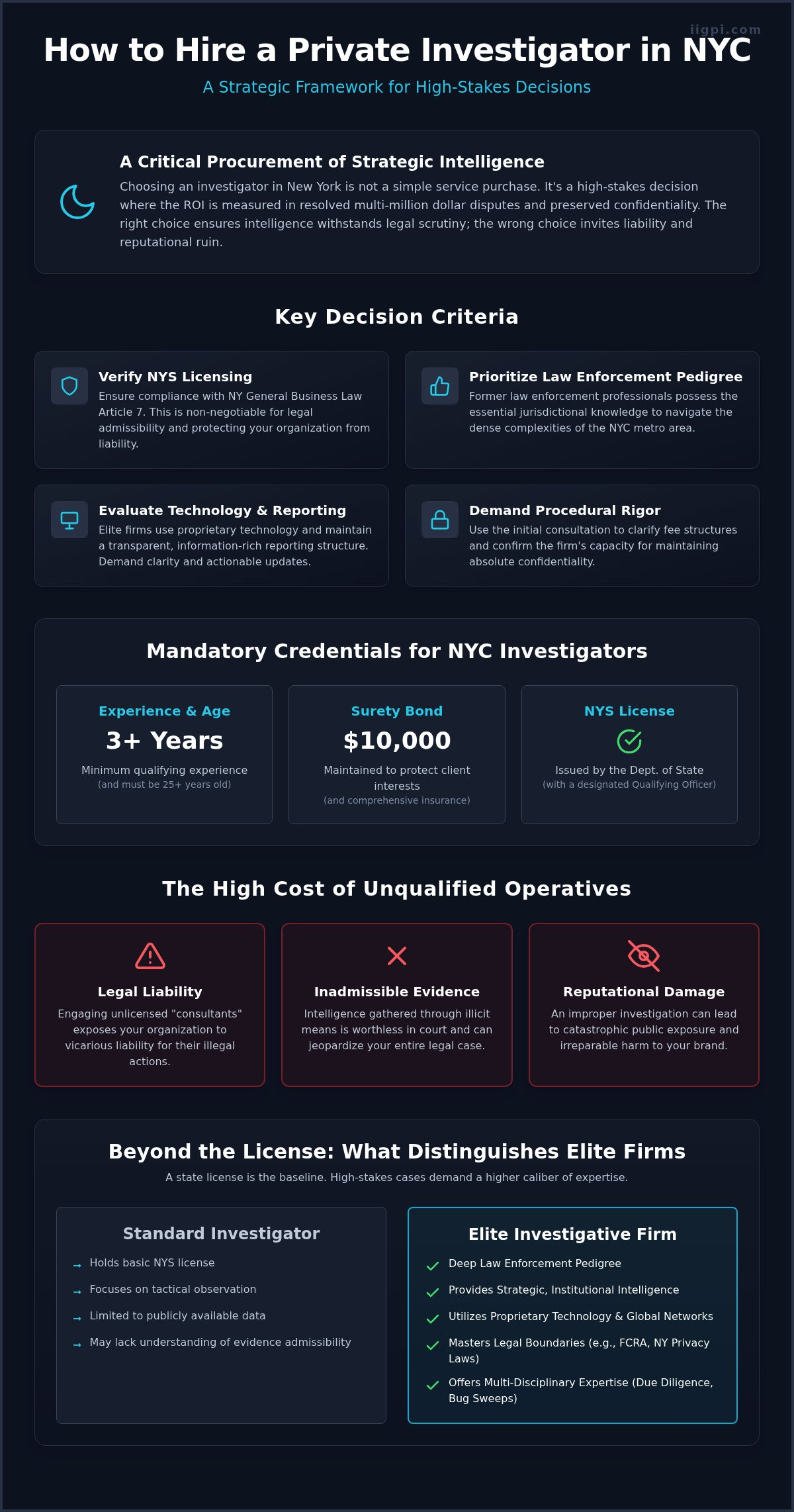
- Recognize the necessity of verifying credentials under New York General Business Law Article 7 to ensure all intelligence remains legally admissible and doesn’t expose your organization to liability.
- Prioritize firms that demonstrate a significant law enforcement pedigree, as this background is essential for navigating the dense jurisdictional complexities of the New York metropolitan area.
- Master the nuances of how to hire a private investigator in nyc by evaluating their proprietary technology and their commitment to maintaining a transparent, information-rich reporting structure.
- Implement a rigorous procedural framework during the initial consultation to clarify fee structures and confirm the firm’s capacity for maintaining absolute confidentiality throughout the engagement.
- Focus on achieving a high return on investment by securing a firm that offers multi-disciplinary expertise, ranging from corporate due diligence to complex electronic bug sweeps.
The Regulatory Landscape: Licensing and Compliance in New York
The governance of investigative services within the state of New York is primarily dictated by General Business Law Article 7, a rigorous statutory framework designed to ensure professional accountability and public safety. This legislation mandates that any entity providing investigative services must be formally licensed by the New York Department of State, a requirement that serves as a critical filter between elite practitioners and unqualified actors. When determining how to hire a private investigator in nyc, the most significant risk involves the engagement of unlicensed “consultants” who operate outside this regulatory perimeter, as such engagements don’t just jeopardize the integrity of the collected intelligence but also expose the client to vicarious liability. Entities like International Investigative Group operate with a deep understanding of these mandates, ensuring that every action taken is within the bounds of the law. Verification of licensure via the NYS Department of State Licensee Search isn’t merely a recommendation; it’s a foundational step in institutional due diligence that protects the client from the legal fallout of an improper investigation.
Mandatory Credentials for NYC Investigators
The licensure process in New York is exceptionally stringent, requiring applicants to be at least 25 years of age and to demonstrate a minimum of three years of qualifying investigative experience or substantial service within a government investigative agency. Every professional firm must designate a Qualifying Officer who holds the requisite expertise to oversee operations and maintain compliance with state mandates. Beyond experience, the state requires the maintenance of a $10,000 surety bond and comprehensive insurance coverage to protect the interests of the public and the client. The Department of State maintains active oversight, possessing the authority to impose disciplinary measures or revoke licenses should a firm fail to uphold the ethical and procedural standards expected of a professional private investigator. These credentials serve as a baseline for quality, ensuring that the firm possesses the institutional stability required for complex corporate or personal matters.
Legal Boundaries of Private Intelligence
The utility of private intelligence is intrinsically linked to its legal admissibility, as evidence gathered through illicit means is typically excluded from judicial consideration. Professional firms must operate within the specific parameters of New York privacy laws and federal statutes, such as the Fair Credit Reporting Act (FCRA), which governs the procurement and use of personal data during background investigations. Understanding how to hire a private investigator in nyc involves assessing a firm’s ability to navigate these restrictions without compromising the mission’s objectives. Elite investigators distinguish themselves by their mastery of what information is legally accessible, ensuring that surveillance and data retrieval protocols align with the standards required by the New York court system, thereby preventing the catastrophic failure of an investigation during the discovery phase of litigation. This legal discipline ensures that the resulting intelligence is both actionable and defensible.
Strategic Assessment: Identifying the Appropriate Investigative Expertise
Determining how to hire a private investigator in nyc necessitates a shift in focus from mere tactical observation to the procurement of institutional intelligence. While a standard New York State private investigator license establishes a baseline of regulatory compliance, it doesn’t guarantee the sophisticated analytical capabilities required for high-stakes financial or legal disputes. The complexity of the New York metropolitan area demands a firm with a significant law enforcement pedigree. Former law enforcement professionals possess the jurisdictional knowledge and technical proficiency to navigate dense urban systems. This background is particularly critical when addressing sophisticated corporate fraud or complex insurance claims where the potential for significant financial loss is high.
Evaluating Institutional Experience
A firm’s operational history serves as the most reliable indicator of its future performance. Stakeholders should prioritize entities that demonstrate a vast portfolio of successful outcomes, such as having surpassed 10,000 cases solved across diverse specializations. This depth of experience is vital in the context of a corporate fraud investigation, where the ability to trace assets and identify systemic vulnerabilities requires an advanced investigative framework. Industry-specific expertise in areas like matrimonial disputes, specie loss, or jewelers loss investigations further distinguishes elite firms from generalist agencies. Identifying a firm with a global network of agents ensures that local knowledge in NYC is supplemented by an international operational capacity.
The Multidisciplinary Approach
Modern intelligence gathering requires a seamless integration of physical surveillance and digital analysis. An elite NYC firm doesn’t operate in silos. Instead, it leverages computer forensics to extract actionable data from digital footprints, which often provides the critical evidence needed in contemporary legal proceedings. This multidisciplinary strategy extends to technical surveillance counter-measures (TSCM), commonly known as electronic bug sweeps, and the use of polygraph testing to verify information. By combining these specialized functions, a firm provides a comprehensive security solution that addresses both physical and virtual threats. Understanding how to hire a private investigator in nyc involves looking for this convergence of skills. For those seeking this level of sophisticated engagement, consulting with a premier investigative firm ensures that all operational objectives are met with precision and discretion.
Methodology and Infrastructure: What Distinguishes Elite Firms
The procurement of actionable intelligence within the New York metropolitan area requires a rigorous adherence to systematic methodologies that extend far beyond basic observation. Elite firms distinguish themselves through the deployment of sophisticated infrastructure and proprietary technology designed to manage complex data sets while securing sensitive information flows. When determining how to hire a private investigator in nyc, decision-makers must scrutinize the firm’s ability to produce a comprehensive investigative dossier that includes high-definition visual evidence and verified chronological logs. This level of transparency isn’t just a matter of professional courtesy; it’s an essential component of institutional accountability that ensures all findings meet the highest evidentiary standards for legal proceedings. Secure communication protocols are equally vital, as the mismanagement of sensitive data can compromise an entire mission before it reaches its conclusion.
Elite investigative institutions often leverage a global network of agents to project influence across international borders while maintaining their strategic headquarters in New York. This capacity for cross-border operations is essential for tracing assets in foreign jurisdictions or investigating transnational corporate fraud. Adherence to New York State private investigator licensing requirements provides the necessary regulatory foundation for these global activities, ensuring that all intelligence gathering remains within the boundaries of international law. By operating through a structured global framework, a firm can bridge the gap between local NYC insights and macro-level systemic challenges, providing a level of reach that standard agencies simply can’t match.
Surveillance and Operational Security
The execution of surveillance services in a dense urban environment demands a high degree of technical proficiency and absolute discretion. Elite operatives utilize high-definition optics and advanced stabilization technology to capture clear evidence from significant distances, a necessity when navigating the logistical hurdles of the five boroughs. Discretion is treated as a core methodology rather than a secondary goal. Agents must possess the expertise to avoid detection within heavy traffic and crowded public spaces, maintaining a constant presence without alerting the subject. Navigating the logistics of extended surveillance in New York requires a sophisticated understanding of urban dynamics and a commitment to maintaining the integrity of the mission through every phase of the engagement.
Digital Forensics and Cyber Intelligence
Modern investigations frequently involve the intersection of physical actions and digital footprints, making digital forensics a pivotal component of modern intelligence gathering. This specialized field involves tracing the origins of financial fraud, uncovering corporate espionage, and identifying sophisticated cryptocurrency scams that hide illicitly obtained assets. Maintaining a strict chain of custody for digital evidence is a non-negotiable requirement for ensuring that data remains admissible in court. By integrating cyber intelligence with traditional investigative methods, firms provide a holistic view of a subject’s activities. This multidisciplinary approach allows for the location of hidden digital assets and the resolution of complex disputes that involve both physical and virtual layers of deception.
The Procedural Framework for Engagement and Retention
The formalization of an investigative engagement within the New York metropolitan area represents a critical juncture in the procurement of institutional intelligence. This phase demands a structured protocol to ensure total alignment between the client’s strategic objectives and the firm’s operational execution. Understanding the procedural nuances of how to hire a private investigator in nyc involves more than a simple service agreement; it requires a comprehensive framework for vetting the firm’s approach to sensitive data and ethical boundaries. By establishing rigorous Key Performance Indicators (KPIs) at the outset, stakeholders can ensure that the investigation yields actionable intelligence that withstands the scrutiny of high-stakes legal proceedings. It’s essential to address potential conflicts of interest early, particularly within the dense network of NYC legal and financial circles, to preserve the integrity of the findings.
The Consultation Phase
The initial consultation serves as the foundational mechanism for establishing a secure line of communication and defining the scope of the engagement. Effective briefing requires the client to disclose all relevant facts, allowing the firm to construct a sophisticated strategic proposal tailored to the specific jurisdictional challenges of the case. During this phase, decision-makers should evaluate the firm’s ability to synthesize complex information into a coherent operational plan. This dialogue isn’t merely an exchange of information; it’s a test of the firm’s intellectual rigor and its capacity for maintaining absolute discretion throughout the investigative lifecycle. Professional firms will demonstrate their expertise by identifying potential hurdles before they manifest, ensuring a proactive rather than reactive methodology.
Financial and Legal Transparency
Transparency in the financial and legal dimensions of an engagement is paramount for maintaining a productive partnership. Professional investigative firms typically utilize a retainer-based model, with fee structures organized around hourly rates for specialized surveillance or flat-fee arrangements for discrete tasks like background investigations. A written contract is a non-negotiable requirement, detailing the precise scope of work, reporting schedules, and the methodology for expense documentation. This document serves as the primary instrument of accountability, protecting both parties from misunderstandings regarding the allocation of resources. To ensure that your objectives are met with the highest level of professional conduct, you should initiate a formal consultation with a premier investigative firm that prioritizes detailed invoicing and clear financial oversight. This level of institutional transparency ensures that the ROI of investigative services is clearly documented through precise reporting and defensible evidence.
Conclusion: The International Investigative Group Advantage
The synthesis of the aforementioned criteria, including regulatory compliance, technical infrastructure, and multidisciplinary expertise, culminates in the selection of a firm that functions as a strategic partner in high-stakes intelligence procurement. International Investigative Group represents the pinnacle of this professional standard, offering a sophisticated framework for those determining how to hire a private investigator in nyc. With a 30-year history of operational excellence founded upon a deep law enforcement pedigree, the firm has navigated the most complex jurisdictional challenges within the New York metropolitan area. This legacy, spearheaded by the expertise of Dan Ribacoff, ensures that every engagement is handled with the intellectual rigor and discretion required by global leaders and institutional stakeholders. Choosing a firm with this level of established authority isn’t just a tactical decision; it’s a commitment to securing the highest possible standard of actionable intelligence.
A Legacy of Authority in NYC
The efficacy of IIG’s methodology is rooted in a profound understanding of the role and function of a private investigator as an instrument of institutional clarity. By successfully concluding over 10,000 matters, including high-profile cases involving fraud in excess of $100 million, the firm has established itself as an authoritative entity in the global investigative landscape. This institutional value isn’t merely a reflection of longevity. It’s a testament to a commitment to the highest standards of professional rigor and evidentiary integrity. The integration of a global network of agents allows the firm to maintain its NYC headquarters while projecting influence across international borders, bridging the gap between regional dynamics and macro-level systemic challenges. Every case is treated as a critical mission where the preservation of confidentiality is paramount.
Initiating Your Investigation
Securing elite investigative counsel requires a direct and secure path to engagement, beginning with a formal briefing at our New York City headquarters. For corporate entities, insurance firms, and private clients facing complex disputes, the transition from uncertainty to actionable intelligence is achieved through a structured consultation process. Understanding how to hire a private investigator in nyc involves recognizing that the highest return on investment is found in firms that prioritize absolute discretion and professional integrity above all else. To begin the process of resolving your specific investigative requirements, you should contact International Investigative Group to establish a secure line of communication. Our former law enforcement professionals are prepared to implement the strategic protocols necessary to secure the resolution of your most sensitive and high-stakes matters through a deliberate and measured approach.
Securing Institutional Integrity Through Elite Investigative Counsel
The procurement of investigative services within the New York metropolitan area represents a significant strategic acquisition that demands rigorous adherence to statutory compliance and professional benchmarks. As detailed throughout this protocol, the distinction between marginal operatives and elite firms rests upon the integration of sophisticated technology, former law enforcement leadership, and a commitment to evidentiary admissibility. It’s essential to recognize that the efficacy of an investigation is measured by its ability to withstand the most rigorous legal and corporate scrutiny.
Mastering how to hire a private investigator in nyc involves prioritizing entities that demonstrate a vast portfolio of institutional success, specifically those with over 30 years of experience and 10,000 cases solved. This level of expertise ensures that complex disputes, from corporate fraud to sensitive personal matters, are resolved with absolute discretion and intellectual depth. We invite you to consult with our elite investigative team at International Investigative Group to secure the strategic intelligence your situation demands. Your pursuit of resolution is fortified by our legacy of professional excellence and global operational reach.
Frequently Asked Questions
Is it legal to hire a private investigator in New York City?
It is entirely legal to engage a private investigator within New York City provided the operative is licensed by the New York Department of State under General Business Law Article 7. This statutory framework ensures that investigative activities are conducted within a regulated perimeter, protecting the client from legal liability. Engaging a licensed firm like International Investigative Group guarantees that all evidence gathered remains admissible in formal judicial proceedings and adheres to professional standards.
How much does a private investigator cost in NYC?
Investment in investigative services is determined by the complexity of the mandate and the technical resources required for successful resolution. When researching how to hire a private investigator in nyc, stakeholders will find that professional firms typically utilize a retainer-based model with hourly rates or flat-fee structures for discrete tasks. These costs reflect the specialized expertise of former law enforcement professionals and the deployment of advanced surveillance or forensic technology necessary for high-stakes matters.
How do I verify if a private investigator is licensed in New York?
Verification of professional credentials is a mandatory step in the procurement of investigative intelligence. You can confirm a firm’s status by utilizing the New York State Department of State Licensee Search database, which provides public access to the registration status of all licensed entities. This verification process ensures that the firm possesses the mandatory bonding and insurance required to operate legally within the state’s rigorous regulatory environment, thereby mitigating risk for the client.
Can a private investigator in NYC testify in court?
Licensed private investigators are frequently called upon to provide expert testimony regarding the evidence and observations documented during an engagement. Their testimony is particularly valuable when supported by a comprehensive investigative dossier containing high-definition visual evidence and chronological logs. Because International Investigative Group operates under former law enforcement leadership, our protocols are specifically designed to meet the highest evidentiary standards required by the New York court system during formal litigation.
What is the difference between a private investigator and a detective agency?
In the context of New York regulatory standards, these terms are often used interchangeably, although “private investigator” is the formal designation recognized by the Department of State. A premier firm distinguishes itself from a standard agency through its institutional infrastructure, global operational capacity, and the depth of its specialized services. International Investigative Group functions as a high-level research and intelligence entity, providing a more sophisticated framework than a typical local detective agency.
Can an investigator access private phone records or bank accounts?
Professional investigators are strictly prohibited from accessing private phone records or bank accounts without legal authorization, such as a court-ordered subpoena. Any operative claiming otherwise is likely engaging in illicit “pretexting” or data theft, which exposes the client to severe legal consequences. Instead, elite firms utilize sophisticated asset searches and due diligence methodologies to identify financial footprints through public records and proprietary databases, ensuring all gathered data remains legally defensible.
How long does a typical investigation take to complete?
The temporal requirements for an investigation are dictated by the specific objectives and the complexity of the subject’s activities. While a discrete surveillance mission might reach a resolution within several days, complex corporate fraud or asset recovery cases often require several weeks or months of intensive analysis. Professional firms establish clear timelines and milestones at the outset to ensure that the flow of intelligence aligns with the client’s strategic needs and provides a clear ROI.
What should be included in a private investigator contract?
A formal investigative contract must delineate the specific scope of work, the financial structure of the retainer, and the protocols for reporting findings. Essential clauses should address absolute confidentiality, the handling of sensitive data, and the firm’s adherence to state and federal privacy laws. This document serves as the primary instrument of institutional accountability, ensuring that both parties maintain a clear understanding of the operational objectives, the expected deliverables, and the legal boundaries.