
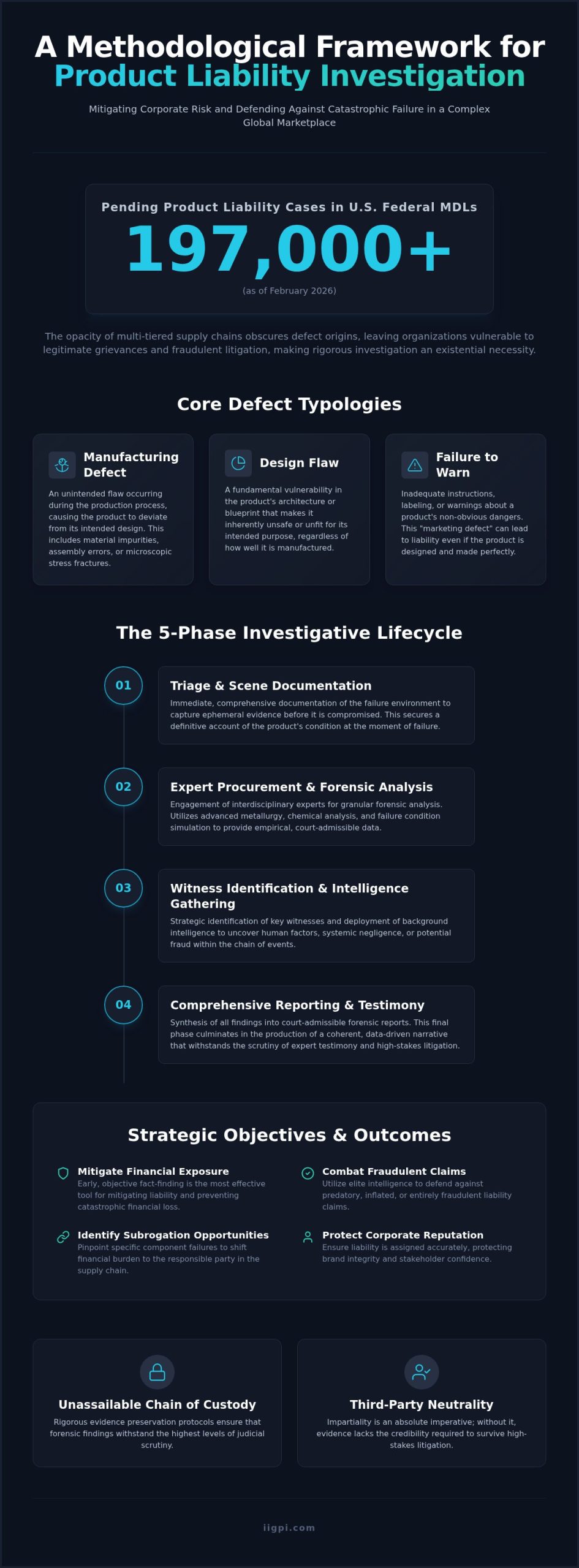
With over 197,000 pending product liability cases in federal multidistrict litigations as of February 2026, the margin for error in corporate risk mitigation has effectively vanished. The execution of a rigorous product liability investigation serves as the primary bulwark against the catastrophic financial and reputational erosion that follows such failures. You likely recognize that the opacity of modern, multi-tiered supply chains often obscures the precise origin of a defect, leaving your organization vulnerable to both legitimate grievances and the predatory nature of inflated or fraudulent litigation. This authoritative guide provides a methodological framework for deploying sophisticated investigative protocols that secure the forensic evidence necessary to mitigate these existential risks. We’ll examine the rigorous standards for maintaining an unassailable global chain of custody, the technical nuances of multi-disciplinary root-cause analysis, and the synthesis of court-admissible forensic reports that define the current standard of excellence in corporate defense and risk management.
Key Takeaways
- Implement a systematic product liability investigation framework designed to synthesize physical failure analysis with the stringent requirements of international tort law.
- Orchestrate a methodological lifecycle that prioritizes immediate forensic documentation and the subsequent engagement of specialized, interdisciplinary experts.
- Categorize defect typologies with precision to identify specific vulnerabilities within the manufacturing process or the fundamental design architecture of a product.
- Secure a definitive chain of custody through rigorous evidence preservation protocols, ensuring that forensic findings withstand the scrutiny of high-stakes judicial proceedings.
- Utilize elite corporate intelligence and decades of former law enforcement experience to mitigate the systemic risks posed by fraudulent or inflated liability claims.
The Conceptual Framework of Product Liability Investigation
A professional product liability investigation functions as a systematic forensic inquiry, transcending simple observation to provide a comprehensive reconstruction of product failure. This process requires an objective synthesis of engineering data and legal standards to determine whether a failure originated from a manufacturing defect, a fundamental design flaw, or a failure to warn. Third-party neutrality remains an absolute imperative in this context; without it, the resulting evidence lacks the credibility required to survive the rigors of high-stakes litigation. For organizations operating at a global scale, maintaining this impartiality is the only way to secure a definitive account of a product’s condition at the moment of failure.
The Role of Investigative Intelligence in Tort Law
Investigative findings provide the empirical substance required to navigate the product liability framework within various international jurisdictions. While modern consumer protection often relies on strict liability, which focuses on the product’s defect rather than the manufacturer’s intent, professional intelligence remains vital for establishing the chain of causation. A thorough inquiry bridges the gap between a physical incident and a legal cause of action by documenting whether a duty of care was breached. It transforms raw data into a coherent narrative that addresses the four elements of negligence, ensuring that legal teams have the factual clarity needed to mount a sophisticated defense.
Strategic Objectives for Corporate and Insurance Stakeholders
Corporate and insurance leaders utilize these investigations to achieve specific, high-value outcomes that protect the bottom line. Early fact-finding is the most effective tool for mitigating financial exposure and preventing the payment of fraudulent or inflated claims. Beyond immediate defense, a product liability investigation identifies subrogation opportunities across a fragmented supply chain. By pinpointing a specific component failure, a firm can shift the financial burden to the negligent party responsible for that particular part of the process. This rigorous approach to fact-finding, often facilitated by specialized investigative services, ensures that liability is assigned accurately and that corporate reputations remain intact.
The Methodological Lifecycle of a Professional Investigation
The execution of a professional product liability investigation necessitates a structured, multi-phased lifecycle that ensures every evidentiary lead is pursued with academic rigor. Phase I commences with immediate triage and comprehensive scene documentation to capture the ephemeral state of a failure environment before it’s compromised by external variables. This moves into Phase II, where the focus shifts to the procurement of interdisciplinary experts who perform granular forensic analysis of the failed components. Phase III and IV involve the strategic identification of key witnesses and the deployment of background intelligence gathering to uncover systemic negligence. Finally, Phase V culminates in the production of comprehensive reporting that prepares the investigative findings for the scrutiny of expert testimony. Each stage is meticulously documented to meet the requirements found within the legal definition of products liability, establishing an unassailable nexus between the identified defect and the resulting harm.
Forensic Engineering and Technical Reconstruction
Forensic engineering is the application of engineering principles to the investigation of failures or other legal problems. Within this specialized framework, investigators utilize advanced metallurgy and chemical analysis to identify microscopic stress fractures or material impurities that indicate a manufacturing defect. By reconstructing the incident environment and simulating failure conditions, teams can determine if a product’s architecture was fundamentally flawed or if external factors influenced the outcome. This level of technical reconstruction provides the empirical data required to challenge or support complex claims in high-value litigation. It’s the precision of this reconstruction that often determines the success of a defense strategy.
Advanced Witness Canvassing and Intelligence
Identifying the human factors behind a product failure requires sophisticated intelligence gathering that goes beyond public records. Leveraging proprietary databases allows for the identification of former employees or whistleblowers who possess critical knowledge of assembly line protocols or internal quality control lapses. The psychological nuances of interviewing claimants and technical staff are managed through formal protocols that ensure statements remain objective and court-admissible. Strategic surveillance often complements these efforts, providing a means to verify the extent of alleged injuries and prevent the financial loss associated with fraudulent claims. Organizations seeking this level of specialized fact-finding often partner with elite global investigative firms to ensure their interests are protected throughout the litigation lifecycle.
Analyzing Defect Typologies: From Design to Distribution
A precise product liability investigation requires a granular deconstruction of failure modes to categorize them within the established product liability legal framework. This analytical phase distinguishes between errors in execution and errors in conception, a distinction that fundamentally alters the strategy of any subsequent litigation. While manufacturing defects represent a deviation from the manufacturer’s own specifications, design defects suggest that the entire product line is inherently hazardous despite perfect assembly. Professional investigators must also scrutinize the distribution chain, as negligence can manifest through improper storage, handling, or unauthorized material substitutions by secondary suppliers. Tracing these variables across a global supply chain demands a high level of corporate intelligence and a forensic persistence that only experienced investigators can provide.
Manufacturing vs. Design Culpability
Determining whether a defect was an isolated incident or a systemic failure involves a rigorous audit of quality control logs, production standards, and individual batch records. Investigators analyze assembly line data to identify specific shifts where deviations occurred, often uncovering that unauthorized material substitutions were made by sub-contractors to reduce operational overhead. If the failure is replicated across multiple units under varied conditions, the investigation shifts focus toward the product’s fundamental architecture to evaluate if a safer alternative design was technologically and economically feasible at the time of manufacture. This distinction remains critical for assigning culpability, as it identifies whether the liability rests with a specific manufacturing facility or the core engineering team.
Marketing and Failure to Warn Investigations
The investigation of marketing defects centers on an empirical audit of instructional manuals, safety labeling, and the adequacy of warnings relative to prevailing industry standards and regulatory requirements. This complex process requires evaluating the ‘foreseeable use’ of a product versus its ‘misuse,’ determining if the manufacturer failed to provide sufficient guidance for reasonably anticipated consumer behaviors. Professional investigators delve into internal corporate communications and historical risk assessments to trace the evolution of known hazards and assess whether the organization suppressed critical safety data. By synthesizing these disparate threads of evidence, specialized investigative firms provide the clarity necessary to establish if a manufacturer fulfilled its duty to warn the public of latent risks.
Protocols for Evidence Preservation and Chain of Custody
The integrity of a professional product liability investigation hinges upon the immediate and uncompromising preservation of evidence during the “Golden Hour,” the critical temporal window following a failure where physical and digital data are most susceptible to degradation, environmental contamination, or unauthorized tampering. During this volatile period, investigators must implement rigorous containment protocols to prevent the loss of ephemeral information that often proves decisive in litigation. Establishing an unassailable record of evidence preservation isn’t merely a technical requirement but a strategic necessity for managing high-stakes liability. Organizations that don’t prioritize these immediate actions risk the irrevocable loss of critical data, which frequently results in spoliation, a legal phenomenon that carries severe procedural ramifications, including heavy judicial sanctions or adverse inference instructions that can fundamentally undermine a corporate defense.
Physical Evidence Management
Managing the physical remains of a product failure requires specialized facilities capable of housing contaminated, hazardous, or structurally compromised materials under strictly controlled environmental conditions. Modern investigative methodologies increasingly utilize high-resolution photogrammetry to create precise digital twins of failure sites, allowing for non-destructive, interdisciplinary analysis and the long-term archival of complex spatial data. This technological integration ensures that the physical context of a failure remains accessible for reconstruction even after the original site has been cleared or remediated. The chain of custody is a chronological documentation or paper trail that records the sequence of custody, control, and transfer of physical or electronic evidence. To maintain this rigorous standard, investigators typically follow a structured intake process:
- Immediate site lockdown and comprehensive access control to prevent unauthorized handling.
- High-resolution digital imaging and 3D spatial mapping to document the exact orientation of components.
- Formalized intake logging and secure tagging for every recovered physical element.
Digital Forensics in Product Liability
In an increasingly digitized industrial landscape, extracting data from IoT-enabled products and smart devices provides a vital secondary layer of objective truth regarding the failure timeline and operational parameters. Software logs from autonomous or semi-autonomous systems must be analyzed with forensic precision to identify anomalies that might indicate algorithmic inconsistencies, sensor malfunctions, or external cyber interference. For organizations requiring a higher degree of technical sophistication, IIG’s computer forensics services provide the advanced analytical capabilities necessary to deconstruct complex digital failures and secure court-admissible electronic evidence. This forensic scrutiny extends to granular metadata analysis, which serves to verify the authenticity of digital records and detect any attempts at unauthorized data alteration. To ensure your product liability investigation findings meet the highest standards of global judicial scrutiny, contact International Investigative Group to deploy elite forensic protocols.
IIG: Elite Global Intelligence for Product Liability Matters
International Investigative Group (IIG) represents the pinnacle of institutional intelligence in the execution of a professional product liability investigation. With a foundation built upon over 30 years of elite experience and a leadership team composed of former law enforcement professionals, the firm offers a level of analytical depth that traditional legal entities often can’t replicate. This background ensures that every fact-finding mission is conducted with the precision required for high-stakes corporate and insurance litigation. By synthesizing complex forensics with strategic intelligence, IIG identifies the critical nexus between product failure and supply chain negligence, providing stakeholders with the empirical evidence needed to mitigate systemic risk and prevent the financial erosion caused by fraudulent claims. Organizations that don’t prioritize these specialized protocols risk exposure to catastrophic legal and financial consequences.
The IIG Advantage: Experience and Authority
The firm’s historical success is evidenced by the resolution of over 10,000 cases, ranging from localized failures to complex, international corporate matters. This vast repository of institutional knowledge allows for a holistic investigative approach where physical surveillance and digital forensics are integrated into a single, cohesive strategy. This methodology ensures that every potential lead, from assembly line anomalies to claimant inconsistencies, is pursued with academic rigor. For business leaders seeking to understand the broader implications of these protocols, IIG’s Definitive Guide to Corporate Investigations provides the conceptual context necessary to navigate the complexities of modern organizational fraud and liability.
Global Reach and Local Expertise
Operating from its headquarters in New York City, IIG maintains a global network of agents capable of addressing the fragmented regulatory environments of multi-jurisdictional supply chains. This international capacity is essential for tracing defects that originate in emerging markets and traverse several geographic borders before reaching the end consumer. By bridging the gap between local investigative nuances and international legal standards, the firm provides seamless support to legal teams during the discovery and litigation phases. This synergy between global reach and local intelligence ensures that product liability investigation findings are both comprehensive and court-admissible across various international forums. Organizations requiring this level of strategic partnership can rely on International Investigative Group to deliver the definitive intelligence required for effective risk mitigation.
Advancing Forensic Rigor in Global Risk Mitigation
The complexity of modern manufacturing and the fragmentation of international supply chains demand a paradigm shift toward more sophisticated investigative methodologies. A successful product liability investigation now requires an interdisciplinary synthesis of engineering forensics, digital metadata analysis, and elite corporate intelligence to withstand the scrutiny of high-stakes judicial proceedings. By establishing an unassailable chain of custody and accurately identifying defect typologies, organizations can effectively insulate themselves from the catastrophic financial erosion associated with systemic failures and fraudulent claims. It’s essential to recognize that International Investigative Group brings over 30 years of institutional experience to these complex matters, leveraging a global network of agents and a foundation in former law enforcement to provide definitive clarity. With over 10,000 cases successfully resolved, our firm offers the intellectual depth and operational reach necessary to protect your interests in any metropolitan center worldwide. Secure the expert intelligence required for your product liability matter by contacting the International Investigative Group today. Your organization’s resilience depends on the quality of the evidence you secure today.
Frequently Asked Questions
What is the primary objective of a product liability investigation?
The primary objective of a product liability investigation is to identify the precise origin of a product failure and establish a causal link between that defect and any resulting damages. This process involves a systematic reconstruction of the product’s lifecycle to determine if the failure stemmed from manufacturing, design, or marketing errors. By securing court-admissible forensic evidence, the investigation provides the empirical foundation necessary to mitigate financial risk and resolve complex litigation.
How long does a typical product liability investigation take to complete?
The duration of an investigation varies significantly based on the complexity of the product and the geographic scope of the supply chain. While initial triage and scene documentation occur immediately, a comprehensive forensic analysis can span several weeks or months. This timeline accounts for specialized laboratory testing, witness locating, and the synthesis of interdisciplinary expert reports. Each phase is executed with the deliberate pace required to ensure the findings withstand rigorous judicial scrutiny.
What types of experts are usually involved in product liability cases?
Product liability matters typically require a diverse cohort of interdisciplinary experts to provide a comprehensive failure analysis. These professionals include forensic engineers, metallurgists, chemical analysts, and digital forensic technicians who specialize in extracting data from IoT devices. Additionally, human factors experts may be engaged to evaluate the adequacy of safety warnings and instructional materials. This collaborative approach ensures that every technical and behavioral variable is addressed within the investigative framework.
Can an investigation determine if a product defect was intentional or negligent?
An investigation determines the nature of a defect by analyzing internal corporate communications, quality control logs, and production standards to identify patterns of behavior. While the inquiry focuses on empirical facts, it can uncover evidence of systemic negligence or the intentional suppression of known risks. By tracing the history of a product’s development, investigators provide the clarity needed to distinguish between an isolated manufacturing error and a fundamental breach of the duty of care.
What is the significance of the chain of custody in these investigations?
The chain of custody is essential for ensuring that evidence remains court-admissible and free from allegations of tampering or environmental contamination. It serves as a chronological paper trail that documents the sequence of custody, control, and transfer of every physical and digital artifact. Without a rigorous chain of custody, the integrity of the entire investigation is compromised, potentially leading to the exclusion of critical findings during high-stakes litigation or insurance recovery efforts.
How does an investigation differ for consumer goods versus industrial equipment?
Investigations into industrial equipment often involve larger-scale failure environments and complex regulatory standards like ISO 9001:2026. Conversely, consumer goods investigations focus on user-end behaviors and high-volume manufacturing consistency. While the forensic principles remain constant, industrial cases typically require more extensive on-site documentation and the analysis of sophisticated automation software. Consumer product inquiries frequently center on the adequacy of instructional labeling and the feasibility of safer alternative designs for the general public.
What role does surveillance play in product liability matters?
Surveillance serves as a critical tool for verifying the legitimacy of alleged injuries and damages in product liability matters. By documenting the claimant’s daily activities, investigators can identify inconsistencies that suggest inflated or fraudulent claims. This objective intelligence provides corporate and insurance stakeholders with the evidence necessary to challenge deceptive narratives. When integrated with forensic findings, surveillance ensures a holistic understanding of the incident’s impact and prevents unjustified financial loss.
How can a company protect itself from fraudulent product liability claims?
A company protects itself by implementing early fact-finding protocols that include immediate scene documentation and rigorous background investigations into claimants. Utilizing the services of an elite firm like International Investigative Group ensures that every product liability investigation is scrutinized with the authority of former law enforcement expertise. With over 30 years of experience and a global network of agents, we help organizations identify fraudulent patterns and secure the definitive evidence required to mitigate predatory litigation risks.