
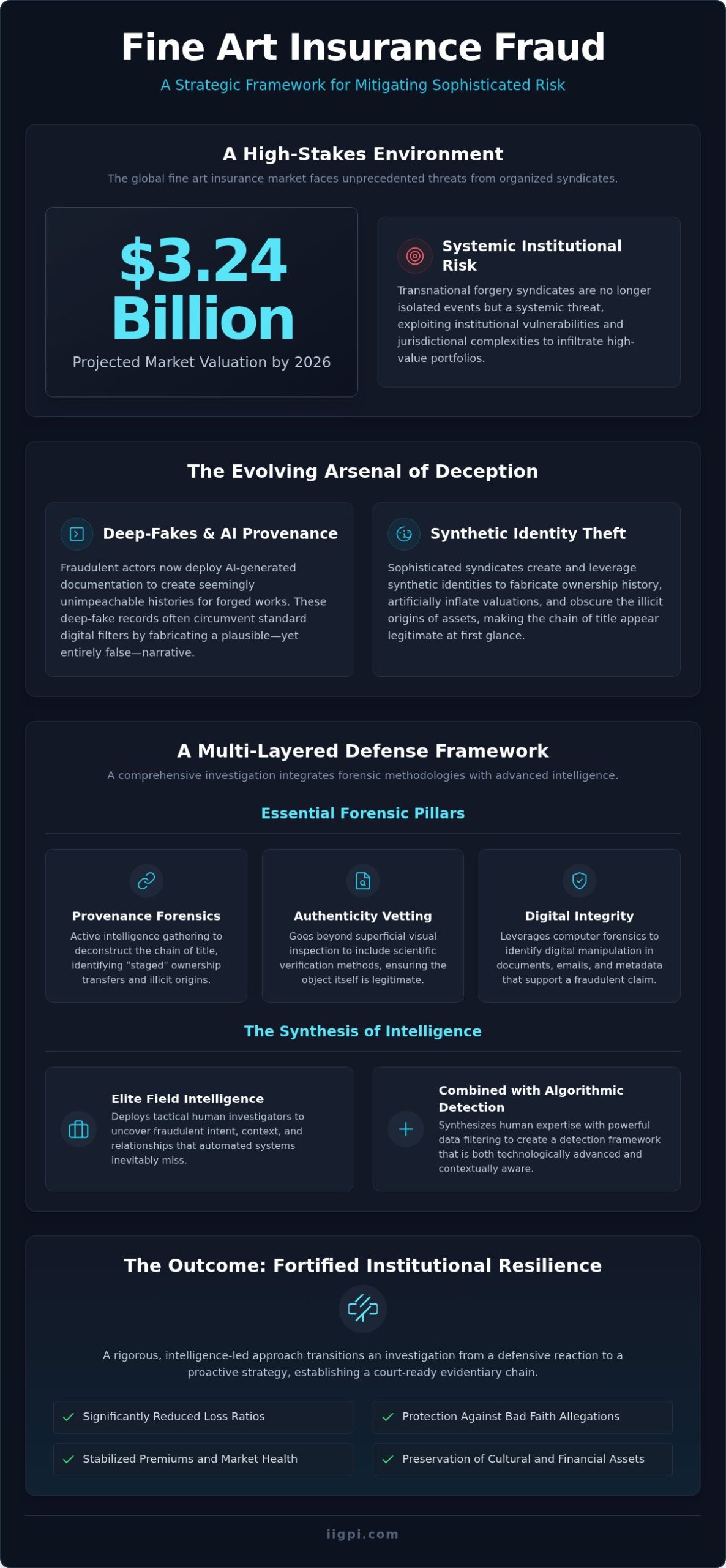
The global fine art insurance market is projected to reach a valuation of $3.24 billion by 2026, a figure that underscores the immense capital at risk within an increasingly opaque global environment. As transnational forgery syndicates deploy more sophisticated methodologies to infiltrate high-value portfolios, the necessity for a specialized fine art insurance fraud investigation becomes a critical component of institutional risk management. Industry leaders understand that generalist adjusters often lack the forensic depth required to navigate the complexities of specie assets, which leaves carriers vulnerable to both financial loss and the legal repercussions of bad faith allegations in contested claims.
This analysis offers an authoritative examination of the advanced methodologies and forensic integrations essential for mitigating sophisticated fraud in the modern era. We provide a strategic framework designed to establish a court-ready evidentiary chain and reduce loss ratios for elite art portfolios. By exploring the critical alignment between forensic science and field intelligence, this discourse prepares decision-makers to counter the systemic challenges of the 2026 art market with intellectual rigor and operational precision.
Key Takeaways
- Analyze the systemic institutional risks posed by transnational forgery syndicates within the projected $3.24 billion global fine art insurance market of 2026.
- Identify the essential forensic pillars, including provenance verification and computer forensics, required to detect sophisticated digital manipulation of art documentation.
- Assess the strategic necessity of synthesizing algorithmic detection with elite field intelligence to decipher fraudulent intent that escapes automated systems.
- Utilize a structured, court-ready framework to conduct a comprehensive fine art insurance fraud investigation, ensuring seamless escalation from red-flag detection to high-level evidentiary assembly.
- Fortify institutional resilience by leveraging the specialized expertise and 30-year legacy of a premier investigative partner operating within the global art market’s epicenter.
The Proliferation of Fine Art Insurance Fraud: A Systemic Institutional Risk
The projected $3.24 billion valuation of the global fine art insurance market in 2026 establishes a high-stakes environment where institutional vulnerabilities are exploited with increasing regularity. Within this framework, Art forgery and fraudulent claims have transitioned from isolated, opportunistic events into sophisticated, transnational operations. A modern fine art insurance fraud investigation must now account for a systemic risk that threatens the fiscal integrity of the world’s most prominent specie portfolios. These syndicates operate across borders, leveraging jurisdictional complexities to obscure the origins of illicit assets. This transition necessitates a shift from basic data filtering to a proactive, intelligence-led approach that scrutinizes the entire lifecycle of an insured asset.
The Macroeconomic Implications for Specie Insurers
The escalation of fraudulent activity exerts significant pressure on the economic equilibrium of the insurance sector. When high-value claims are successfully prosecuted by organized syndicates, the resulting erosion of institutional shareholder value can be profound. In the New York market, this instability manifests as inflationary pressure on premiums, which complicates the risk management strategies of museums and private collectors alike. Analysis reveals that professional investigators serve as a stabilizing force. By implementing rigorous evidentiary protocols, they assist carriers in maintaining sustainable loss ratios and protecting the valuation of cultural assets. This stabilization isn’t merely a matter of claim denial; it’s about maintaining the overall health of the cultural economy.
Emerging Fraud Modalities: Deep-Fakes and Synthetic Provenance
Technological advancements in 2026 have introduced new vectors of deception that challenge traditional underwriting and adjustive processes. Fraudulent actors now utilize AI-generated provenance documentation and synthetic identity theft to create seemingly unimpeachable histories for forged works. These deep-fake records often circumvent standard digital filters that lack the capacity to identify intent-based deception. It’s a reality where a document’s metadata may appear valid while the narrative it supports is entirely fabricated.
Standard software solutions often fail to detect the nuanced anomalies present in sophisticated art loss claims. The necessity for expert intervention is no longer a luxury; it’s a strategic requirement for institutional resilience. Integrating computer forensics with elite field intelligence allows for the identification of digital manipulation before it results in a catastrophic payout. This multi-layered detection framework ensures that only claims with verified physical and historical reality are honored. By doing so, insurers fortify themselves against the sophisticated methodologies of contemporary forgery syndicates that view the art market as a soft target for high-yield financial crime.
Forensic Methodologies in Fine Art Authentication and Provenance Verification
The execution of a rigorous fine art insurance fraud investigation depends upon the synthesis of three primary investigative pillars: provenance forensics, authenticity vetting, and digital integrity. While traditional art history relies heavily on stylistic attribution, a modern institutional framework requires the seamless integration of tactical intelligence and scientific verification. This multi-modal approach is especially critical in specie loss investigations involving high-value galleries, where the financial exposure necessitates an evidentiary standard that transcends superficial visual inspections. It’s not enough to verify the object; the investigator must verify the entire ecosystem surrounding the claim to ensure total fiscal security.
Provenance Forensics and Ownership Integrity
Tracing ownership history through opaque international markets requires a transition from passive historical research to active tactical intelligence gathering. In contested claims, investigators must identify “staged” ownership transfers designed to artificially inflate an asset’s valuation or obscure its illicit origins. This process involves the meticulous deconstruction of the chain of title to ensure that every transaction represents a legitimate exchange of value. The protocols established by the FBI Art Crime Team provide a foundational benchmark for these efforts, emphasizing the necessity of global cooperation in recovering stolen cultural property. By scrutinizing the financial and social networks of previous owners, investigators can expose the fraudulent stratagems employed by sophisticated forgery syndicates. The evidence must be absolute.
Digital Evidence and Metadata Anomalies
The role of digital forensics has become paramount in modern litigation and the subsequent denial of fraudulent fine art claims. Digital integrity analysis allows for the identification of metadata anomalies in photography or documentation provided during the claims process. For example, inconsistencies in GPS coordinates, timestamps, or editing software signatures within image files often expose a coordinated attempt to simulate theft or damage. Adherence to technical evidentiary standards, as outlined in our computer forensics guide, ensures that these findings remain resilient under intense judicial scrutiny. Our firm’s NYC heritage provides a unique advantage in producing credible, court-admissible evidence within the world’s most litigious and complex art market.
The synthesis of these methodologies creates a robust evidentiary chain that protects the carrier’s interests. When digital manipulation is identified early in the investigative cycle, it provides the leverage necessary to resolve disputes before they escalate into costly legal battles. Insurance carriers seeking to fortify their portfolios against these evolving threats can benefit from a formal fine arts loss investigation to ensure total operational security and the preservation of institutional capital.
For carriers whose portfolios extend beyond specie assets into the automotive sector, it is also beneficial to explore Vehicle Claim Appraisal and Evidence Packages to maintain consistent evidentiary standards across all departments.
The Synthesis of Algorithmic Detection and Elite Field Intelligence
The current global fiscal environment necessitates a paradigm shift in how specie insurers approach risk mitigation. The integration of computational power and empirical observation represents the contemporary frontier of a fine art insurance fraud investigation. While sophisticated algorithms possess the capacity to analyze vast datasets for anomalies, they’re fundamentally limited by their inability to verify the underlying physical reality of an asset. Machine learning models excel at identifying historical patterns, yet they often falter when confronted with unique, non-patterned fraudulent behaviors that characterize the elite art market. International Investigative Group addresses this technological gap by synthesizing data-driven leads with rigorous boots-on-the-ground execution. This methodology ensures that human oversight serves as the definitive filter, effectively reducing the frequency of false positives that often plague automated claim management systems.
Bridging the Gap Between Analytics and Admissibility
An AI-generated flag constitutes a preliminary indicator rather than a conclusive basis for legal claim denial. Without physical corroboration and a meticulously documented chain of custody, digital insights lack the evidentiary weight required for judicial proceedings. The application of AI in art authentication highlights the necessity of human expertise to interpret complex results within a broader geopolitical and socioeconomic context. Effective investigations demand advanced tactical observation, a subject detailed extensively in our surveillance services guide. By deploying elite field intelligence, insurers can transform algorithmic suspicion into court-admissible reality. This transition from data to evidence is the only path toward achieving a robust, court-ready chain of custody that withstands the scrutiny of high-stakes litigation.
Behavioral Analysis and Expert Interviewing
The strategic application of forensic psychophysiology remains a cornerstone of resolving multi-million dollar art loss cases where physical evidence may be obscured or deliberately tampered with. Under the leadership of Dan Ribacoff, our firm utilizes expert interviewing and polygraph testing to scrutinize the testimonies of claimants and intermediaries. This behavioral analysis provides a critical layer of situational intelligence that digital fraud detection can’t replicate. It’s through this direct engagement that investigators uncover fraudulent intent, distinguishing between legitimate loss and coordinated deception. By aligning behavioral science with forensic technology, institutional entities can achieve a level of certainty that protects their most valuable portfolios from sophisticated transnational syndicates. This holistic approach ensures that every fine art insurance fraud investigation we conduct is anchored in both scientific rigor and human intuition.
Strategic Protocols for Executing a Fine Art Insurance Fraud Investigation
The institutional response to a suspicious claim must be governed by a structured sequence of protocols that ensure procedural rigor and evidentiary integrity. Effective risk mitigation relies on a disciplined escalation framework where carriers transition from standard administrative processing to a formal fine art insurance fraud investigation. This process begins with an initial assessment phase, where identified anomalies are synthesized into a comprehensive investigative brief. Professional investigators then move into the execution phase, a stage characterized by the seamless coordination of global agents and specialized forensic technicians who examine the physical and digital realities of the loss. The final reporting phase delivers authoritative, court-ready documentation that provides the necessary litigation support to withstand intense judicial scrutiny.
Identifying Red Flags in Gallery and Private Collection Claims
Operating within the prestigious art districts of New York requires strict adherence to the legal frameworks governing private surveillance and forensic data collection. Investigators must navigate complex privacy statutes to ensure that all gathered intelligence remains admissible in a court of law. There’s also an ethical imperative to maintain absolute impartiality throughout the inquiry. This objectivity protects the institutional reputation of the insurance carrier and mitigates the risk of bad faith allegations in contested claims. Adhering to the Insurance Fraud Investigation Services framework ensures that every action taken aligns with the highest compliance standards of 2026. This commitment to ethical rigor reinforces the credibility of the findings and provides a robust defense against legal challenges.
For carriers managing high-value specie portfolios, the transition from suspicion to certainty requires a partner with deep intellectual and operational resources. If your organization is confronted with a complex claim that demands elite forensic scrutiny, you can secure your interests by initiating a professional fine arts loss investigation today. This proactive approach is the most effective method for stabilizing institutional risk profiles and ensuring that only legitimate claims are honored within the volatile global art market.
Fortifying Institutional Resilience through the International Investigative Group Advantage
In a global marketplace where the valuation of fine art insurance is projected to reach $3.24 billion by 2026, the necessity of a premier investigative partner is absolute. A sophisticated fine art insurance fraud investigation requires more than technical proficiency; it demands a deep integration into the cultural and fiscal epicenters of the art world. International Investigative Group (IIG) occupies this space as an elite, research-driven entity, leveraging a 30-year legacy of solving over 10,000 cases globally. By operating from a strategic base in New York City, the firm provides insurers with the intellectual rigor and authoritative results necessary to navigate the complexities of high-value specie portfolios. Our global reach ensures that investigations remain seamless across international borders, effectively countering the strategies of transnational forgery syndicates.
A Legacy of Excellence in High-Value Specie Loss
The firm’s historical performance is exemplified by the resolution of complex, high-stakes disputes, including the successful deconstruction of a $12 million fraudulent burglary claim that threatened the stability of a major carrier’s portfolio. This level of success is rooted in the unique perspective offered by a leadership team founded by former law enforcement professionals. It’s this background that informs our uncompromising evidentiary standards and our ability to operate within the notoriously opaque NYC art market. We invite high-level stakeholders to explore our comprehensive service suite via the International Investigative Group homepage to assess how our methodologies align with their specific risk management objectives.
Strategic Partnership and Institutional Consultation
IIG functions as a sophisticated extension of an insurance carrier’s Special Investigation Unit (SIU), providing specialized expertise that generalist adjusters often lack. Our approach is fundamentally bespoke, recognizing that every high-value art asset presents a unique risk profile requiring a tailored fine art insurance fraud investigation. This institutional consultation bridges the gap between field intelligence and executive decision-making, ensuring that every inquiry results in a robust, court-ready evidentiary chain. Within the 2026 fiscal environment, proactive fraud detection isn’t merely an operational preference. It’s a foundational requirement for institutional resilience and the preservation of global cultural capital. By aligning with a partner committed to intellectual rigor, carriers can effectively mitigate the escalating sophistication of modern art forgery.
Securing the Future of Global Cultural Portfolios
The convergence of advanced forensic provenance verification and digital integrity analysis represents the definitive standard for institutional risk mitigation in the 2026 art market. As transnational forgery syndicates deploy increasingly sophisticated methodologies, it’s clear that reliance on generalist adjusters creates unacceptable vulnerabilities for specie insurers. A specialized fine art insurance fraud investigation provides the intellectual and operational rigor necessary to transform algorithmic suspicion into court-ready evidentiary reality. This multi-layered approach ensures that institutional interests remain protected against the systemic risks of a volatile global landscape.
International Investigative Group, founded by internationally recognized forensic expert Dan Ribacoff, brings over 30 years of specialized experience to high-value loss cases. Our global network of agents operates across major art markets to provide seamless, intelligence-led solutions. By aligning forensic science with tactical field intelligence, we assist carriers in maintaining sustainable loss ratios and protecting shareholder value. Consult with our elite investigative team at International Investigative Group to fortify your institutional resilience. Establishing a proactive defense today ensures the long-term security of your most prestigious cultural assets.
Frequently Asked Questions
How does fine art insurance fraud detection differ from general property fraud analytics?
Fine art detection requires a focus on the intrinsic historical and scientific validity of the asset rather than mere physical possession. While general property analytics prioritize replacement value and actuarial data, a fine art insurance fraud investigation centers on provenance integrity and authenticity vetting. This necessitates specialized knowledge of the global art market’s opaque structures and the forensic deconstruction of ownership chains to identify anomalies that standard property software cannot recognize.
What are the primary indicators of a fraudulent fine art insurance claim in 2026?
Primary indicators include sudden, unsubstantiated escalations in an asset’s insured valuation and the presence of gaps in the documented chain of title. In the 2026 landscape, metadata anomalies in digital photography or documentation often signal staged damage or theft. Additionally, claims involving works with synthetic provenance or those appearing in high-risk jurisdictional markets serve as significant red flags that demand immediate forensic scrutiny to prevent institutional loss.
Is evidence gathered by a private investigator regarding art provenance admissible in New York courts?
Evidence gathered by a licensed private investigator is admissible in New York courts provided it adheres to strict chain of custody and legal collection protocols. Professional investigators serve as expert witnesses who can testify to the authenticity of provenance research and forensic findings. By maintaining a court-ready evidentiary chain, IIG ensures that all intelligence gathered during a fine arts loss investigation remains resilient under the scrutiny of intense judicial review and defense cross-examination.
How can computer forensics identify a fraudulent insurance filing for a “staged” art theft?
Computer forensics identifies fraudulent filings by deconstructing the metadata embedded within digital image files and claim documentation. Investigators scrutinize GPS coordinates, timestamps, and software signatures to detect inconsistencies between the reported event and the digital reality of the file’s creation. For example, an image purportedly taken at a crime scene that contains metadata from a different location or time provides definitive, court-admissible evidence of a staged theft or damage scenario.
What is the role of physical surveillance in contested fine art loss claims?
Physical surveillance serves as a critical tool for verifying the underlying physical reality of a claim and identifying behavioral inconsistencies in the claimant’s narrative. In contested art loss cases, elite surveillance provides real-time intelligence regarding the movement of assets or the involvement of undisclosed intermediaries. This field intelligence complements digital forensics by providing a layer of situational awareness that’s essential for uncovering fraudulent intent and facilitating the successful recovery of high-value specie assets.
How does Dan Ribacoff’s law enforcement background influence IIG’s approach to art fraud?
Dan Ribacoff’s law enforcement background instills a culture of uncompromising evidentiary rigor and structured investigative methodology within the firm. This foundation ensures that every fine art insurance fraud investigation is conducted with the same precision as a criminal inquiry, prioritizing the assembly of court-ready evidence. His expertise in forensic psychophysiology and expert interviewing allows IIG to decipher fraudulent intent through a disciplined approach that bridges the gap between field intelligence and judicial admissibility.
Can fine art fraud detection be fully automated through artificial intelligence?
Artificial intelligence cannot fully automate fraud detection because it lacks the capacity to verify the physical reality of an object or decipher complex human intent. While algorithmic tools excel at identifying patterns within large datasets, they’re fundamentally limited by their inability to conduct physical provenance verification or behavioral analysis. Human oversight remains the definitive filter for reducing false positives and ensuring that every suspicious flag is corroborated by empirical, forensic, and tactical evidence.
What steps should a specie insurer take immediately upon suspecting a fraudulent art claim?
Specie insurers should immediately move to preserve all digital and physical evidence while avoiding any actions that could be construed as bad faith. The next step involves escalating the matter to a specialized investigative partner to develop a formal investigative brief and initiate a forensic audit of the asset’s provenance. Early intervention is paramount for ensuring that the evidentiary chain remains intact and that all tactical options for asset recovery and claim denial are professionally explored.