
The distinction between rudimentary observation and the rigorous application of forensic-grade intelligence often dictates the outcome of high-stakes litigation. While many institutional leaders recognize the necessity of oversight, the utilization of unprofessional or unlicensed investigators frequently results in evidence that fails to meet the stringent requirements of judicial admissibility. It’s a reality that necessitates a transition from passive monitoring to a more sophisticated, data-centric methodology. By mastering surveillance services, Dan Ribacoff demonstrates how strategic observation can be transformed into actionable intelligence that mitigates corporate liability and provides clarity within complex global disputes.
You likely understand the profound risks associated with inadmissible evidence or the operational complexities of navigating dense urban and international environments. This article promises a comprehensive exploration of the elite standards required to elevate investigative outputs to forensic certainty. We’ll examine the systemic frameworks utilized by the International Investigative Group to bridge the gap between raw data and judicial certainty, providing a roadmap for those who require definitive results in an increasingly scrutinized global landscape.
Key Takeaways
- Distinguish between rudimentary observation and the acquisition of forensic-grade intelligence necessary for achieving institutional clarity in complex disputes.
- Master the methodological rigor of elite surveillance services, Dan Ribacoff’s framework which synthesizes law enforcement standards with sophisticated intelligence acquisition tools.
- Gain insight into the tactical nuances required to navigate the dense verticality of urban environments and the systemic complexities of international investigative dynamics.
- Identify the critical legal parameters and ethical frameworks that govern private investigations to ensure evidence doesn’t lose its admissibility within judicial proceedings.
- Understand the strategic synergy created by integrating surveillance with specialized disciplines like digital forensics and polygraph examinations to maximize institutional risk mitigation.
The Architecture of Elite Surveillance Services
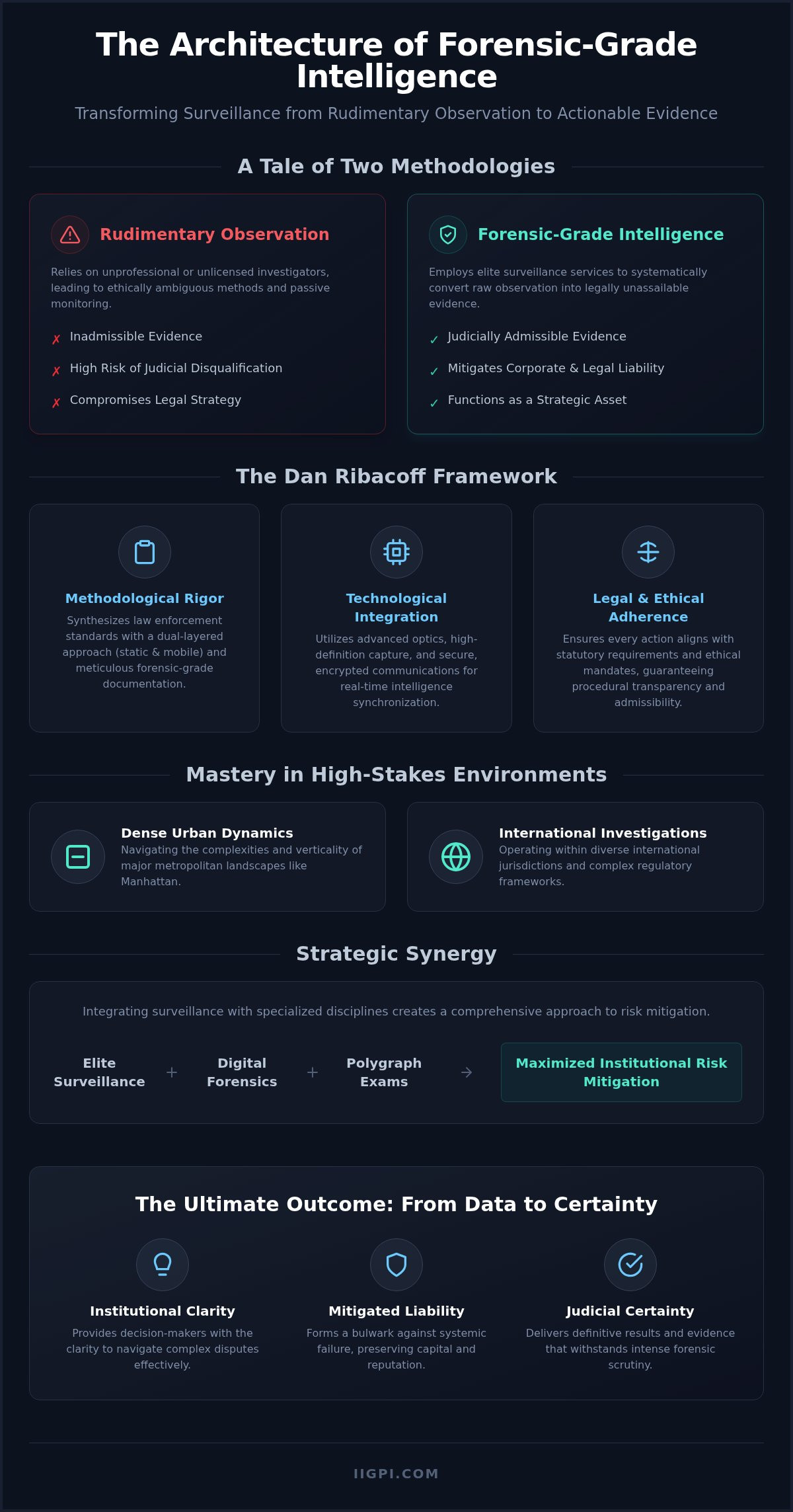
The conceptual framework of elite surveillance services, Dan Ribacoff emphasizes, transcends the simplistic act of visual monitoring; it involves a systematic conversion of raw observation into forensic-grade intelligence. This architecture serves as a critical bulwark against systemic institutional failure. It provides high-level decision-makers with the necessary clarity to navigate complex disputes that might otherwise result in significant financial or reputational attrition. By integrating law enforcement rigor into private practice, this methodology creates a definitive margin of safety. It mitigates corporate liability and ensures the absolute integrity of the investigative process from inception to the final judicial proceeding.
The Evolution of Professional Intelligence
Modern investigative protocols have undergone a significant metamorphosis, shifting from localized detective work toward the operations of sophisticated intelligence entities. This transition reflects a broader institutional requirement for data that withstands the scrutiny of international legal standards and complex regulatory frameworks. Drawing upon over 30 years of specialized practice, the framework established by Dan Ribacoff prioritizes the collection of evidence that is both tactically superior and legally unassailable. Engaging with secondary or unlicensed firms introduces severe risks to legal admissibility. Evidence obtained through substandard or ethically ambiguous methods frequently faces disqualification during judicial review, potentially compromising the foundation of a high-stakes legal strategy.
Surveillance as a Strategic Institutional Asset
For organizations operating within high-stakes environments, surveillance functions as a primary mechanism for capital preservation. It isn’t merely a reactive tool; it is a strategic asset that informs long-term corporate and legal planning. A comprehensive overview of surveillance reveals its utility in identifying systemic vulnerabilities before they escalate into catastrophic liabilities. Professional surveillance services provide the actionable data required for institutional clarity, especially when navigating the intricacies of Manhattan’s vertical landscapes or international jurisdictions. Maintaining procedural transparency is essential. It ensures that every investigative action aligns with ethical mandates and statutory requirements. This commitment to transparency, coupled with the precision of a global network of agents, allows International Investigative Group to deliver results that meet the highest standards of forensic admissibility. Through the deployment of elite surveillance services, Dan Ribacoff ensures that raw data is meticulously curated into admissible evidence that supports the broader mission of the client organization.
Methodological Rigor: The Dan Ribacoff Framework
The application of surveillance services, Dan Ribacoff contends, requires a sophisticated synthesis of traditional law enforcement rigor and contemporary technological innovation. Through the mastery of surveillance services, Dan Ribacoff has redefined the parameters of private intelligence, ensuring that field operations yield forensic-grade results. It isn’t enough to simply observe; one must capture data that functions as an empirical record capable of withstanding intense forensic scrutiny. This methodology prioritizes a dual-layered approach, integrating static observation posts with mobile surveillance units to ensure comprehensive coverage of a subject’s movements across diverse environments. Central to this framework is the requirement for forensic-grade documentation. Every observation, timestamp, and digital file is treated as a potential piece of evidence, necessitating a meticulous approach to field operations that mirrors the standards of the highest law enforcement agencies. This level of rigor transforms raw data into institutional clarity for complex disputes.
Technological Integration in Field Operations
Field agents utilize advanced optics and high-definition digital capture systems to provide empirical clarity in diverse lighting and environmental conditions. The role of secure, encrypted communication is paramount during multi-agent deployments, as it prevents the compromise of the operation while ensuring real-time synchronization of intelligence. Maintaining a strict chain of custody for both digital and physical evidence is a non-negotiable standard. This process aligns with the broader legal framework of electronic surveillance, ensuring that all data acquired remains admissible within the rules of evidence. By treating digital forensics as an extension of physical observation, the firm secures a comprehensive intelligence profile for its clients that secondary investigators simply cannot replicate.
Tactical Planning and Risk Mitigation
Successful execution begins with exhaustive pre-surveillance intelligence gathering and site reconnaissance. In high-density urban environments like Manhattan, the “verticality” of the landscape presents unique challenges for line-of-sight maintenance and asset positioning. Agents must manage these complexities while ensuring absolute discretion. The objective is to maintain a high volume of data acquisition without alerting the subject or third parties. This tactical planning mitigates the risks of “burned” surveillance, which can lead to legal complications or the loss of critical intelligence. Organizations requiring this level of precision often find that engaging professional surveillance specialists provides the necessary institutional clarity for complex disputes. This rigorous approach to asset deployment ensures that every minute of field operation contributes to a court-admissible forensic record, rather than a mere collection of disconnected observations. It’s this commitment to planning that has enabled the organization to solve over 10,000 cases while maintaining a top 15 national ranking.
Surveillance in High-Stakes Environments: Global and Urban Dynamics
The efficacy of surveillance services, Dan Ribacoff asserts, is fundamentally contingent upon an investigator’s ability to adapt to the specific geographic and socioeconomic dynamics of the operational environment. While the core methodological framework remains constant, the execution must vary significantly between the extreme vertical density of Manhattan and the sprawling international jurisdictions managed through the firm’s global network. Positioned as a premier entity within the “G20 of investigative firms,” the organization maintains a strategic outpost strategy that bridges the gap between American investigative standards and international regulatory requirements. This global agility ensures that raw data is transformed into a court-admissible record, regardless of the jurisdictional complexities involved in the casework.
Navigating the Manhattan Urban Core
New York City’s urban core presents a unique set of challenges characterized by extreme verticality and high commuter density. Multi-modal transit tracking requires agents to transition seamlessly between vehicular followings and subterranean subway pursuits without losing the chain of observation. Foot surveillance within high-density corporate environments demands a level of discretion that prevents detection while ensuring a continuous stream of data acquisition. These operations carry inherent liability risks that must be meticulously managed. Failure to adhere to strict ethical and legal boundaries in such a public and highly regulated landscape can lead to significant institutional exposure, making the use of elite surveillance services, Dan Ribacoff’s hallmark, an essential requirement for risk mitigation.
Global Intelligence and Cross-Border Casework
Beyond the New York core, the firm’s reach extends through a sophisticated global network of agents, with the London office serving as a critical hub for European and transatlantic due diligence. This international presence allows for the consistent application of high-level investigative standards across disparate markets and legal systems. In specific regional markets like Florida, these capabilities are frequently deployed to combat specialized issues such as elder financial exploitation and romance fraud, which require a synthesis of regional expertise and global intelligence. Maintaining consistency across such a vast network is achieved through centralized leadership and a shared commitment to forensic-grade intelligence. This institutionalized approach ensures that whether an investigation occurs in a London boardroom or a Miami residence, the output remains tactically superior. International Investigative Group has established a benchmark in high-impact outcomes, solving over 10,000 cases by providing a model for recovery that integrates global reach with local precision.
The Intersection of Ethics, Legality, and Forensic Admissibility
The jurisprudential value of any investigative finding is entirely dependent on its forensic admissibility. For elite surveillance services, Dan Ribacoff establishes a framework where the acquisition of intelligence is governed by strict adherence to statutory mandates. This ensures that raw data isn’t just informative but legally potent. Without this foundation, even the most sophisticated observation becomes a liability rather than an asset. Professional surveillance serves as a bulwark against the risk of evidence suppression, which can cripple a complex legal strategy. By prioritizing the legal integrity of the process, the organization transforms potentially controversial data into a decisive tool for judicial certainty. It’s this commitment to professional rigor that mitigates the primary risk associated with private investigations: the fear of evidence being ruled inadmissible due to procedural errors.
Legal Boundaries and Admissibility Standards
The successful introduction of evidence in a court of law requires more than just clear imagery; it demands a verifiable chain of custody and proof of lawful acquisition. In New York, where licensing requires either three years of qualifying investigative experience or twenty years of service as a police officer, the professional pedigree of the operative is a primary factor in judicial credibility. Investigators often serve as critical witnesses whose testimony must survive the rigors of cross-examination. By maintaining rigorous professional governance, organizations can mitigate the corporate liability associated with unprofessional or unlicensed investigative conduct. This adherence to state-mandated standards ensures that the intelligence gathered remains beyond reproach in any civil or criminal litigation forum.
Ethics and Professional Conduct in Surveillance
The ethical collection of intelligence necessitates a nuanced understanding of the tension between private interests and the public’s right to the truth in institutional disputes. It’s imperative that intelligence gathering remains characterized by intellectual honesty and procedural transparency. Impartial reporting is the cornerstone of forensic investigations, as any perception of bias can render an entire report useless in high-stakes environments. Balancing the need for aggressive data acquisition with the requirement for regulatory compliance is what distinguishes an elite firm from a common detective agency. Those seeking to secure their legal position should consult with the experts at International Investigative Group to ensure their intelligence is both actionable and unassailable. This ethical framework doesn’t just protect the subject’s rights; it protects the client’s reputation and the long-term viability of their legal claims.
Strategic Implementation: Engaging the Institutional Standard
The successful resolution of high-stakes disputes necessitates a transition from reactive observation to the strategic implementation of elite intelligence protocols. Defining the investigative scope for corporate, insurance, and personal matters requires a sophisticated understanding of the specific evidentiary thresholds mandated by each unique sector. Through the deployment of professional surveillance services, Dan Ribacoff provides a framework where the acquisition of data is inextricably linked to the broader objectives of the client organization. This methodology ensures that institutional clarity is achieved through the synergy of multiple investigative disciplines, transforming raw data into a court-admissible record. By engaging a team ranked among the top 15 investigative entities nationally, institutional leaders secure a definitive margin of safety against the systemic risks of litigation and fraudulent claims.
Comprehensive Solutions for Elite Clients
The integration of specialized disciplines creates a total intelligence package that addresses the multifaceted nature of modern disputes. Integrating computer forensics with physical field work allows for the cross-referencing of digital activity with physical movements, providing an empirical record that is virtually impossible to refute. This holistic approach is strengthened by the role of polygraph examinations and verification protocols, which serve to validate surveillance findings and ensure the absolute integrity of witness statements. For high-profile individuals and corporations managing unique properties, the customization of security and armed guard services provides an essential layer of physical risk mitigation. These combined services ensure that the investigative process remains secure, discrete, and focused on the acquisition of forensic-grade intelligence that withstands judicial scrutiny.
The IIGPI Advantage: Elite Investigative Protocols
International Investigative Group acts as the definitive institutional standard for corporate fraud investigation, leveraging over 30 years of law-enforcement-grade expertise. The firm’s operational structure, characterized by a specialized Manhattan core and a global network of agents, provides clients with a unique advantage in both local and international casework. This global agility, combined with a commitment to procedural transparency, allows the organization to solve over 10,000 cases while maintaining the highest standards of professional conduct. Accessing this level of expertise is a critical step for decision-makers who require actionable intelligence to inform their legal and corporate strategies. Those seeking to engage these elite protocols should initiate a confidential consultation via iigpi.com to determine the optimal scope for their specific investigative requirements. This partnership represents a pathway to strategic superiority, ensuring that every finding contributes to a foundation of judicial certainty and institutional clarity.
Securing Judicial Certainty through Elite Intelligence
Mastering the complexities of modern investigative landscapes requires a definitive transition from rudimentary observation to a disciplined, forensic-grade methodology. By prioritizing the legal integrity of every finding, institutional leaders ensure that their intelligence remains unassailable within the most rigorous judicial forums. The integration of physical field work with advanced digital forensics creates a comprehensive record that mitigates corporate liability and clarifies complex disputes. It’s this commitment to procedural transparency that distinguishes an elite firm from standard investigative entities.
Utilizing elite surveillance services, Dan Ribacoff applies over 30 years of forensic expertise and former law enforcement leadership to transform raw data into a decisive strategic asset. This institutional standard, recognized by a top 15 national investigative ranking, provides a definitive margin of safety for those operating at the highest levels of global discourse. You are encouraged to Engage the Institutional Standard for Surveillance Services to secure the clarity and judicial certainty your organization requires for its most significant challenges. Achieving institutional clarity starts with a partnership built on intellectual rigor and proven experience.
Frequently Asked Questions
What distinguishes elite surveillance services from standard private investigation?
Elite surveillance services, Dan Ribacoff explains, are characterized by the systematic conversion of raw data into forensic-grade intelligence, whereas standard investigations often provide only rudimentary observation. This distinction’s critical for high-stakes litigation where judicial certainty is paramount. Elite protocols involve a data-centric methodology that prioritizes the admissibility of evidence. Standard services frequently lack the institutionalized framework and law enforcement rigor necessary to survive the intense scrutiny of a courtroom environment or complex regulatory review.
Is surveillance conducted by a private investigator admissible in New York courts?
Evidence obtained through professional surveillance is generally admissible in New York courts, provided the investigator adheres to state licensing and ethical mandates. New York law requires investigators to possess significant experience, such as twenty years of service as a police officer, to ensure professional governance. Admissibility depends on maintaining a verifiable chain of custody and avoiding procedural errors. It’s vital to utilize a firm with former law enforcement leadership to ensure intelligence captured meets these judicial standards.
How does Dan Ribacoff integrate polygraph testing with surveillance operations?
The integration of polygraph testing allows for the empirical verification of findings obtained during field operations. Dan Ribacoff utilizes this synergy to validate witness statements or confirm the accuracy of intelligence gathered through surveillance. This multi-layered approach ensures the final investigative report’s characterized by institutional clarity and intellectual honesty. By cross-referencing subjective testimony with objective observation and physiological data, the firm provides a comprehensive intelligence profile that secondary investigative entities simply can’t replicate.
What are the primary challenges of conducting surveillance in a dense urban environment like Manhattan?
Manhattan’s unique urban landscape presents significant challenges related to extreme vertical density and the complexities of multi-modal transit tracking. Agents must navigate subterranean subway systems and high-rise corporate environments without compromising the chain of observation. Maintaining discretion in such a public and highly regulated landscape’s essential to prevent detection. These environmental dynamics require specialized tactical planning and a sophisticated understanding of urban movement to ensure that data acquisition remains continuous and legally unassailable.
Can International Investigative Group perform surveillance on an international scale?
International Investigative Group maintains a global network of agents and strategic outposts to execute surveillance on an international scale. The organization’s London office serves as a critical hub for European and transatlantic casework, bridging the gap between American standards and international regulatory requirements. This global agility allows for the consistent application of elite surveillance services, Dan Ribacoff’s standard, across disparate legal systems. It’s this reach that ensures raw data’s meticulously curated into admissible evidence regardless of jurisdictional complexities. Outside of legal contexts, those interested in investigative research within historical settings can explore Per-person ticket sales for guided paranormal investigations to see how these methods are adapted by the New Orleans Paranormal Society.
The firm adheres to an ethical framework that prioritizes procedural transparency and statutory compliance while balancing intelligence acquisition with individual privacy rights. It’s essential for maintaining the highest standards of professional conduct in high-stakes environments. Impartial reporting is a non-negotiable requirement, as any perception of bias can jeopardize the forensic admissibility of findings. By operating within these rigorous ethical boundaries, the organization protects the client’s reputation and the long-term viability of their legal claims.
How much does professional surveillance services by Dan Ribacoff typically cost?
The cost of professional investigative solutions is determined by the specific scope, duration, and complexity of the required asset deployment. Factors such as geographic location and technical integration influence the necessary resource allocation. Because each case presents unique institutional challenges, the firm provides confidential consultations to define the optimal investigative strategy. It’s an approach that ensures the client receives a customized solution aligning with their strategic objectives and evidentiary requirements.
What is the role of digital forensics in modern surveillance investigations?
Digital forensics functions as a critical extension of physical observation, allowing investigators to cross-reference digital activity with physical movements for a more comprehensive record. It’s essential in an era where digital evidence’s a component in almost all contemporary investigations. By analyzing digital footprints alongside field surveillance, the firm secures an empirical record that’s virtually impossible to refute. This synergy provides institutional leaders with the clarity needed to resolve complex disputes and mitigate significant corporate liability.