
In the hyper-competitive corridors of Manhattan, the departure of a high-level executive often signals a silent, systemic hemorrhage of proprietary intelligence that can destabilize an organization’s market position overnight. You likely recognize that merely suspecting a breach of restrictive covenants is insufficient; without empirical, court-admissible evidence, your strategic advantages remain vulnerable to exploitation by rival entities. It’s critical to move beyond suspicion toward a methodology rooted in forensic rigor and objective documentation.
This analysis provides a rigorous examination of the protocols established by Dan Ribacoff, investigating non-compete agreement violations nyc with the precision required to withstand judicial scrutiny and secure institutional integrity. We’ll explore the integration of forensic digital analysis and sophisticated surveillance techniques necessary to document violations within the context of New York’s evolving legislative frameworks, such as the proposed $500,000 salary threshold for enforceability. By synthesizing thirty years of investigative experience with modern forensic methodologies, this guide delineates the pathway toward successful litigation and the definitive protection of your organization’s strategic advantages.
Key Takeaways
- Understand the systemic economic impact of executive departures on the New York City corporate sector and how restrictive covenants function to maintain market equilibrium.
- Master the multidisciplinary framework pioneered by Dan Ribacoff, investigating non-compete agreement violations nyc by integrating traditional law enforcement principles with advanced corporate intelligence strategies.
- Discern the specific evidentiary requirements necessary for New York litigation, focusing on the documentation of prohibited activities and the forensic recovery of intellectual property.
- Gain insight into the shifting regulatory landscape of the New York corporate sector, including the implications of the “reasonableness” test applied by the judiciary to restrictive covenants.
- Identify the procedural requirements for initiating a comprehensive investigation that utilizes over thirty years of expertise to secure your firm’s competitive positioning.
The Strategic Implications of Non-Compete Violations in the NYC Market
The departure of key personnel in the New York City corporate environment represents more than a mere shift in human capital; it constitutes a potential disruption of institutional stability and market equilibrium. When a high-level executive exits, they carry with them years of proprietary knowledge, strategic relationships, and internal operational data. The Non-compete clause serves as a critical mechanism designed to mitigate these risks by preventing the immediate transfer of such intellectual assets to direct competitors. Without these protections, the erosion of market share becomes a tangible threat to the organization’s long-term viability.
The Vulnerability of Proprietary Information
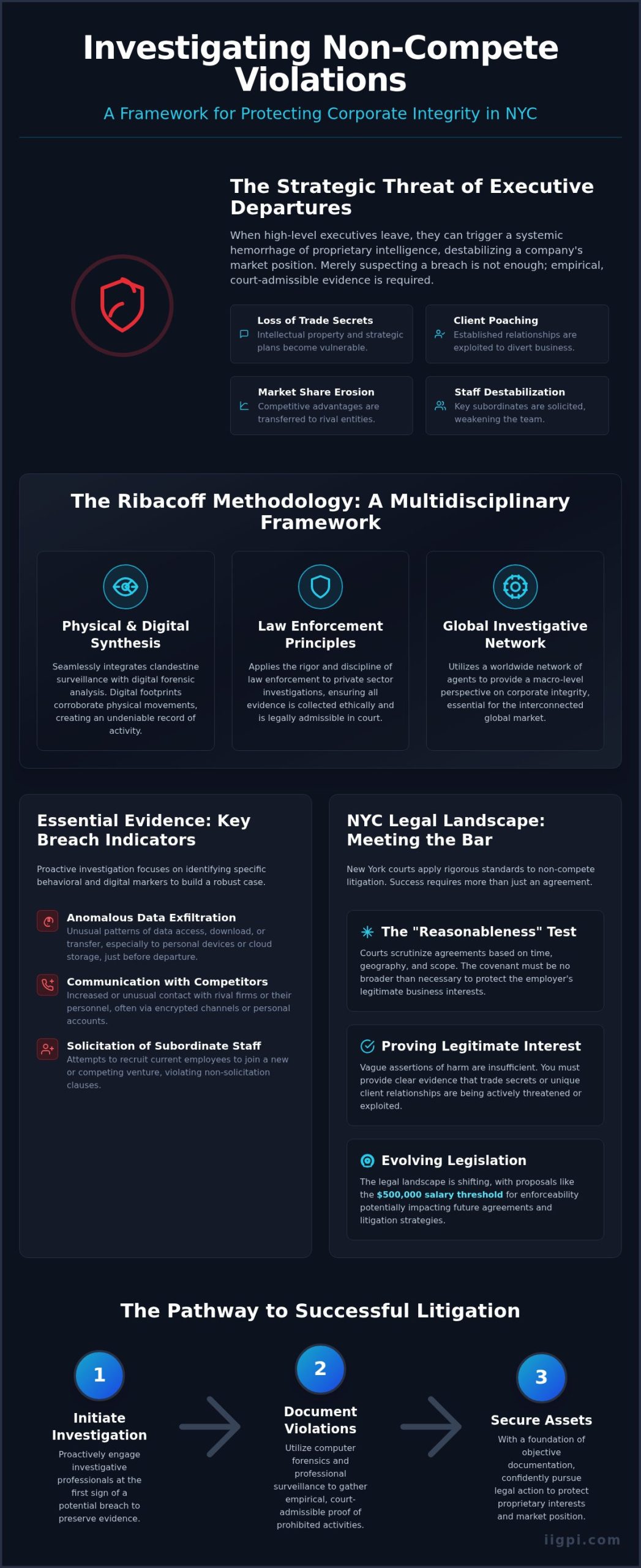
Intellectual property remains exceptionally fragile within modern digital infrastructures. Departing employees frequently leverage established client relationships to facilitate their transition. They often underestimate the forensic visibility of their actions, assuming that personal devices or encrypted channels offer total anonymity. Key indicators of an impending breach include anomalous data exfiltration patterns, increased communication with external competitors, or the sudden solicitation of subordinate staff. Dan Ribacoff, investigating non-compete agreement violations nyc, emphasizes that identifying these behavioral and digital markers early is essential for preserving a firm’s strategic advantages. It’s not just about the loss of data; it’s about the loss of the competitive edge that data provides.
New York City’s Competitive Landscape
Manhattan serves as a global epicenter for finance, technology, and legal services, industries defined by aggressive talent acquisition strategies. The density of high-stakes firms creates an environment where the temptation to bypass restrictive covenants is amplified by the potential for significant short-term gains. New York courts maintain a rigorous precedent for non-compete litigation, applying a “reasonableness” test that demands clear evidence of a legitimate business interest being protected. This legal standard means that vague assertions of harm won’t suffice in a courtroom setting. Stakeholders must recognize that the mere existence of an agreement is rarely sufficient without a proactive investigative posture.
Reactive responses to suspected breaches often result in irreparable loss of market share or the compromise of trade secrets. Proactive investigative measures, including computer forensics and professional surveillance, provide the empirical basis required for successful legal intervention. Ensuring corporate integrity in this volatile market necessitates a commitment to documenting violations with a level of precision that meets the highest standards of evidence. Organizations that fail to monitor these transitions effectively don’t just lose talent; they lose their intellectual foundation.
The Ribacoff Methodology: A Framework for Corporate Integrity
The Ribacoff Methodology represents a multidisciplinary architecture designed to address the systemic vulnerabilities inherent in high-level corporate transitions. This holistic approach transcends traditional inquiry by synthesizing diverse intelligence streams into a singular, cohesive narrative of breach. Under the direction of Dan Ribacoff, investigating non-compete agreement violations nyc involves the application of former law enforcement principles to private sector challenges, ensuring that every action adheres to the highest standards of professional conduct and legal admissibility. By employing a global network of agents, the International Investigative Group facilitates a macro-level perspective on corporate integrity that is essential in the interconnected and aggressive New York market.
Synthesis of Physical and Digital Intelligence
Effective investigation requires the seamless coordination between clandestine surveillance teams and forensic analysts. Digital footprints often provide the primary corroboration for physical movements, creating an undeniable record of a subject’s activities that traditional methods alone might fail to capture. For instance, the recovery of deleted communications or the identification of unauthorized cloud access points can substatiate observations made during field surveillance. This integration is central to the Computer Forensics pillar, which serves as the technical foundation for documenting modern non-compete breaches. It’s this synthesis that allows for the construction of a comprehensive evidentiary profile that withstands the intense scrutiny of opposing counsel during litigation.
Dan Ribacoff’s Investigative Philosophy
The philosophy articulated by Dan Ribacoff focuses on the acquisition of objective, verifiable evidence that removes ambiguity from the adjudicative process. Within the complex legal framework of non-compete agreements, the burden of proof rests heavily on the employer to demonstrate specific harm and legitimate business interests. Ribacoff’s approach prioritizes academic rigor and intellectual depth, ensuring that investigative reports are not merely descriptive but analytical in nature. Ethical boundaries are maintained through a strict adherence to jurisdictional regulations, which is paramount when Dan Ribacoff, investigating non-compete agreement violations nyc, assesses the conduct of departing executives in the dense corporate landscape of Manhattan.
This commitment to excellence ensures that stakeholders receive reports characterized by gravitas and technical precision, suitable for the highest levels of corporate decision-making. Organizations seeking to fortify their strategic defenses often find that a comprehensive corporate investigation is the most effective deterrent against future misconduct. By prioritizing empirical verification over speculative inquiry, the methodology provides a definitive solution for leaders who demand intellectual rigor in their risk management protocols.
Essential Evidence: Proving Breaches of Restrictive Covenants
Proving a breach within the rigorous New York City judicial system requires more than circumstantial suspicion; it demands a robust assembly of empirical evidence that directly correlates to the restrictive language of the employment contract. The primary categories of evidence essential for NY litigation include documented physical presence at a competitor’s facility, forensic logs of data exfiltration, and verified communications with restricted clientele. Dan Ribacoff, investigating non-compete agreement violations nyc, focuses on the acquisition of data that bridges the gap between digital activity and physical conduct. The burden of proof rests on the plaintiff to demonstrate that the former employee’s actions have caused specific, quantifiable harm to the organization’s legitimate business interests.
Surveillance as a Definitive Proof
Clandestine observation remains the most effective method for documenting prohibited employment and unauthorized client solicitation in real-time. Protocols for documenting contact with restricted clients involve the meticulous logging of meetings, including the precise time, location, and the identity of the parties involved. High-definition video and photographic logs serve as the cornerstone of this process, providing a visual record that’s difficult to dispute during cross-examination. For a deeper understanding of these operational standards, stakeholders should consult the Professional Surveillance Services guide, which outlines the technical requirements for court-admissible visual evidence. These records ensure that the subject’s physical movements are documented with the gravitas required for high-stakes corporate litigation.
Forensic Digital Analysis
Digital forensics provides the technical infrastructure necessary to uncover the silent breach of restrictive covenants that often occurs months before a resignation. Analysts employ specialized techniques for recovering deleted communications, identifying anomalous file transfers, and detecting unauthorized access to proprietary databases. This process involves the reconstruction of a subject’s digital activities to identify patterns of data exfiltration that typical internal monitoring systems might miss. By mapping digital footprints against physical surveillance data, investigators can establish a comprehensive timeline of the violation. It’s this level of detail that allows for the identification of specific trade secrets that have been compromised during the transition.
While digital and physical evidence form the basis of external litigation, internal investigations often benefit from the application of polygraph testing to screen for internal collusion or to confirm the extent of trade secret misappropriation. Within the NYC corporate landscape, the integration of these diverse evidentiary streams ensures that the investigative report serves as a definitive instrument for securing a favorable settlement. The objective isn’t merely to identify the breach but to provide the technical detail required to protect the organization’s intellectual foundation and market position. High-level decision-makers rely on this intellectual rigor to maintain the strategic equilibrium of their firms.
Navigating the Legal Landscape of NYC Non-Compete Investigations
The legal environment governing restrictive covenants in New York is currently experiencing a period of significant transformation that demands a sophisticated investigative response. In June 2026, the New York State Senate passed bill S9759, which seeks to prohibit non-compete agreements for employees earning less than $500,000 annually, with this threshold indexed to the Consumer Price Index starting in 2027. Simultaneously, the New York City Council is considering Int 0115-2026, a bill that would impose a $500 civil penalty for each violation of its proposed ban. Dan Ribacoff, investigating non-compete agreement violations nyc, operates within this fluid regulatory framework, ensuring that all evidence gathered remains relevant and actionable despite these legislative shifts. Leaders must recognize that the validity of their restrictive covenants depends on a precise alignment with these emerging standards.
Until such legislation is fully codified, the enforceability of these agreements continues to rely on the common law “reasonableness” test applied by the judiciary. New York judges require that a covenant be no broader than necessary to protect a legitimate business interest, such as trade secrets, confidential customer lists, or unique services. Proving this requires empirical data that demonstrates a specific, quantifiable threat to the firm’s intellectual foundation. Without such proof, the courts are increasingly likely to strike down agreements they perceive as overly restrictive or punitive toward the worker.
Admissibility in New York Courts
The presentation of surveillance data in legal proceedings demands a rigorous adherence to established evidentiary standards. Detailed, unbiased reporting is paramount; a report that appears partisan or speculative will likely be dismissed by the court. By following Corporate Fraud Investigation protocols, investigators ensure that the chain of custody for digital and physical evidence is never compromised. A private investigator’s role often extends to serving as an expert witness, where they must articulate the methodology used to document the breach with intellectual depth and clarity. This testimony bridges the gap between raw data and the legal requirements of the case.
Privacy and Compliance Standards
All investigative actions must withstand intense legal scrutiny regarding privacy rights and statutory compliance. This involves strict adherence to the Fair Credit Reporting Act (FCRA) and specific New York City ordinances that govern surveillance and data collection. Dan Ribacoff, investigating non-compete agreement violations nyc, prioritizes these compliance standards to prevent the exclusion of critical evidence during trial. Organizations that neglect these legal boundaries risk not only the loss of their case but also potential counter-litigation for privacy violations. To ensure your firm’s investigative protocols meet these rigorous standards, it’s advisable to initiate a formal corporate consultation to review your current evidentiary strategies.
Securing Proprietary Interests with International Investigative Group
The International Investigative Group stands as a premier institution within the sector of corporate risk management, offering a sophisticated architecture for the protection of institutional intelligence. Led by Dan Ribacoff, the firm leverages more than thirty years of specialized experience to address the systemic complexities associated with restrictive covenant breaches. With a global network of agents and a record of over 10,000 cases solved, the organization provides the intellectual depth required to navigate the high-stakes corporate environment of Manhattan while maintaining the capacity for international operations. This synthesis of local expertise and global reach ensures that firms can monitor transitions with a level of precision that smaller, less experienced entities cannot replicate.
When Dan Ribacoff, investigating non-compete agreement violations nyc, applies his methodology, the focus remains on the acquisition of empirical evidence that meets the most rigorous judicial standards. The advantage of engaging this firm lies in the seamless integration of computer forensics with traditional surveillance, creating a multifaceted evidentiary record that is both comprehensive and definitive. This approach ensures that proprietary interests are not only identified but secured through an investigative framework that anticipates the defensive maneuvers of departing executives. By prioritizing objective verification over speculative inquiry, the firm provides a reliable solution for leaders who demand technical precision in their integrity protocols.
The Investigative Onboarding Process
The initiation of a non-compete investigation begins with a comprehensive strategy development phase, during which the specific parameters of the suspected breach are analyzed against the existing contractual framework. This initial phase involves the customization of investigative plans to address the unique operational nuances of the client’s industry, whether in finance, technology, or specialized services. High-level decision-makers who recognize the immediate threat of intellectual property loss or the erosion of market share are encouraged to contact IIG directly to facilitate a formal assessment of their institutional vulnerabilities. This structured onboarding ensures that every investigative resource is deployed with maximum efficiency and tactical relevance.
Conclusion: Protecting the Future of Your Firm
Professional intervention constitutes the only viable pathway for organizations seeking to mitigate the systemic risks associated with non-compete violations in the New York market. As the legal landscape continues to evolve toward higher thresholds for enforceability, the necessity for empirical, court-admissible evidence becomes paramount for any firm wishing to maintain its competitive equilibrium. The International Investigative Group serves as the premier partner for corporate risk mitigation, providing the serious and sober analysis required to secure an organization’s strategic advantages. By prioritizing intellectual rigor and elite service, the firm ensures that your organization’s future remains founded on the integrity of its proprietary intelligence and the long-term stability of its market position.
Advancing Institutional Resilience through Strategic Investigative Protocols
The preservation of institutional stability within the New York City corporate landscape necessitates a multidisciplinary approach to risk mitigation that transcends mere suspicion. By synthesizing traditional surveillance with advanced computer forensics, organizations can establish a definitive record of breach that aligns with the rigorous “reasonableness” test applied by the state judiciary. Dan Ribacoff, investigating non-compete agreement violations nyc, provides the intellectual depth and technical precision required to navigate these complex legal and operational challenges effectively. Securing your firm’s strategic advantages remains a continuous process of empirical verification and proactive documentation. Organizations that prioritize these rigorous investigative standards are better positioned to withstand the systemic disruptions caused by high-level executive transitions. To fortify your organization’s intellectual foundation, you should Consult with Dan Ribacoff and the International Investigative Group for Elite Corporate Solutions. With over 30 years of specialized experience in New York City and globally recognized leadership in forensic investigations, the firm offers the authoritative analysis necessary to protect your proprietary interests. Ensuring the integrity of your corporate assets today provides the essential framework for your organization’s future growth and sustained market dominance.
Frequently Asked Questions
How does Dan Ribacoff document a non-compete violation?
Dan Ribacoff utilizes a synthesis of clandestine surveillance and forensic digital analysis to provide empirical documentation of restrictive covenant breaches. This involves the meticulous logging of a subject’s physical presence at a competitor’s facility and the recovery of digital footprints, such as unauthorized file transfers or communications with restricted clients. By integrating these diverse intelligence streams, the investigative reports offer a definitive record that meets the highest standards of evidentiary rigor required for Manhattan corporate litigation.
Is investigative evidence admissible in New York non-compete litigation?
Investigative evidence is admissible in New York courts provided it adheres to strict standards regarding the chain of custody and statutory privacy regulations. Detailed reports featuring high-definition visual documentation and forensic digital logs are frequently utilized to satisfy the “reasonableness” test applied by the judiciary. When Dan Ribacoff, investigating non-compete agreement violations nyc, presents such findings, the focus remains on delivering objective data that withstands cross-examination and supports the firm’s legitimate business interests.
What is the cost associated with a corporate non-compete investigation?
The financial investment required for a corporate investigation depends entirely on the complexity of the case, the duration of the surveillance required, and the depth of the forensic digital analysis involved. Factors such as the executive’s seniority and the volume of proprietary data at risk influence the scope of the engagement. Stakeholders should view these costs within the context of risk mitigation, as professional documentation often facilitates successful litigation or favorable out-of-court settlements.
Can computer forensics uncover evidence of trade secret theft?
Computer forensics is a primary instrument for identifying the unauthorized exfiltration of trade secrets and proprietary operational intelligence. Specialists employ advanced techniques to recover deleted files, identify anomalous data transfers to external storage, and detect unauthorized cloud access occurring during transition periods. These technical findings provide the empirical foundation necessary to prove that a departing employee has compromised the organization’s intellectual foundation, which is a critical component in enforcing restrictive covenants.
How long does a typical non-compete investigation in NYC take?
The duration of a non-compete investigation is contingent upon the specific behavioral patterns of the subject and the complexity of the digital environment. While some cases yield definitive evidence within a few weeks of active surveillance, others require a longitudinal approach to document sustained contact with restricted clientele or the gradual exfiltration of data. A structured investigative timeline ensures that all evidence is captured with the technical precision required to support long-term strategic and legal objectives.
Why should a firm choose Dan Ribacoff over a general detective agency?
Selecting Dan Ribacoff ensures that the investigation is conducted with the intellectual rigor and technical expertise required for high-stakes corporate environments. Unlike general detective agencies, International Investigative Group integrates former law enforcement leadership with specialized computer forensics to address complex systemic breaches. This authoritative approach provides a level of analytical depth and professional credibility that is essential when engaging with global leaders and the sophisticated legal frameworks of the New York City region.
What are the legal risks of conducting an internal investigation without professional help?
Conducting an internal investigation without professional oversight introduces significant risks, including the compromise of evidentiary integrity and the potential violation of statutory privacy rights. Unskilled attempts to access digital devices often result in the permanent loss of forensic data or the inadmissibility of evidence in court. Internal efforts may lack the objective impartiality required to withstand judicial scrutiny, potentially exposing the organization to counter-litigation or the dismissal of their non-compete claims.
Does IIG provide services for both domestic and international non-compete breaches?
International Investigative Group maintains a global network of agents capable of addressing restrictive covenant breaches across domestic and international jurisdictions. This macro-level perspective is essential for modern organizations that operate within interconnected global markets where executive transitions often cross geographic boundaries. Whether the violation occurs within the Manhattan corporate landscape or involves an international competitor, the firm provides a cohesive investigative architecture to secure proprietary interests and maintain institutional integrity.