
If high-risk blockchain addresses intercepted over $502 billion in illicit funds throughout 2025, the traditional assumption that digital ledger transparency acts as an absolute deterrent to crypto fraud has been decisively dismantled. You likely recognize that the perceived irreversibility of distributed ledger transactions, coupled with a persistent lack of international jurisdictional clarity, creates a sanctuary for sophisticated cybercriminals who exploit these systemic vulnerabilities. This investigation provides an authoritative analysis of the modern digital threat landscape and the specialized forensic methodologies required to penetrate layers of obfuscation for the successful recovery of misappropriated assets.
Much like the complex geopolitical maneuvers observed in exclusive international forums, the pursuit of stolen digital capital demands a synthesis of elite computer forensics and global intelligence rigor. We’ll examine the critical transition from high-level regulatory frameworks, such as the EU’s Markets in Crypto-Assets (MiCA) standards, to the operational enforcement protocols necessary for identifying perpetrators. This framework serves as a definitive guide for securing the forensic proof required for formal legal proceedings and achieving the restoration of institutional or private holdings. It’s an essential roadmap for those navigating the intersection of decentralized finance and international law.
Key Takeaways
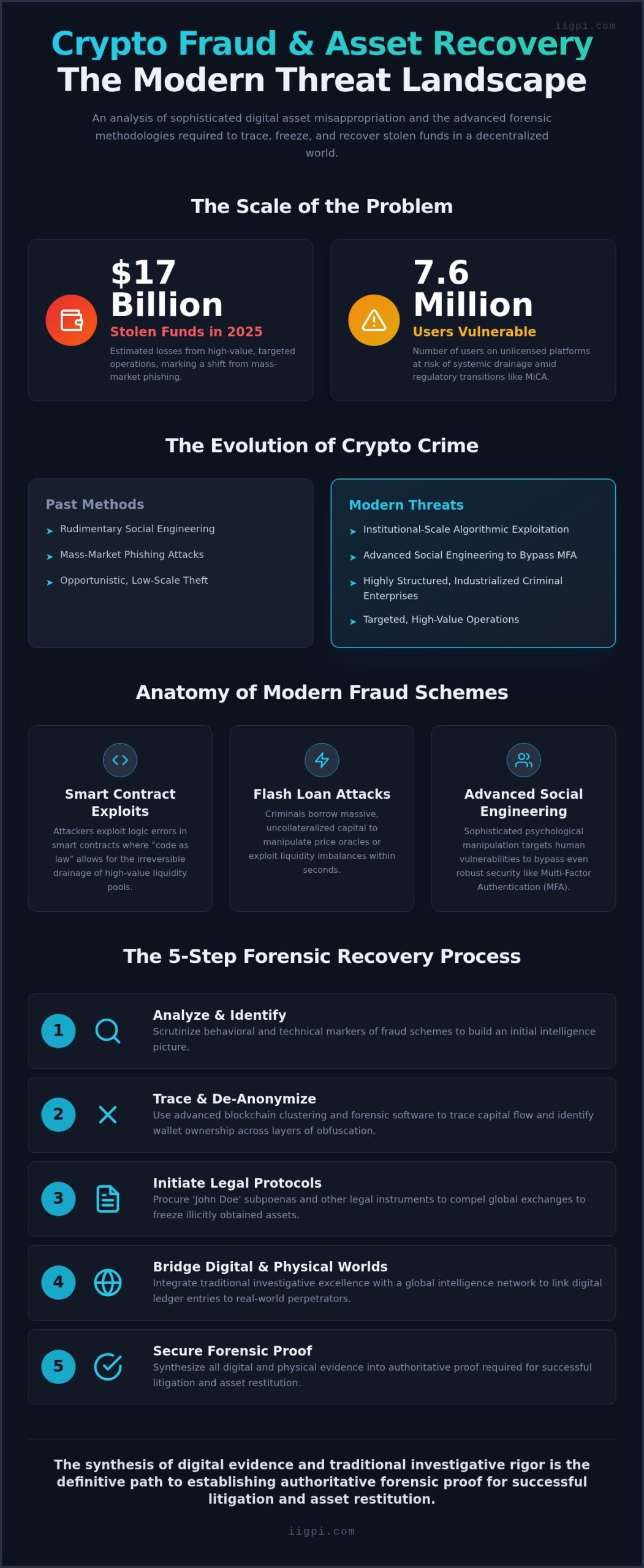
- Analyze the systemic evolution of digital asset misappropriation to identify the behavioral and technical markers characteristic of sophisticated social engineering schemes.
- Implement advanced blockchain clustering methodologies and specialized forensic software to trace the flow of capital and identify wallet ownership after an instance of crypto fraud.
- Utilize strategic legal protocols, including the procurement of ‘John Doe’ subpoenas, to facilitate the freezing of illicitly obtained assets within global exchange ecosystems.
- Integrate decades of traditional investigative excellence with a global intelligence network to effectively bridge the gap between digital ledger entries and physical-world perpetrators.
- It’s through the synthesis of digital evidence and traditional investigative rigor that one can establish the authoritative forensic proof required for successful litigation and asset restitution.
The Proliferation of Cryptocurrency Fraud in the Global Financial Ecosystem
The rapid integration of digital assets into the global financial architecture has precipitated a parallel evolution in criminal methodology. While early iterations of illicit activity were characterized by rudimentary social engineering, the current era is defined by institutional-scale algorithmic exploitation. The Proliferation of Cryptocurrency Fraud reflects a transition from opportunistic theft to a sophisticated, industrialized sector of global shadow finance. Decentralized ledger technology, while offering unprecedented transparency, presents unique challenges for traditional fraud detection because of the inherent tension between pseudonymous address structures and the finality of transaction execution. This shift necessitates a move beyond passive awareness toward an investigative imperative that prioritizes forensic intervention over simple risk mitigation.
Defining the Scope of Digital Asset Misappropriation
Distinguishing between legitimate market volatility and actionable criminal fraud requires a meticulous examination of intent and technical manipulation. Victims often face a significant hurdle in the form of cross-border jurisdictional voids, as the decentralized nature of the assets permits perpetrators to operate from regions with limited regulatory oversight. Within the context of forensic financial investigation, crypto fraud denotes the illicit acquisition of digital assets through deceptive technical or social engineering mechanisms that circumvent the cryptographic integrity of blockchain protocols. This lack of centralized recourse means that traditional law enforcement is often overstretched, leaving a vacuum that only elite private investigative intelligence can fill effectively.
The Systemic Vulnerabilities of Decentralized Finance (DeFi)
The 2026 DeFi landscape is increasingly defined by the exploitation of smart contract vulnerabilities, where the “code as law” philosophy allows attackers to drain high-value pools through logic errors. Flash Loan attacks have emerged as a primary tool for modern corporate fraud, enabling criminals to borrow massive capital without collateral to manipulate price oracles or exploit liquidity imbalances within seconds. As of mid-2026, the transition toward the EU’s MiCA standards has highlighted the risks associated with unlicensed platforms, where an estimated 7.6 million users remain vulnerable to systemic drainage. These vulnerabilities aren’t merely technical glitches; they represent structural weaknesses that require a synthesis of computer forensics and traditional investigative intelligence to address. Identifying the perpetrator in these scenarios requires tracing the flow of assets through multiple layers of obfuscation before they’re converted into fiat currency or laundered through non-compliant exchanges.
Deconstructing the Anatomy of Modern Crypto Fraud Schemes
The industrialization of crypto fraud has transformed digital asset misappropriation into a highly structured criminal enterprise that challenges the foundational security of global financial systems. According to an FTC report on crypto scam trends, the methodologies utilized by threat actors have transitioned from mass-market phishing to targeted, high-value operations that yielded an estimated $17 billion in stolen funds during 2025. This evolution is characterized by the strategic integration of behavioral psychology with technical exploits. Criminals no longer rely solely on technical brute force; they utilize sophisticated social engineering to circumvent even robust multi-factor authentication (MFA) protocols by manipulating the human elements of the security chain.
Advanced Persistent Threats (APTs) and Social Engineering
Elite threat actors now employ complex psychological frameworks designed to establish deep-seated trust over extended periods, a tactic most evident in the professionalization of “Pig Butchering” schemes. These operations are often orchestrated by transnational criminal networks utilizing specialized infrastructure and money laundering mule networks. The emergence of AI-driven deepfakes has further complicated this landscape by enabling highly convincing fraudulent investment solicitations that mimic trusted advisors or corporate leaders. These tools allow for near-perfect executive impersonations, contributing to a staggering 1400% year-over-year increase in impersonation tactics during 2025. AI-enabled scams were found to be 4.5 times more profitable than traditional methods in the same period, necessitating a synthesis of digital forensics and behavioral profiling to dismantle the deceptive architecture used to manipulate high-level decision-makers.
Institutional-Scale Scams: From Ponzi Schemes to Rug Pulls
The Application of Digital Forensics in Tracing Illicit Blockchain Transactions
The forensic investigation of crypto fraud relies upon the immutable transparency of public ledgers, which provide a granular and chronological record of every value transfer within the digital ecosystem. Expert technicians utilize sophisticated blockchain ‘clustering’ algorithms to identify patterns of wallet ownership, effectively aggregating disparate addresses into identifiable entities based on common spending behaviors and co-input heuristics. This process is augmented by proprietary forensic software that maps the complex flow of misappropriated funds across multiple protocols, revealing the structural pathways and exit points used by cybercriminals. The initial 48-hour window following a security breach is of paramount importance; it represents the critical period before assets are typically disseminated through high-velocity obfuscation layers or off-ramped into non-compliant fiat gateways.
Methodologies for On-Chain Data Analysis
Digital investigators treat public ledgers as an unerring historical archive, utilizing them to trace funds through successive ‘hops’ between intermediary wallets that are often used to dilute the visibility of the primary theft. This multi-layered tracing methodology ensures that every movement is documented with cryptographic certainty, providing the evidentiary weight necessary for subsequent legal proceedings and asset recovery efforts. For those seeking a deeper understanding of these technical requirements, an authoritative Computer Forensics Guide offers comprehensive insights into the rigorous standards required for corporate and legal investigations. By analyzing transaction metadata, including time-stamps, IP-linked signatures, and gas fee patterns, forensic specialists can often pierce the perceived veil of anonymity to establish a direct link between the crime and the perpetrator’s broader digital footprint.
Overcoming Obfuscation: Mixers, Tumblers, and Privacy Coins
Technical countermeasures such as mixers, tumblers, and anonymity-enhanced cryptocurrencies like Monero present significant challenges by attempting to sever the link between sender and recipient through cryptographic shielding. Professional investigators employ advanced heuristic analysis to ‘de-mix’ these transactions, identifying subtle behavioral anomalies and timing correlations that betray the underlying flow of capital despite these technical attempts at concealment. The limitations of digital-only tracing become apparent when confronting sophisticated state-sponsored actors or transnational syndicates who utilize offline settlement mechanisms. It’s at this junction that the synergy between digital forensics and human intelligence becomes indispensable, leveraging global networks to locate the physical infrastructure and real-world identities supporting these ostensibly virtual crimes. This synthesis of technical data and traditional investigative rigor is what allows for the identification of perpetrators who believe they’re operating beyond the reach of conventional law.
Strategic Protocols for Mitigating Losses and Initiating Asset Recovery
The transition from digital tracing to tangible asset recovery requires a sophisticated legal maneuver known as the ‘John Doe’ subpoena. This mechanism allows investigators to compel centralized exchanges to disclose account holder information associated with specific wallet addresses identified during the crypto fraud investigation. By collaborating with global exchanges, professional investigators can initiate the freezing of illicitly obtained assets before they are off-ramped into the traditional banking system. This coordination is essential for navigating the complexities of international mutual legal assistance treaties (MLATs), which often prove too slow for the high-velocity nature of digital capital movement. Expert intervention ensures that the evidentiary trail remains unbroken, providing a foundation for the eventual restoration of misappropriated holdings in cases of complex crypto fraud.
The Legal Landscape of Crypto Asset Seizure
NYC courts have increasingly recognized the admissibility of digital forensic evidence, provided it meets rigorous chain-of-custody standards. Private investigation firms act as a critical conduit between the technical realities of the blockchain and the requirements of legal counsel. They facilitate the procurement of Mareva injunctions, which serve as global freezing orders to prevent the dissipation of assets across multiple jurisdictions. This legal rigor ensures that the forensic dossier is court-ready, translating abstract on-chain data into actionable legal testimony that can withstand the scrutiny of high-level judicial review. The objective is to present a narrative that clearly identifies the nexus between the perpetrator’s digital actions and the resulting financial loss.
Private Investigation vs. Law Enforcement: A Strategic Comparison
While public law enforcement agencies are often constrained by limited resources and bureaucratic delays, private firms provide dedicated assets and superior operational speed. The efficacy of these investigations is significantly enhanced when conducted by professionals with a former law enforcement perspective, as they possess an intimate understanding of both criminal tradecraft and the evidentiary standards required for prosecution. For a comprehensive understanding of these functions, one should review The Role of a Private Investigator in modern financial recovery. This strategic advantage is particularly vital in 2026, as the volume of violent ‘wrench attacks’ and sophisticated institutional scams continues to rise, necessitating an elite alternative to public services. Organizations requiring immediate intervention should consider the benefits of Theft Investigations to secure their interests against transnational threats. The synergy between computer forensics and traditional investigative rigor provides a definitive pathway to asset restitution that public agencies simply cannot match.
Professional Investigative Intelligence: The International Investigative Group Advantage
International Investigative Group (IIG) stands as the premier authority for resolving complex crypto fraud, leveraging a synthesis of over 30 years of traditional investigative excellence and cutting-edge digital forensics. While many organizations rely on software-based solutions that offer only a partial view of the threat landscape, our methodology integrates the analytical rigor of former law enforcement with the technical precision required to penetrate decentralized ledger obfuscation. This dual-layered approach is why NYC’s most prestigious corporate entities and legal firms consistently select IIG for high-stakes financial crime resolution. By bridging the gap between digital evidence and real-world accountability, we ensure that the pursuit of justice extends beyond the screen to produce actionable results in the physical world.
Over Thirty Years of Investigative Excellence in NYC and Beyond
IIG’s legacy is built upon the successful resolution of over 10,000 cases, a milestone that underscores our position as a dominant force in global investigative discourse. Our law enforcement roots provide an essential framework for our digital protocols, ensuring that every piece of evidence gathered meets the stringent requirements of judicial scrutiny. This institutional expertise is particularly vital when addressing the sophisticated social engineering and institutional-scale scams that define the 2026 threat landscape. For a detailed analysis of how traditional methods support digital inquiries, one should examine our Professional Surveillance Services, which remain a cornerstone of our comprehensive investigative strategy. This legacy of excellence allows us to operate with a level of confidence and authority that overstretched public agencies simply cannot replicate.
Integrating Computer Forensics with Global Surveillance Networks
The true differentiator in modern recovery efforts is the ability to locate the physical individuals behind ostensibly anonymous digital wallets. Our global network of agents allows us to move beyond on-chain data, utilizing real-world intelligence to identify the geographic locations and physical identities of perpetrators. This synergy between computer forensics and global surveillance networks addresses a critical gap in the current investigative market, where most providers fail to transition from digital tracing to physical intervention. We provide customized security and intelligence solutions tailored to the unique needs of high-net-worth victims, ensuring that the recovery process is both discreet and effective. Our approach recognizes that crypto fraud is not merely a digital anomaly but a real-world crime that requires a physical-world resolution. To initiate a comprehensive review of your case and begin the recovery process, Contact International Investigative Group for a Confidential Consultation to leverage our elite global resources.
Advancing Toward Systemic Resilience and Asset Restitution
The resolution of sophisticated crypto fraud in the current financial epoch requires a departure from passive defensive postures toward a synthesis of elite computer forensics and traditional investigative rigor. We’ve established that the perceived anonymity of the blockchain is a surmountable obstacle when addressed through advanced clustering methodologies and the strategic application of global intelligence networks. Success in asset recovery is predicated upon the rapid deployment of legal protocols and the ability to bridge the gap between digital ledger entries and real-world identities. International Investigative Group, founded by former law enforcement professionals, provides this essential bridge by leveraging 30 years of NYC investigative excellence and a global network of agents situated in major financial hubs. This institutional depth ensures that every forensic dossier is prepared to withstand the most rigorous judicial scrutiny while identifying the physical perpetrators behind the digital veil. Organizations and individuals must recognize that while the threat landscape is increasingly complex, the methodologies for identifying perpetrators and restoring misappropriated holdings have reached a new level of professional maturity. Secure Your Digital Assets with Elite Investigative Intelligence. The path to recovery remains open for those who engage with authoritative expertise.
Frequently Asked Questions
Can crypto fraud actually be traced if the blockchain is anonymous?
Blockchain technology is fundamentally pseudonymous rather than anonymous; it provides an immutable public record that allows forensic specialists to trace the movement of assets with mathematical certainty. By utilizing sophisticated clustering algorithms and analyzing transaction metadata, investigators can aggregate disparate wallet addresses to identify the underlying entities. This technical transparency ensures that even complex crypto fraud leaves a permanent evidentiary trail that can be deconstructed through expert forensic intervention.
What should be my first step after discovering my cryptocurrency has been stolen?
Immediate documentation of all technical data is the most critical initial step. You should secure transaction hashes, receiving wallet addresses, and any correspondence with the perpetrator without alerting them to your discovery. This preservation of evidence allows forensic technicians to begin tracing efforts within the vital first 48 hours. Rapid engagement with an elite investigative firm ensures that the evidentiary chain remains intact for future legal proceedings.
Why should I hire a private investigator instead of just going to the police?
Public law enforcement agencies are frequently overstretched and may lack the specialized technical resources required to prioritize complex digital asset searches. Private investigative firms provide dedicated personnel and superior operational speed; they aren’t constrained by the same bureaucratic delays that often hinder public sector responses. This allows for a more focused and high-velocity pursuit of misappropriated capital across international jurisdictions where public agencies might face significant procedural hurdles.
How long does a professional crypto fraud investigation typically take?
The duration of an investigation is contingent upon the complexity of the obfuscation techniques employed and the responsiveness of international legal systems. While initial on-chain tracing can often be completed within days, the subsequent legal processes for asset recovery may extend over several months. A structured investigative framework prioritizes the immediate freezing of assets, which serves to mitigate further loss while the more time-consuming identification and litigation phases proceed.
Is it possible to recover funds that have been moved through a crypto mixer?
Recovery remains possible through the application of advanced heuristic analysis and timing correlations that can ‘de-mix’ ostensibly anonymous transactions. Professional investigators identify subtle behavioral anomalies and volume patterns that betray the underlying flow of capital despite the use of tumblers. While these technical countermeasures increase the difficulty of the search, they don’t provide an absolute shield against sophisticated forensic methodologies that utilize cross-chain intelligence.
What kind of evidence do I need to provide to start a forensic investigation?
To initiate a formal forensic inquiry, you must provide comprehensive documentation of the incident, including specific transaction IDs and the public wallet addresses involved. Any communication logs, phishing emails, or screenshots of fraudulent investment platforms are essential for building a behavioral profile of the perpetrator. This technical and social data provides the foundation upon which investigators construct a court-ready dossier for eventual asset restitution and legal action.
Are private investigators able to freeze assets on cryptocurrency exchanges?
Private investigators don’t possess the unilateral authority to freeze assets; instead, they facilitate the legal procurement of ‘John Doe’ subpoenas and Mareva injunctions. By providing exchanges with definitive forensic proof of crypto fraud, investigators compel these platforms to comply with global freezing orders. This strategic coordination between digital intelligence and legal counsel is the primary mechanism for securing misappropriated holdings before they can be disseminated further.
Does International Investigative Group handle international crypto fraud cases?
International Investigative Group operates a global network of agents situated in major financial hubs to resolve transnational digital crimes effectively. Our former law enforcement professionals utilize their 30 years of NYC investigative excellence to navigate the complexities of international mutual legal assistance treaties. This global reach ensures that digital crimes are traced to their real-world physical locations, regardless of where the perpetrator or the misappropriated assets are situated.